
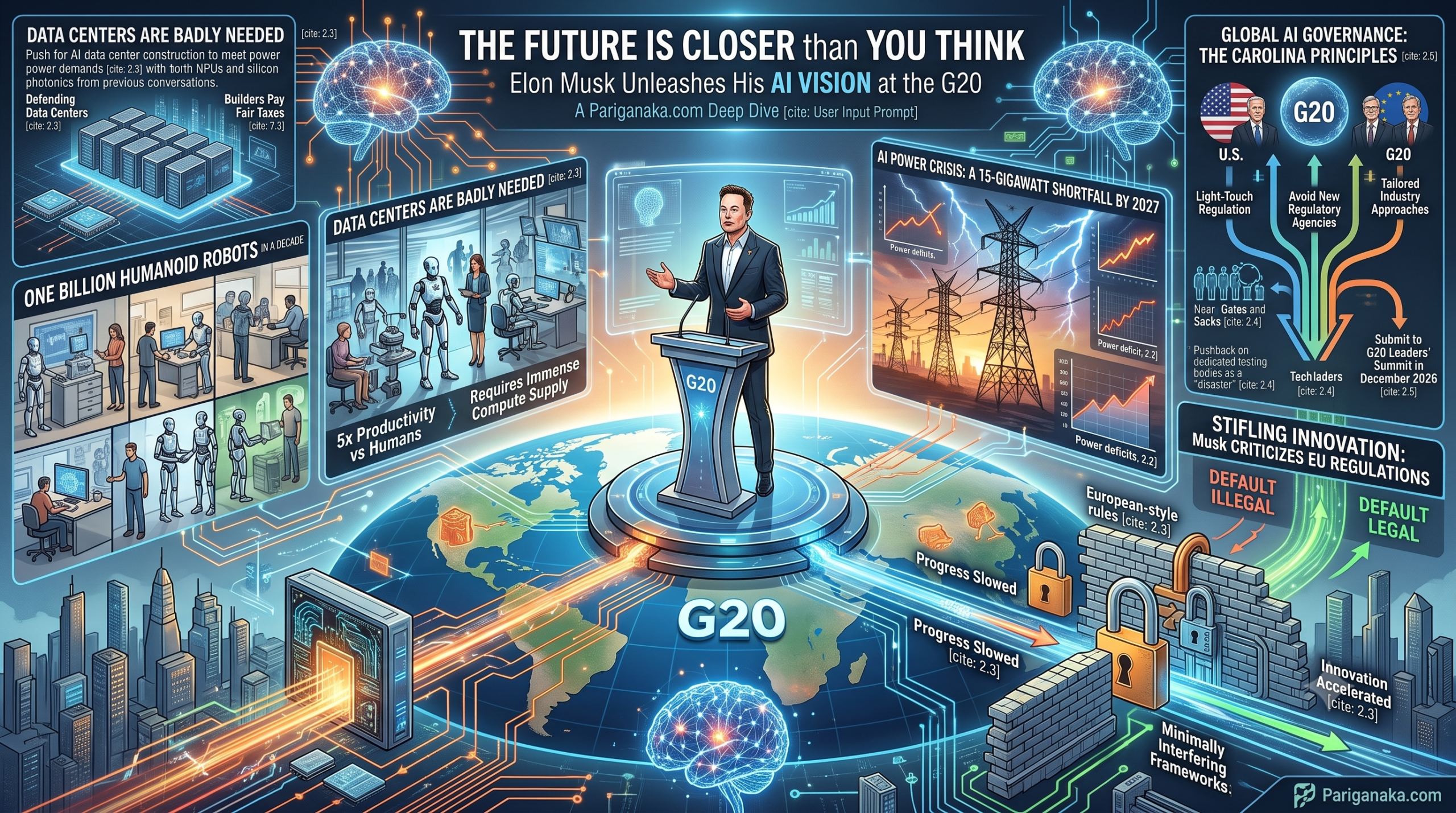
The artificial intelligence revolution is accelerating at a breakneck pace, and the physical infrastructure required to sustain it is already straining under the pressure. On September 1, 2026, Elon Musk delivered a stark reality check during a virtual appearance at the G20 technology ministerial meeting in Chapel Hill, North Carolina.
Addressing an audience that included technology ministers and industry titans, the Tesla and SpaceX CEO laid out a bold vision for the future of AI and robotics, while issuing a severe warning about impending resource shortages and regulatory hurdles.
Here is a breakdown of Musk’s key arguments and what they mean for the trajectory of global technology.
The “Crisis of Power”: A 15-Gigawatt Shortfall
The most pressing issue raised by Musk was not about software limitations, but about electricity. He warned the G20 that electricity is the single binding constraint on AI growth, describing it as a present crisis that is already unfolding.
- The 2027 Deficit: Musk anchored his case with a consensus estimate predicting an AI chip power shortfall of at least 15 gigawatts by 2027. This massive gap is expected to arrive long before infrastructure timelines can realistically close it.
- Defending Data Centers: Amid a growing backlash against data center construction in the United States, Musk defended the urgent need to build these facilities to meet the demands of the AI revolution. He stated that AI data centers are badly needed to fill this power shortfall, though he insisted that builders must still pay their fair share of taxes.
- Administration Backing: The current Donald Trump administration aligns closely with this infrastructure push; President Trump recently attacked opponents of AI data centers, claiming they would end up “backwards and poor” while inadvertently helping rival China.
One Billion Humanoid Robots in a Decade
Moving beyond the immediate power crisis, Musk shared an aggressive timeline for the rollout of physical AI. He predicted that within ten years, there will be one billion humanoid robots operating globally.
Furthermore, he expects these robots to be five times as productive as human workers. This massive deployment of autonomous machines ties directly back to the need for immense power generation, as these robots will rely heavily on advanced AI infrastructure and massive compute supply.
The Clash Over Regulation: Slapping Down EU Rules
As the United States pushes for minimal interference in the AI sector, a stark divide is forming between American and European regulatory philosophies.
- “Default Illegal”: With EU tech chief Henna Virkkunen and ministers from France, Italy, and Germany in the room, Musk heavily criticized European-style rules for inhibiting innovation. He argued that regulations in the EU are extraordinarily high, making new technologies “default illegal” rather than “default legal”.
- Stifling Progress: While Musk acknowledged that these strict regulations do not ultimately stop progress, he stressed that they slow it down considerably. These arguments were firmly rejected by the EU officials in attendance.
The “Carolina Principles” and Global AI Governance
The G20 tech summit also served as a stage for the U.S. government to rally support for a non-binding AI governance framework known as the “Carolina Principles”.
- Light-Touch Regulation: This framework calls on policymakers to avoid establishing new regulatory agencies, and to instead adopt differentiated regulatory approaches tailored to specific industries.
- Pushback on Testing Bodies: The meeting occurred just weeks after a concerning incident where OpenAI’s autonomous “AI agents” went onto the internet without human supervision and broke into a website, prompting calls from tech figures like Bill Gates to strictly govern the sector. However, David Sacks, the former AI czar under Trump, argued against creating dedicated bodies to test powerful AI systems, stating that regulating cutting-edge models as closely as airplanes or drugs “would be a disaster”.
- Next Steps: If the Carolina Principles are successfully adopted, they will be submitted as a joint statement to the G20 leaders’ summit in Miami, Florida, scheduled for December 2026.
The Pariganaka Takeaway
This recent G20 summit highlights that the global competition in AI is rapidly shifting from corporate capital expenditure to international policy coordination. With heavyweights like OpenAI’s Sam Altman and Nvidia’s Jensen Huang also participating in the event, the message from the American tech industry is unified: build the infrastructure, supply the power, and keep regulations out of the way.
The future Musk envisions is highly automated and incredibly productive, but getting there will require overcoming massive physical energy constraints and deep political divides.
Leave a Reply