
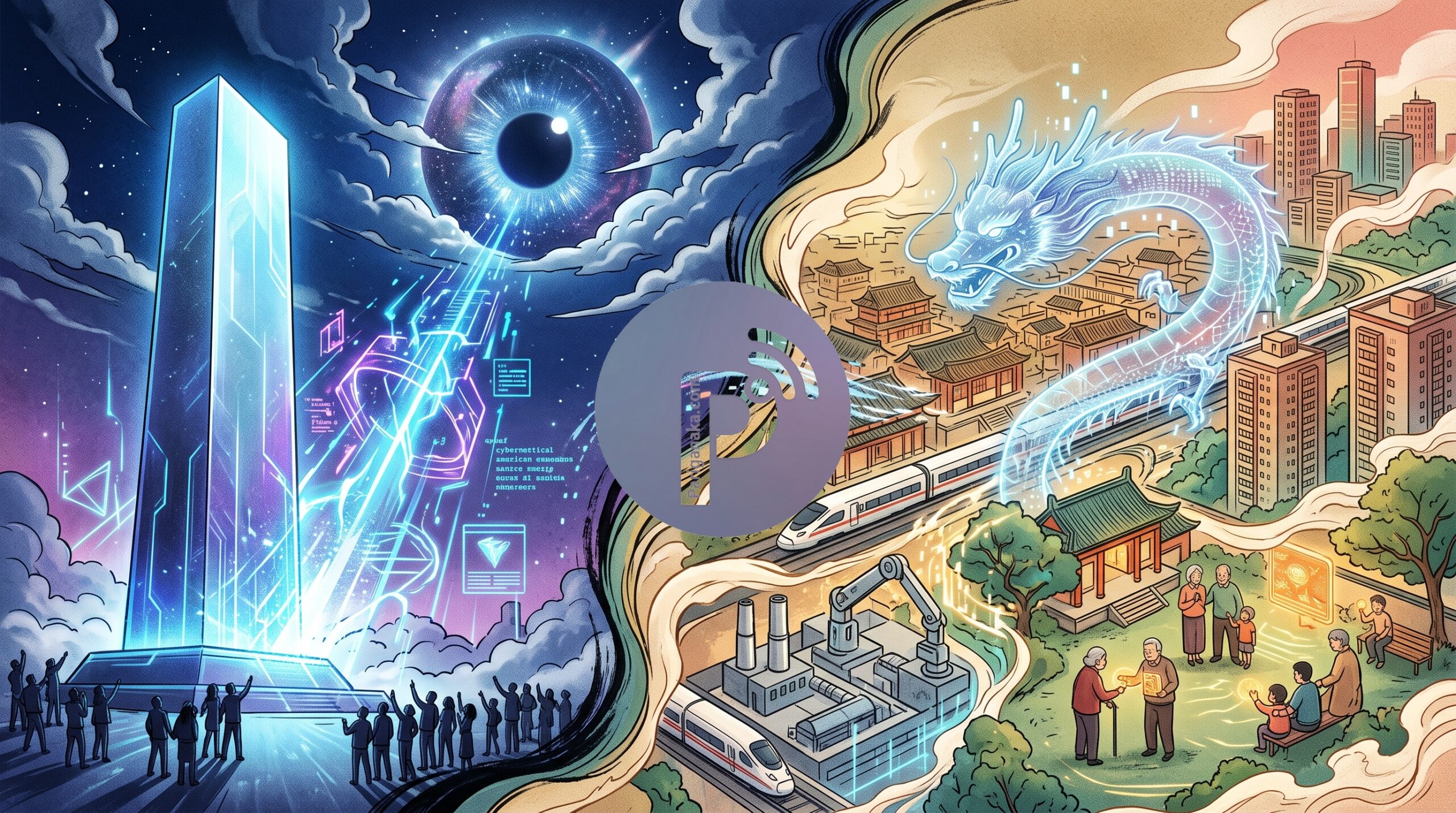
If you listen to the prevailing discourse in Silicon Valley, the development of Artificial Intelligence is a high-stakes race towards Artificial General Intelligence (AGI)—a march toward a “singularity” that will either result in a messianic utopia or a Terminator-style doomsday. Furthermore, it is framed as a geopolitical zero-sum game: the US must develop AGI before China does.
But according to Yi-Ling Liu, author and journalist specializing in Chinese internet culture and AI, the view from inside China is vastly different. The rhetoric of a “race to AGI” is virtually absent. Instead, China’s approach to AI is rooted in deep pragmatism, cultural fluidity, and a focus on solving immediate, structural societal problems.
Here is what China understands about the AI revolution that the American discourse often misses.
1. Diffusion Over Singularity
In the US, AI development is largely hyper-focused on “scaling” models to achieve AGI and superintelligence. In China, the industry is far less obsessed with hypothetical sci-fi endpoints.
Instead, the core focus is on diffusion—the practical application and integration of AI technologies into every facet of society and the economy. Chinese policymakers, tech entrepreneurs, and everyday citizens are looking at how AI can be commercialized and deployed to supercharge a sluggish economy and streamline daily life. It is less about creating an “omnipotent god” and much more about creating functional tools that can be sold, utilized, and scaled across traditional industries.
2. A Fluid Approach to Sentience
One of the most striking differences between the two cultures is how they interact with AI on a philosophical level. In the West, there is a deep-seated anxiety about AI consciousness, which Liu suggests is somewhat rooted in a Western, Evangelical Christian tradition that draws a hard binary line between man and machine, or sentient and non-sentient.
In contrast, Chinese culture—influenced by Daoist and Buddhist traditions—features a more fluid boundary between humans and the inanimate world. As a result, Chinese users tend to have a much less fraught relationship with AI companions. They are more willing to integrate AI into their personal lives, openly converse with bots about their mental health, and accept the technology without getting paralyzed by the philosophical debate of whether the software is truly “conscious.”
3. Anxiety Over the System, Not the Machine
Silicon Valley circles frequently debate whether AI will create a “permanent underclass” of unemployable humans. While Chinese citizens absolutely share anxieties about economic precarity, their fear is not inherently directed at the AI itself.
In China, the feeling of being trapped in an underclass already exists. The meritocracy feels calcified, leading to viral cultural movements like “involution” (endless, hyper-competitive rat-racing with no reward) and “lying flat” (rejecting societal expectations to work oneself to the bone). Chinese workers aren’t necessarily terrified that an AI will take a fulfilling job; many already feel crushed by a system of corporate feudalism and state control. The systemic burnout is already a reality, with or without generative AI.
4. Solving Real Problems: The “Silver Economy”
While top-down government directives may promote grandiose goals like quantum computing and space exploration, the immediate, existential crisis driving Chinese AI application is demographic collapse.
China’s population is rapidly aging, and youth unemployment is at record highs. Consequently, one of the biggest “wind vents” (a Chinese entrepreneurial term for a massive market opportunity) is the “Silver Economy.” Entrepreneurs aren’t just building abstract language models; they are frantically deploying AI and technology to manage elder care. Innovations are flowing into robotics, automated facilities, and even ghostwriting elderly memoirs, as the society scrambles to support an aging populace without enough young people to bear the burden.
The Path Forward: Collaboration Over Competition
Despite the macro-level geopolitical tensions, the ground reality of the tech sector is much more intertwined than political rhetoric suggests. Chinese founders still deeply admire Silicon Valley, and many look to the US for market expansion (a trend known as chuhai, or “going abroad”).
Beneath the narrative of a looming tech war, Track-2 dialogues between US and Chinese scientists, policymakers, and academics are already happening. The true promise of AI in the coming decades might not be found in which superpower builds a supercomputer first, but in grassroots, cross-border collaborations—sharing safety standards, mental health applications, and educational tools that benefit the global public.
Leave a Reply