
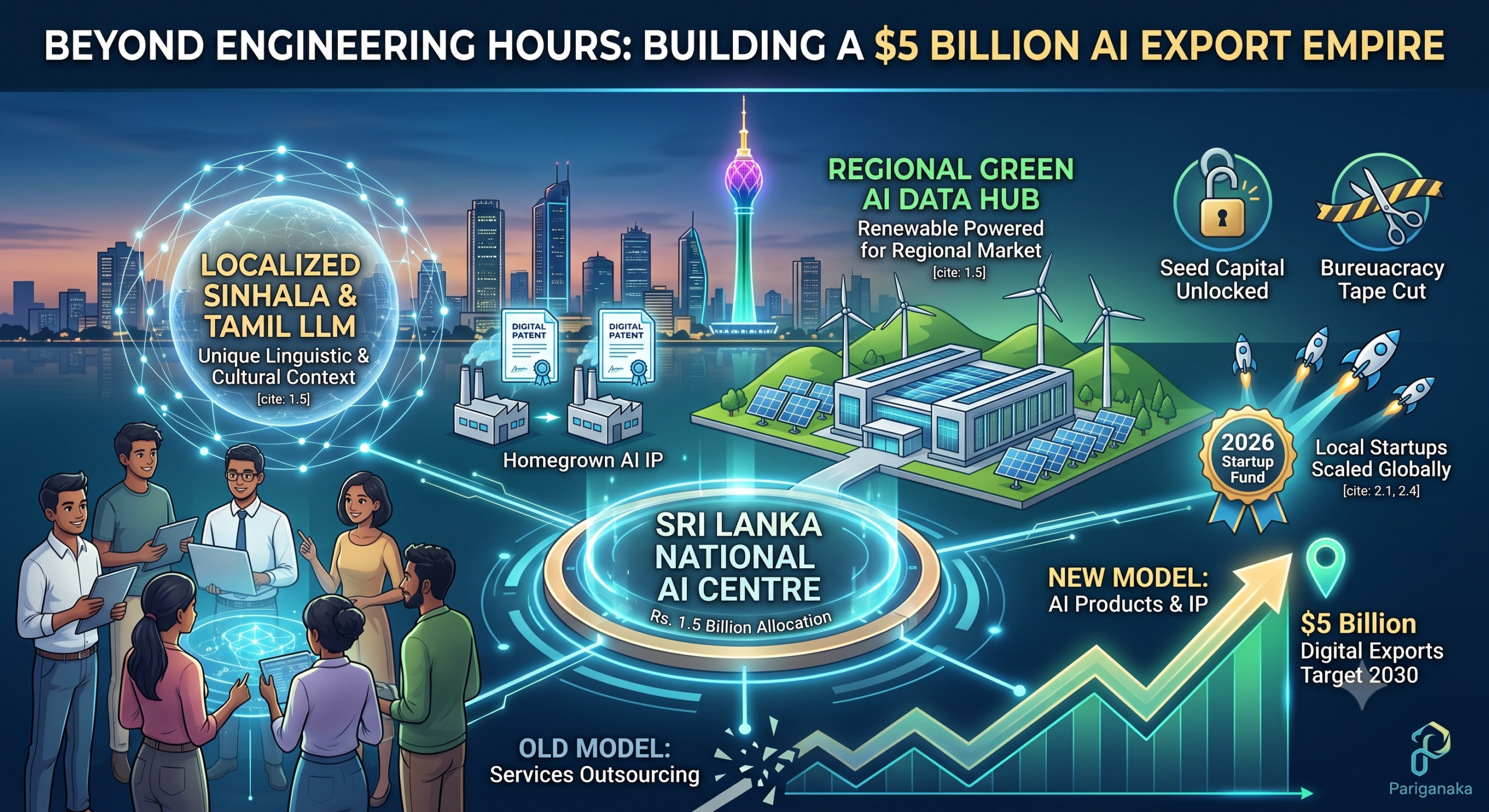
Sri Lanka’s IT sector has long been proud of its world-class software engineers. But in 2026, the global rules of the game have changed. The government has issued a stark warning: the era of simply selling “engineering hours” is over, as Artificial Intelligence fundamentally reshapes the economics of digital exports. To achieve the ambitious target of generating $5 billion in digital exports by 2030, Sri Lanka is making a massive pivot from service-based outsourcing to building original AI-driven products and Intellectual Property (IP).
Here are the top three ways the nation is aggressively restructuring its digital economy this year.
💡 1. Shifting from Services to Intellectual Property (IP)
For years, local IT firms thrived by providing offshore coding and software maintenance for Western companies. However, AI can now write and debug code in a fraction of the time.
- The Product Revolution: The Ministry of Digital Economy is urging the local tech industry to move beyond traditional software services. The new economic focus is on creating homegrown digital products, owning intellectual property, and offering higher-value digital services.
- Building a Local LLM: To ensure technological sovereignty and relevance, the government has emphasized the critical need for Sri Lanka to develop its own Large Language Model (LLM), specially tailored to the country’s unique cultural, linguistic, and social contexts.
🔋 2. Establishing Green AI Data Centers for the Region
AI requires massive computing power, which in turn demands massive amounts of electricity. Sri Lanka is leveraging its geography and climate to turn this global necessity into a lucrative foreign exchange opportunity.
- A Regional Infrastructure Hub: The government is currently undergoing procurement processes to build dedicated AI data centers. These facilities are designed not only to meet domestic requirements but to provide AI data center services to the wider regional market.
- Powered by Renewables: Capitalizing on the country’s strong potential for green energy, these upcoming AI data centers will run on sustainable power sources. This eco-friendly approach reduces carbon emissions and makes Sri Lanka an attractive destination for global tech giants looking to fulfill their sustainability goals.
🚀 3. Unleashing Capital: The 2026 Startup Fund and National AI Centre
Innovation requires capital, and the state has stepped in to bridge the funding gap for local tech entrepreneurs.
- Government-Backed Seed Capital: In January 2026, the government officially launched a dedicated startup fund designed to unlock private capital, support innovation, and help local startups scale globally. This initiative aims to remove bureaucratic red tape and introduce investor-friendly reforms, providing initial seed capital from the government to lower the cost of innovation.
- The National AI Centre: While Sri Lanka possesses a highly skilled workforce, widespread AI adoption across enterprises remains a challenge. To address this structural gap, the government has proposed the establishment of a National AI Centre, backed by a significant Rs. 1.5 billion allocation in the national budget.
The Pariganaka Takeaway:
The 2026 digital roadmap marks a critical turning point for Sri Lanka. We are no longer content with just being the back-office coders for the rest of the world. By developing localized AI models, building renewable-powered data centers, and heavily funding local startups, Sri Lanka is aggressively engineering a future where we own the technology and the intellectual property. The $5 billion export dream is no longer just a target; it is actively being built.
Leave a Reply