
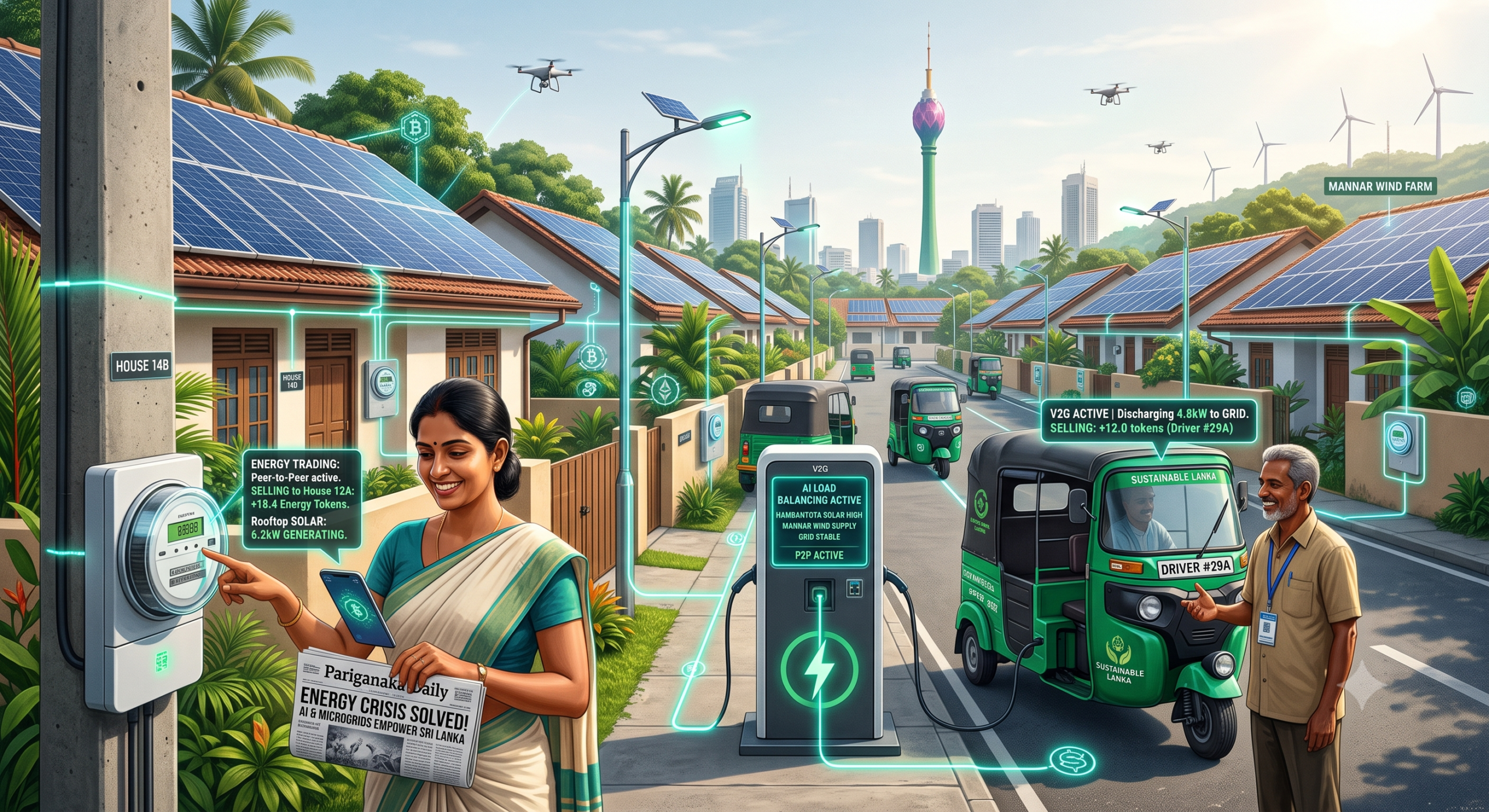
Just a few years ago, the hum of diesel generators and the frustration of rolling blackouts were everyday realities for Sri Lankans. Today, in 2026, the nation’s energy landscape is unrecognizable. Sri Lanka has successfully transitioned from a fragile, centralized grid heavily dependent on imported fossil fuels to a robust, intelligent network of renewable energy.
By decentralizing power generation and putting Artificial Intelligence in charge of grid distribution, the Ceylon Electricity Board (CEB) and local green-tech startups have turned every home into a mini-power plant.
Here are the top three technologies that have made Sri Lanka a global model for energy resilience this year.
☀️ 1. Peer-to-Peer (P2P) Solar Trading via Blockchain
The rooftop solar panels seen across Colombo and the suburbs are no longer just powering individual homes; they are part of a decentralized digital marketplace.
- The Virtual Power Plant: If a house in Nugegoda generates more solar power than it consumes during the day, the excess energy isn’t just dumped blindly into the national grid. Instead, it is routed through a localized microgrid.
- Smart Contracts: Using a blockchain-based app on their smartphones, homeowners can automatically sell their surplus electricity directly to their neighbors who might be running heavy appliances. Smart contracts instantly execute the transaction, deducting digital “Energy Tokens” from the buyer and crediting the seller, completely bypassing traditional billing delays and empowering citizens to become “prosumers” (producers + consumers).
🧠 2. AI Load Balancing and Weather Prediction
Renewable energy is notoriously unpredictable—solar panels need sun, and wind turbines need a breeze. To maintain grid stability without relying on coal plants as a backup, AI is now the ultimate grid conductor.
- Predictive Generation: A centralized AI system constantly analyzes hyper-local meteorological data. If the AI predicts heavy cloud cover over a massive solar park in Hambantota tomorrow afternoon, it automatically compensates by increasing the output from wind farms in Mannar or drawing from industrial battery reserves.
- Real-Time Load Shedding (The Smart Way): Instead of shutting down entire neighborhoods during peak demand, the AI communicates with smart meters installed in homes. It can autonomously make micro-adjustments—like momentarily pausing non-essential smart water heaters or dimming streetlights by 10%—to stabilize the grid without the consumer ever noticing a drop in their quality of life.
🛺 3. Vehicle-to-Grid (V2G) Technology and Electric Tuk-Tuks
The rapid adoption of electric vehicles (EVs), particularly the electrification of Sri Lanka’s iconic three-wheelers, has provided an unexpected solution to energy storage.
- Batteries on Wheels: Sri Lanka now boasts a massive fleet of electric tuk-tuks. While parked at charging stations during off-peak hours (like midday when solar energy is abundant), they charge up cheaply.
- Discharging at Peak Hours: During the evening peak demand (between 6:30 PM and 8:30 PM), these connected vehicles can use Vehicle-to-Grid (V2G) technology to sell a portion of their stored battery power back to the national grid at a premium price. This effectively turns the nation’s transport fleet into a massive, distributed mega-battery, preventing nighttime power shortfalls while earning drivers extra income while they sleep.
The Pariganaka Takeaway: Sri Lanka’s energy revolution in 2026 proves that the solution to power scarcity wasn’t just building bigger power plants, but building a smarter grid. By leveraging AI, blockchain, and decentralized solar, we have achieved energy sovereignty. The power no longer just flows from the top down; it flows sideways, between neighbors, vehicles, and communities, creating an unbreakable web of green energy.
Leave a Reply