
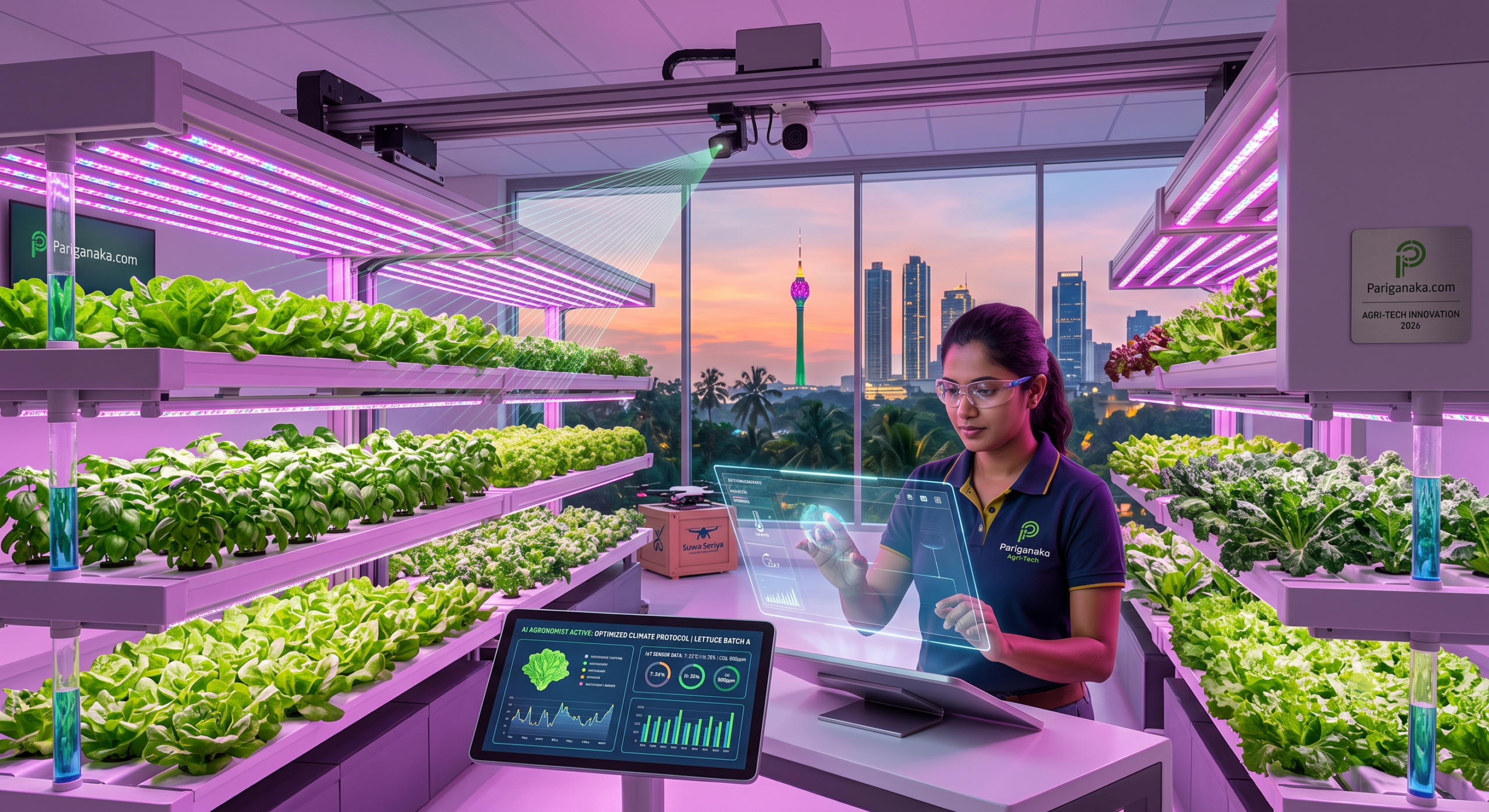
For generations, Sri Lankan agriculture has been heavily dependent on shifting monsoon cycles, vast expanses of fertile land, and unpredictable weather patterns. However, rapid urbanization, changing global climates, and the need for economic resilience have driven a massive agricultural transformation. In 2026, the future of farming in Sri Lanka is moving indoors, going vertical, and getting driven by code.
From the suburbs of Colombo to the industrial parks of Gampaha, tech-driven Vertical Farming hubs are springing up, leveraging Artificial Intelligence and Internet of Things (IoT) sensors to grow fresh produce with zero chemical pesticides and a fraction of the water used in traditional farming.
Here are the top three tech advancements rewriting Sri Lanka’s agricultural playbook this year.
🏗️ 1. Automated Climate Control and Hyper-Controlled Environments
Traditional farming leaves crops at the mercy of sudden droughts or torrential downpours. Automated indoor vertical farms eliminate these environmental risks completely.
- Precision Atmosphere: These facilities use sealed, multi-tiered stacks where every single variable—temperature, humidity, carbon dioxide levels, and airflow—is continuously monitored by IoT sensor grids.
- The AI Agronomist: An AI-driven central operating system constantly reads these sensor data metrics. If the temperature fluctuates by even half a degree or the humidity drops, the AI autonomously adjusts the climate control systems instantly. This precise environment allows exotic and high-value leafy greens to thrive year-round, regardless of external weather conditions.
💡 2. Dynamic LED “Light Recipes” and Hydroponics
Plants do not necessarily need natural sunlight to thrive; they need specific wavelengths of light. Vertical farms replace the sun with highly specialized, energy-efficient LED arrays.
- Customized Light Spectra: Crops require different light bands at various stages of their life cycle. The vertical farm’s AI adjusts the LED arrays to emit precise “light recipes”—blending specific ratios of blue, red, and far-red light to maximize photosynthesis. Blue light might be dialed up to encourage thick, leafy growth, while red light is boosted to stimulate flowering.
- Hydroponics and Aeroponics: Instead of soil, crops are grown in nutrient-rich water solutions (hydroponics) or suspended in air where their roots are intermittently misted with nutrients (aeroponics). This closed-loop system uses up to 90% less water than traditional soil farming because the water is continuously filtered and recycled through the facility, making it incredibly sustainable.
📊 3. Computer Vision and Predictive Yield Analytics
Managing thousands of plants stacked several meters high is impossible to do manually. AI-powered cameras act as the ultimate tireless field scouts.
- Real-Time Health Audits: Overhead high-resolution cameras equipped with computer vision sweep across the vertical layers daily. The AI scans every leaf, looking for microscopic signs of nutrient deficiencies, early-stage root rot, or cellular stress before visible symptoms appear.
- Predictive Harvesting: By analyzing the growth rate and surface area of the crops, the software can forecast the exact day and hour a batch will reach peak nutritional value and taste. This allows operators to lock in supply chains with local supermarkets and export partners down to the exact kilogram, completely eliminating harvest waste.
The Pariganaka Takeaway: Vertical farming in 2026 proves that agriculture is transforming from a labor-heavy gamble against nature into a predictable, highly optimized data science. By decoupling crop yields from weather volatility and land availability, Sri Lanka is creating a highly resilient urban food supply chain. The future of farming isn’t about clearing more forests—it’s about building smarter networks upwards.
Leave a Reply