
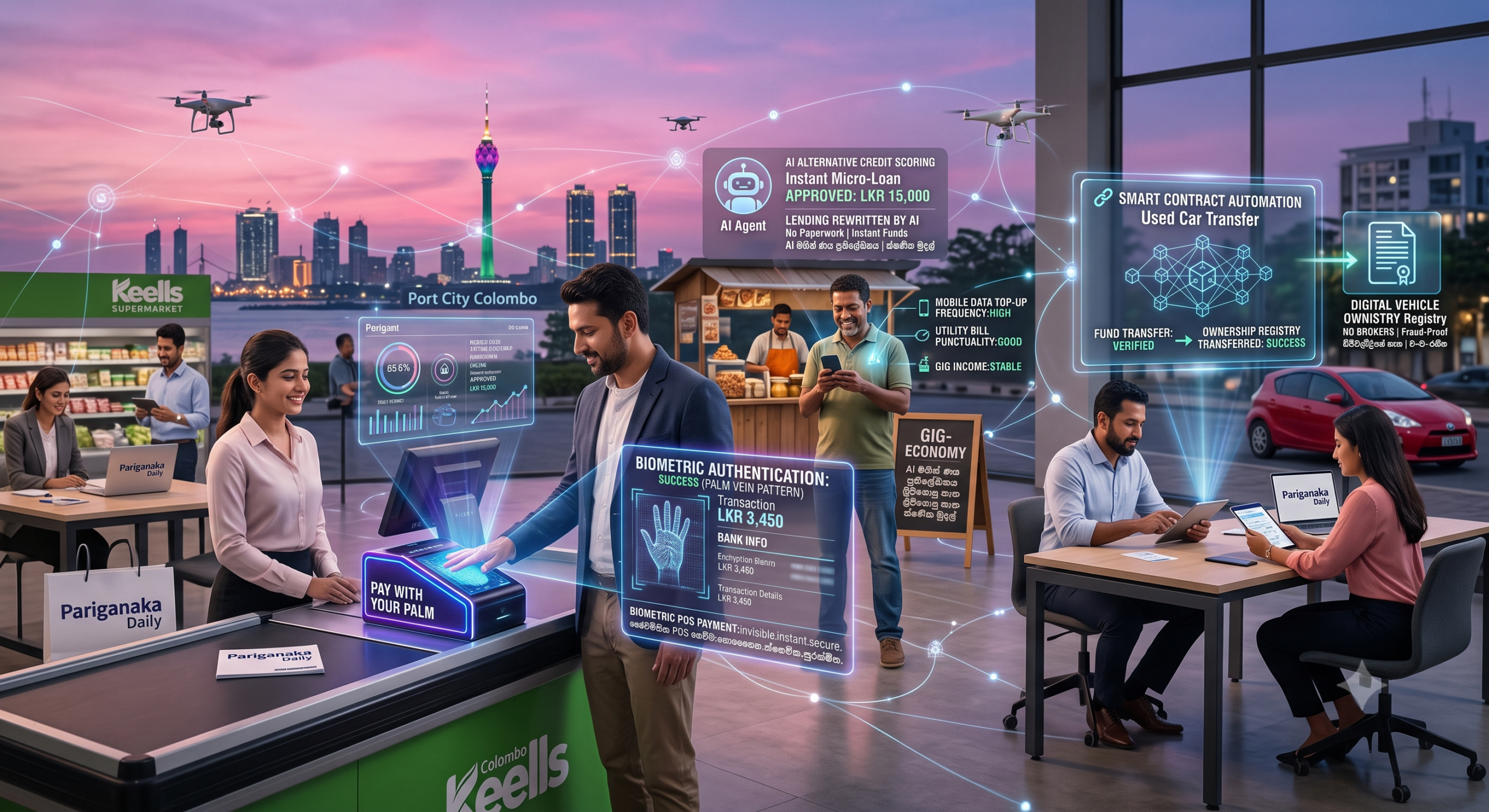
If you look inside the wallet of an average Sri Lankan in July 2026, you will likely notice a significant absence of physical cash. The long queues at local ATMs and the hassle of searching for exact change are rapidly becoming a thing of the past.
Sri Lanka’s financial sector is undergoing a massive digital overhaul. Moving far beyond basic mobile banking apps and simple QR codes, the new era of FinTech is making money completely invisible, instantaneous, and highly personalized.
Here are the three major tech trends transforming how Sri Lankans earn, spend, and borrow money this year.
✋ 1. Biometric POS: Paying with Your Palm
For the last few years, scanning a LANKAQR code with a smartphone was the gold standard for cashless payments. However, the latest Point of Sale (POS) systems are eliminating the need for a smartphone entirely.
- Your Body is Your Wallet: Major supermarket chains and retail outlets in Colombo and Kandy are now rolling out biometric payment terminals. By linking your bank account to a highly secure, encrypted scan of your palm vein pattern or facial geometry, you can now pay for your groceries simply by hovering your hand over the scanner.
- Frictionless Retail: This technology drastically speeds up checkout times and completely neutralizes the threat of stolen credit cards or lost smartphones. The transaction is authorized in milliseconds, relying on hardware-level encryption that cannot be replicated by deepfakes or silicone molds.
🤖 2. AI Alternative Credit Scoring and Instant Micro-Lending
Historically, getting a loan in Sri Lanka meant enduring weeks of paperwork, proving a fixed salary, and having a pristine traditional credit score. In 2026, Artificial Intelligence has entirely rewritten the rules of lending.
- Beyond the CRIB: Local FinTech startups and forward-thinking banks are now utilizing “Alternative Data” AI models. With your permission, these AI agents analyze your digital footprint—such as your mobile data top-up frequency, utility bill payment punctuality, and e-commerce purchasing habits—to determine your creditworthiness.
- Instant Approvals: This allows freelancers, gig-economy workers (like Uber drivers or freelance developers), and rural entrepreneurs who lack traditional payslips to access instant micro-loans directly through their mobile wallets. The AI assesses the risk and approves funds directly to their accounts in under 60 seconds.
🔗 3. Smart Contracts for Everyday Transactions
Blockchain technology has finally matured past cryptocurrency speculation and is now being used for practical, everyday legal and financial agreements in Sri Lanka.
- Automated Trust: “Smart Contracts” are self-executing contracts where the terms of the agreement are written directly into lines of code.
- Real Estate and Vehicle Sales: In 2026, tech-savvy Sri Lankans are using these blockchain contracts to buy used vehicles or lease apartments. Once the buyer transfers the digital funds to an escrow account, the smart contract automatically verifies the payment and instantly transfers the digital ownership registry to the new owner. It eliminates the need for expensive third-party brokers, reduces legal fees, and mathematically prevents fraud.
The Pariganaka Takeaway: The concept of money in 2026 has fundamentally changed. It is no longer just paper notes you hold in your hand; it is a seamless digital utility. As biometric payments become the norm and AI opens up fair lending to everyone, Sri Lanka is rapidly accelerating toward a fully inclusive, cashless economy. The businesses that survive this decade will be the ones that understand that the modern consumer expects transactions to be invisible.
Leave a Reply