
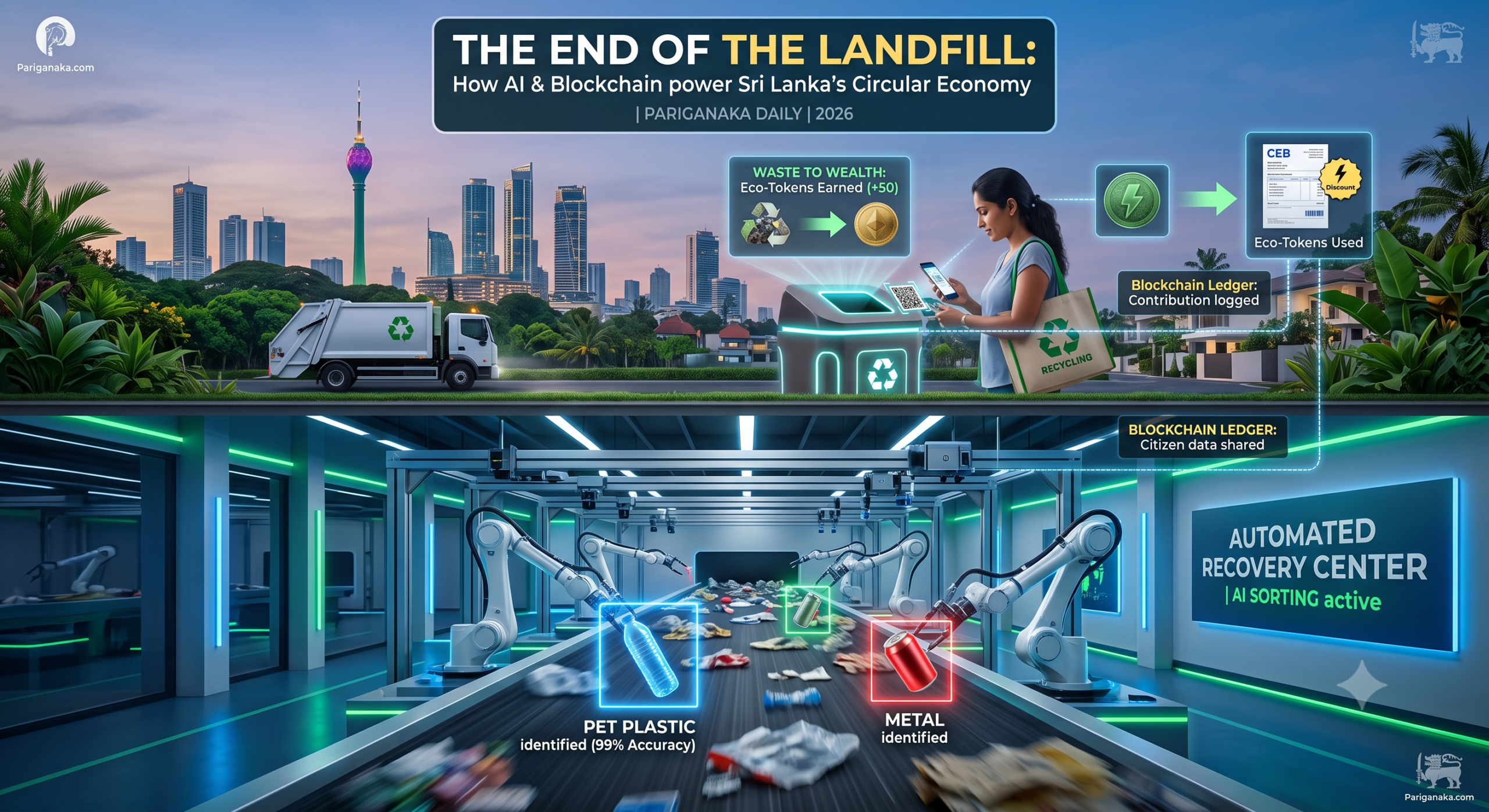
For years, urban waste management in Sri Lanka was a looming crisis, characterized by overflowing neighborhood bins and massive, unsustainable landfills. Fast forward to 2026, and the concept of “throwing things away” has fundamentally changed. Trash is no longer seen as a toxic byproduct of city life; it is a highly traceable, valuable commodity.
Spearheaded by the Western Province Smart City Initiative and local green-tech startups, Sri Lanka is rapidly transitioning to a “Circular Economy.” By combining Internet of Things (IoT) sensors, robotic sorting, and blockchain ledgers, the nation is turning its garbage into digital wealth.
Here are the top three technologies making Sri Lanka’s landfills obsolete this year.
♻️ 1. IoT Smart Bins and Automated Collection Grids
The days of garbage trucks blindly driving down every street, regardless of whether the bins are full or empty, are over. Waste collection in 2026 is a hyper-efficient, data-driven operation.
- Sensor-Equipped Receptacles: Public waste bins across Colombo and Kandy are now equipped with ultrasonic IoT sensors. These sensors continuously monitor the fill level and internal temperature (to prevent combustion) of the bins, transmitting this data in real-time to a central municipal cloud.
- Predictive Fleet Routing: Instead of fixed routes, an AI algorithm analyzes this data daily to calculate the most fuel-efficient, traffic-free path for the city’s fleet of electric garbage trucks. Trucks only visit neighborhoods where bins have hit an 80% capacity threshold, cutting municipal fuel costs by 40% and drastically reducing early morning traffic congestion.
🦾 2. Computer Vision and Robotic Sorting Facilities
Historically, sorting recyclable materials from general waste was a dangerous, unhygienic, and manual task. Today, the heavy lifting is done entirely by machines at newly established high-tech recovery facilities.
- High-Speed Optical Sorting: As mixed waste moves down rapid conveyor belts, overhead cameras powered by computer vision analyze every single item in milliseconds. The AI can instantly differentiate between a crushed PET plastic bottle, a tin can, and a piece of organic food waste based on its shape, density, and light reflection.
- Pneumatic Robotic Arms: Once identified, AI-guided robotic arms swoop down with pneumatic suction cups to extract valuable recyclables from the moving belt with 99% accuracy. This automated process operates 24/7, processing thousands of tons of waste far faster and safer than human hands ever could.
🪙 3. “Waste-to-Wealth” Blockchain Tokenization
The most revolutionary change in 2026 is how citizens are incentivized to recycle at home, turning everyday citizens into active participants in the circular economy.
- Smart Household Recycling: Citizens now use standard QR-coded biodegradable bags for their recyclables. When they drop these bags into neighborhood smart bins, the bin scans the QR code, weighs the bag, and uses edge AI to roughly verify the contents.
- Earning Eco-Tokens: The system instantly logs this contribution onto a secure blockchain ledger and rewards the citizen by depositing “Eco-Tokens” directly into their national digital wallet. These digital tokens can be seamlessly used to pay for CEB electricity bills, top up public transit cards, or receive discounts at local supermarkets.
The Pariganaka Takeaway: Waste management in 2026 is no longer just an environmental obligation; it is a lucrative tech industry. By deploying AI and blockchain, Sri Lanka is proving that with the right technology, there is no such thing as “garbage”—only resources that haven’t been sorted yet. We are actively engineering a future where our cities are cleaner, our citizens are rewarded for sustainability, and the traditional landfill is relegated to the history books.
Leave a Reply