
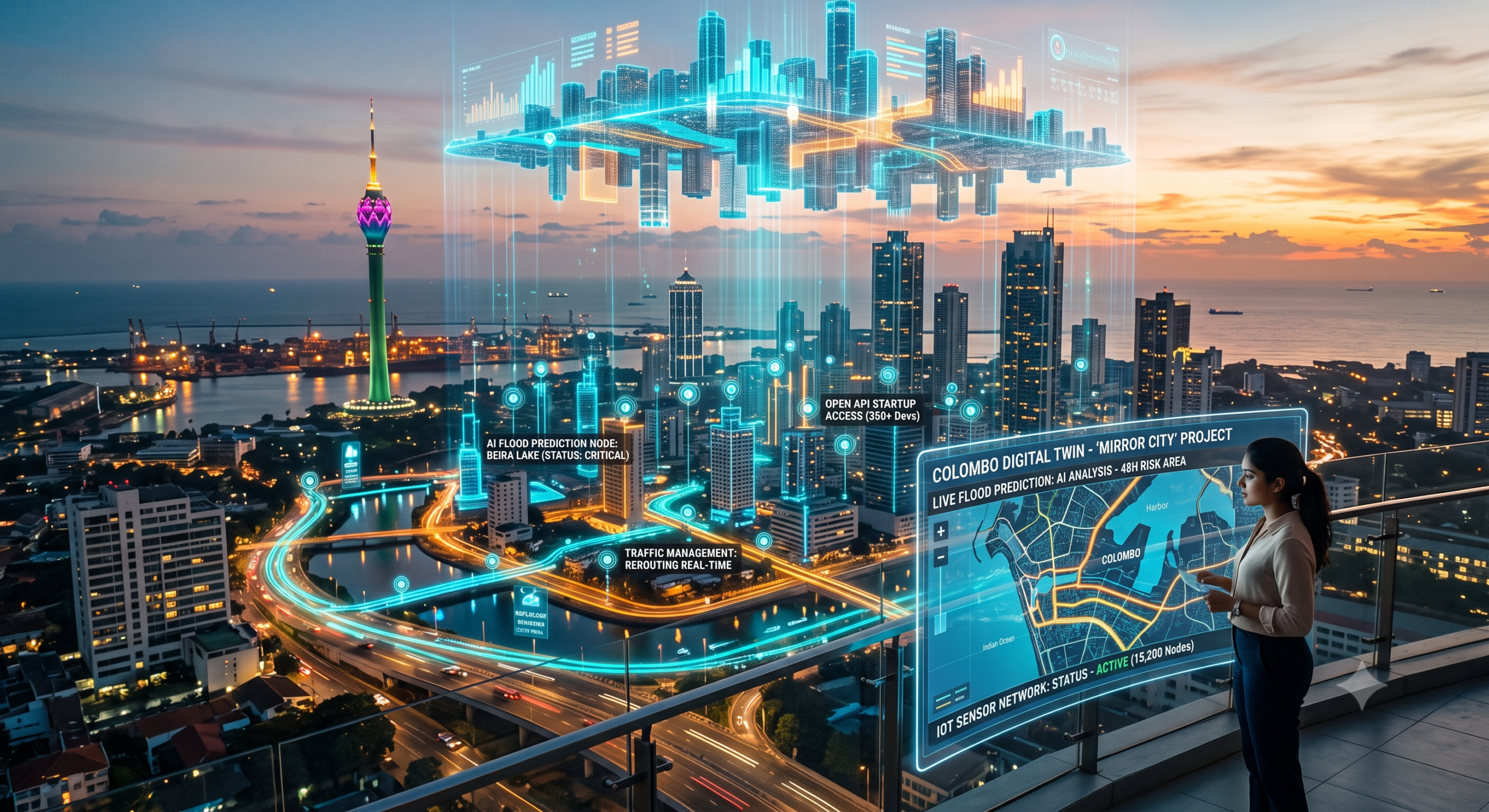
Colombo’s skyline is changing rapidly, but in 2026, the most groundbreaking developments are not being built with concrete and steel—they are being built with data.
Sri Lanka has officially entered the era of Smart City infrastructure with the partial rollout of the Colombo “Mirror City” Project. By combining Artificial Intelligence, the Internet of Things (IoT), and big data, tech professionals are transforming how the commercial capital operates on a daily basis.
Here is a look at how this highly anticipated technology is actively upgrading Sri Lanka’s urban landscape.
🏙️ What Exactly is the “Mirror City”?
In simple terms, a “Digital Twin” is a 1:1, real-time virtual simulation of a physical object or environment. In this case, it is a living, breathing digital replica of Colombo.
- Data-Driven Reality: Thousands of IoT sensors installed across the city—on traffic lights, water pipelines, electrical grids, and public transport—feed live data into a centralized cloud network.
- The End of Trial-and-Error: Before the Urban Development Authority (UDA) or municipal councils lay a single brick for a new flyover or bus lane, the proposed changes are first built inside the digital twin. Planners can instantly see how a new construction project will impact traffic flows, pedestrian movement, and power consumption across the entire city.
🌧️ AI Flood Prediction and Disaster Management
For decades, sudden monsoon downpours have caused gridlock and flash flooding across Colombo. The digital twin is finally providing a proactive tech solution.
- Predictive AI: The system integrates live meteorological data with topographical maps and underground drainage sensor inputs.
- Real-Time Rerouting: Instead of reacting after a road is submerged, the AI predicts exactly which streets will flood up to 48 hours in advance based on rainfall density. This allows authorities to pre-emptively clear drainage blockages and automatically update navigation apps like Google Maps and local taxi platforms to reroute traffic before the congestion happens.
🚦 Open APIs: A Goldmine for Local Startups
The most exciting part of the Mirror City project for the local IT sector is that the data is not entirely locked behind government doors.
- Building on the Grid: An Open API framework is gradually being made available to registered Sri Lankan tech startups and independent developers.
- New App Ecosystem: Local software engineers are already utilizing this anonymized city data to build next-generation applications. We are seeing early prototypes for “Smart Parking” apps that guide drivers to the exact open parking slots in Colombo 01, and unified public transit apps that track the exact location and crowd density of approaching buses and trains.
The Pariganaka Takeaway: > The Colombo Digital Twin proves that fixing our infrastructure does not always require more cement; sometimes, it just requires better data. As the Mirror City expands, it will create an entirely new sub-sector for local IoT specialists, data scientists, and cloud engineers. The future of Colombo is not just being built by architects—it is being built by software developers.
Leave a Reply