
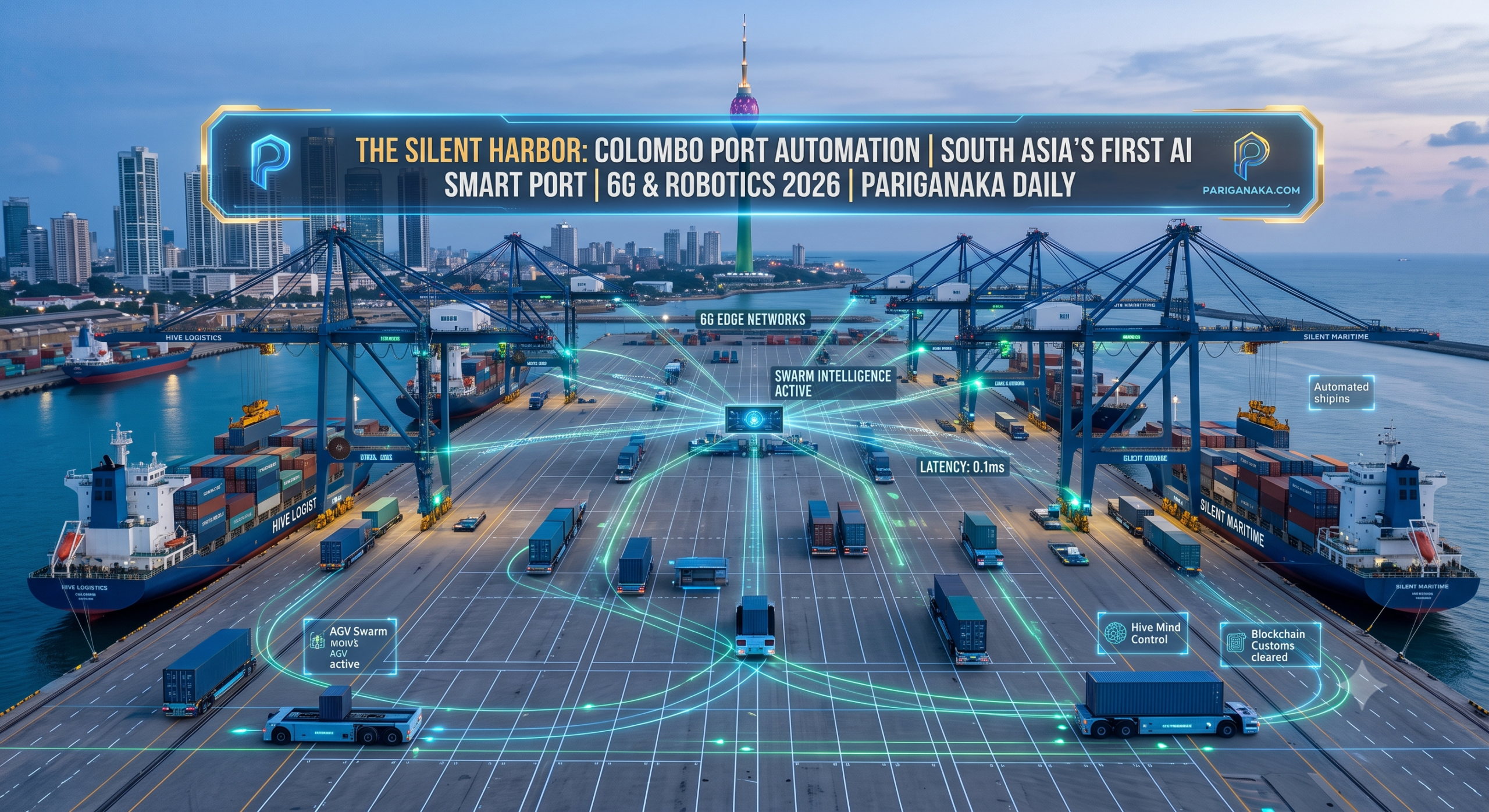
For centuries, the Port of Colombo has been the bustling, noisy heart of Sri Lanka’s trade economy. However, if you stand near the newly integrated Colombo Port City logistics zones in 2026, you will notice something unusual: the silence. The shouting foremen, the exhaust fumes of idling trucks, and the chaotic paperwork have all been replaced by the quiet hum of electric motors and the invisible flow of digital data.
Sri Lanka has officially upgraded its maritime infrastructure from a traditional transit hub to a fully automated, AI-driven machine. By deploying early 6G enterprise networks and swarm robotics, Colombo is now processing cargo faster than any other port in the region.
Here are the top three digital logistics trends revolutionizing Colombo’s maritime trade this year.
📡 1. Enterprise 6G and Ultra-Low Latency Operations
While 5G connected our smartphones, the newly deployed localized 6G network at the port is designed exclusively for machines. When a massive robotic crane is moving a 40-foot container over a ship, a delay of even half a second in the video feed could be catastrophic.
- Edge Computing: The 6G network processes data directly at the “edge” (right there on the docks) rather than sending it to a distant cloud server. This provides zero-latency communication between the port’s central AI and the physical machinery.
- Remote Piloting: The few human operators left do not sit in glass cabins hundreds of feet in the air. Instead, they sit safely in air-conditioned control rooms within the Port City Financial District, wearing VR headsets to supervise multiple automated cranes simultaneously through ultra-HD, real-time stereoscopic camera feeds.
🤖 2. Swarm Robotics and Automated Guided Vehicles (AGVs)
The chaotic dance of human-driven terminal tractors is a thing of the past. The ground-level movement of cargo is now handled by an autonomous fleet of electric Automated Guided Vehicles (AGVs).
- The Hive Mind: These AGVs do not operate individually; they act as a single “swarm” controlled by a central AI logistics brain. If a ship arrives early, the AI instantly calculates the most efficient offloading sequence and mathematically routes dozens of AGVs across the tarmac without a single collision or traffic jam.
- 24/7 Efficiency: Because these vehicles are purely electric and autonomous, they don’t need shift changes, tea breaks, or lighting to see at night. They operate in complete darkness, rolling over wireless induction charging pads embedded in the asphalt to keep their batteries topped up continuously.
🔗 3. Blockchain Customs and “Frictionless” Clearance
The biggest bottleneck in global shipping has always been the paperwork. In 2026, Sri Lanka Customs and the Port Authority have integrated their systems into an immutable blockchain ledger.
- Smart Contracts: When a cargo ship departs from Singapore heading to Colombo, its manifest is uploaded to the blockchain. An AI system immediately audits the digital paperwork, checks the origin of the goods, and calculates duties.
- Pre-Cleared Cargo: By the time the ship drops its anchor in Sri Lankan waters, the smart contract automatically deducts the necessary tariffs from the importer’s digital wallet and issues a digital green light. The cargo is cleared before it even touches the dock, eliminating weeks of bureaucratic red tape and entirely removing human corruption from the equation.
The Pariganaka Takeaway: The automation of the Port of Colombo in 2026 is a masterclass in economic survival. By removing the friction of human error, outdated paperwork, and slow communication, Sri Lanka is leveraging deep-tech to punch far above its weight class. We are no longer just an island in the Indian Ocean; we are the fastest, most intelligent maritime router in South Asia.
Leave a Reply