
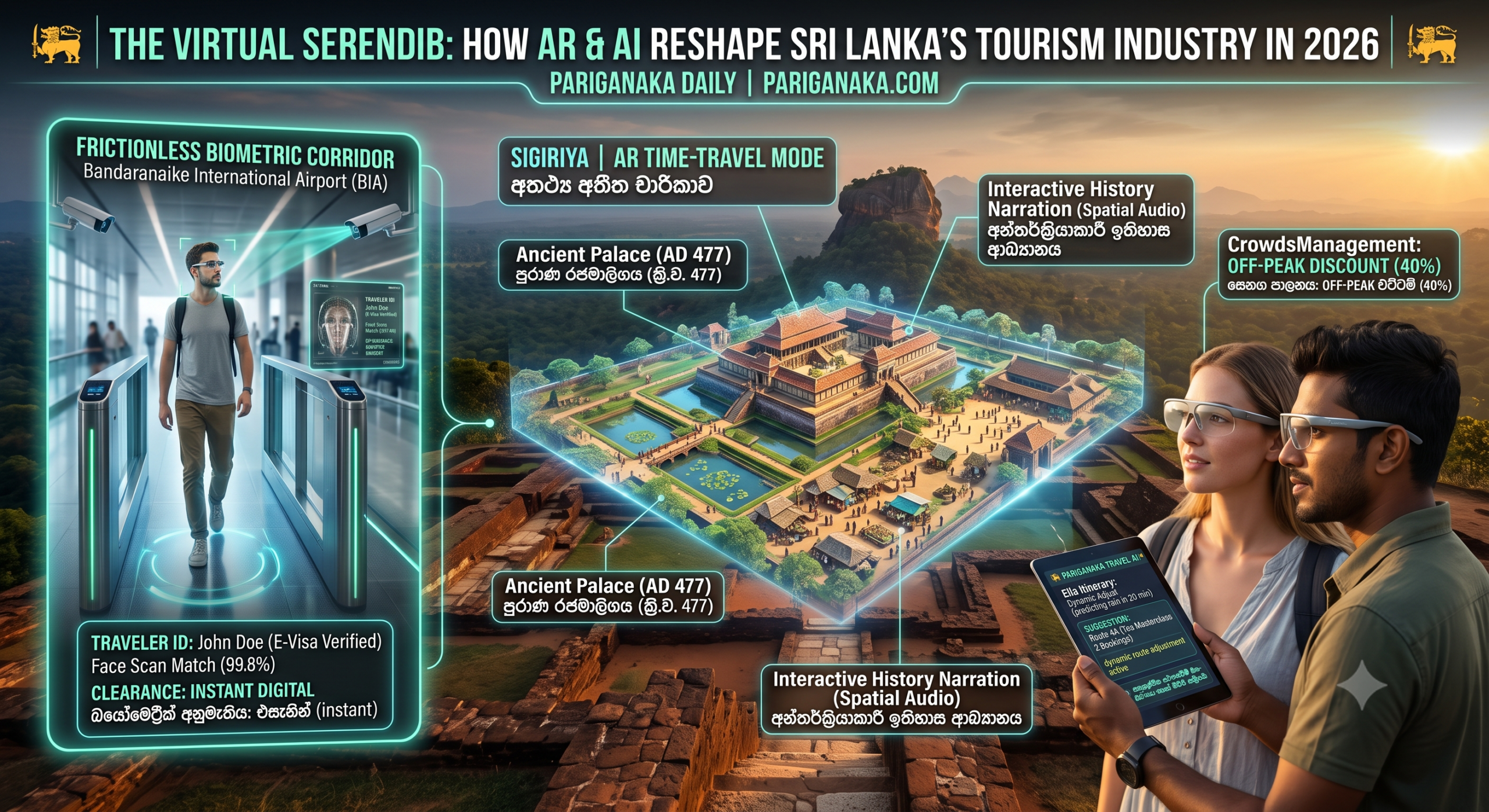
For decades, Sri Lanka’s tourism model relied heavily on its natural beauty, ancient ruins, and traditional hospitality. Fast forward to 2026, and the island has transformed into a premium “smart destination.” Rather than replacing the natural and historical charm of the country, technology is being used to amplify it, offering travelers an immersive, hyper-personalized experience from the moment they step off the plane.
By integrating Augmented Reality (AR), biometric security, and Artificial Intelligence, the Ministry of Tourism and local tech startups have completely redesigned the modern holiday.
Here are the top three digital trends revolutionizing the Sri Lankan travel experience this year.
🕶️ 1. Time-Travel Tourism with Augmented Reality (AR)
Visiting ancient ruins used to require a lot of imagination and a good tour guide. Today, Augmented Reality has turned Sri Lanka’s cultural triangle into a living museum.
- Rebuilding History: When tourists visit the Sigiriya Rock Fortress or the ancient city of Polonnaruwa, they are now offered lightweight AR smart glasses at the ticket counter. As they look at the brick foundations, the glasses project historically accurate, 3D holographic reconstructions of the palaces, bustling marketplaces, and flowing water gardens exactly as they appeared over a thousand years ago.
- Interactive Storytelling: The AR glasses provide spatial audio in over 30 languages. If a visitor looks at a specific fresco or a carved moonstone, the AI detects their gaze and instantly narrates the history and mythology behind the artifact, completely eliminating the language barrier for international guests.
🤖 2. The AI-Powered “Hyper-Concierge”
The days of static, printed travel itineraries are over. Tourists in 2026 are guided by dynamic AI assistants that adapt to their needs in real-time.
- Dynamic Itinerary Adjustments: Upon booking their flights, tourists are granted access to a localized AI travel app. If a traveler is en route to Ella for a hike and the AI detects a sudden shift in weather patterns predicting heavy rain, it will autonomously suggest an alternative route, perhaps redirecting them to a highly-rated indoor culinary masterclass or a scenic train ride, booking the tickets seamlessly in the background.
- Smart Crowd Management: To prevent over-tourism at popular hotspots like the Nine Arches Bridge or Yala National Park, the AI ecosystem uses heat-mapping data. It incentivizes tourists to visit during off-peak hours by offering dynamic, real-time discounts on entry fees or nearby cafes, ensuring a peaceful experience for the traveler and sustainable traffic for the environment.
✈️ 3. “Frictionless” Biometric Border Control
The first impression of any country is its airport, and the Bandaranaike International Airport (BIA) has undergone a massive digital facelift to eliminate the dreaded immigration queue.
- The Walk-Through Corridor: Sri Lanka has adopted a “frictionless” biometric entry system. Tourists upload their passport details and facial scans via the e-Visa portal before leaving their home country. Upon landing at BIA, there are no physical stamping counters or paperwork. Travelers simply walk through a biometric corridor where high-speed cameras scan their faces in motion.
- Instant Digital Clearance: Within milliseconds, the system verifies their identity against global databases and opens the automated gates. What used to be a grueling two-hour wait during peak tourist season is now a seamless, two-minute walk straight to the baggage carousel.
The Pariganaka Takeaway: Sri Lanka’s tourism industry in 2026 proves that tradition and technology can coexist beautifully. By using AR to resurrect our ancient history and AI to remove the friction of modern travel, we are not just showing the world our heritage; we are allowing them to step inside it. Technology has elevated the island from a simple tropical getaway to an intelligent, world-class experiential destination.
Leave a Reply