
Published: August 6, 2026 | By Pariganaka Editorial Team
For years, the tech world has operated on a simple rule: if you want powerful artificial intelligence, you need a massive internet connection and giant data centers. But as we step into August 2026, the landscape is undergoing a radical transformation.
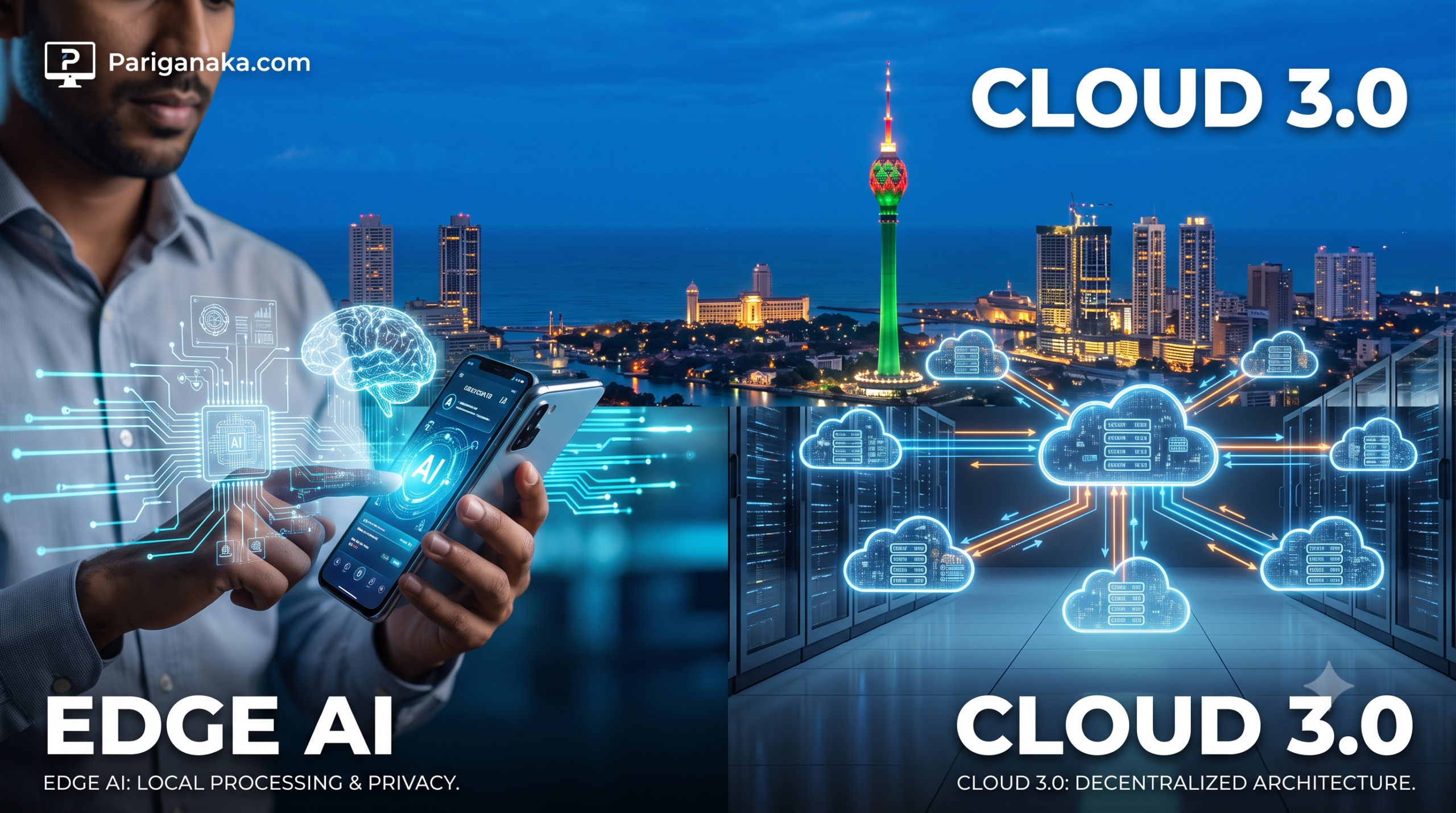
We are officially entering the era of Edge AI and Cloud 3.0. What does this mean for Sri Lankan businesses, developers, and everyday users? It means unprecedented processing power is moving out of distant server farms and directly into the palm of your hand.
⚡ The Rise of Edge AI: Processing on the Go
The biggest hardware bottleneck for AI in 2026 is no longer computing power, but rather electricity and memory. Previously, running a high-quality AI model required a massive cloud connection. That era is officially over.
This month, the new generation of mobile chips—such as Apple’s A20 Bionic and the latest Snapdragon 8 Gen 5—feature advanced Neural Processing Units (NPUs) capable of running massive 70-billion parameter models entirely on-device.
For the average Sri Lankan user, this is a game-changer. It means:
- Zero Latency: No more waiting for a cloud server to process your request; the AI thinks instantly on your phone.
- Offline Accessibility: Advanced AI tools will work perfectly even in areas with low connectivity, empowering rural education and agriculture.
- Maximum Privacy: Since data never leaves your device to be processed in the cloud, sensitive personal and business information remains completely secure.
☁️ Cloud 3.0 and Sovereign Architectures
As Edge AI handles local processing, the cloud itself is evolving into “Cloud 3.0”. After a decade focused purely on migration and cost efficiency, the cloud is now becoming the active operational backbone for AI-driven applications.
AI cannot scale using only classical public cloud architectures. Instead, organizations are being pushed toward hybrid, private, multi, and sovereign cloud models. This shift allows companies to fine-tune models on proprietary data while managing data sensitivity and maintaining low-latency inference.
This evolution also brings the concept of “tech sovereignty” to the forefront as a strategic priority, where nations and enterprises build resilient, interdependent ecosystems—like sovereign clouds and regional AI models.
🇱🇰 The Opportunity for Local Developers
As Sri Lanka builds toward its ambitious digital economy goals, mastering this shift in infrastructure is critical.
- Expressing Intent: The software development paradigm is shifting from manually writing code to “expressing intent,” where developers articulate desired outcomes and the AI autonomously delivers and integrates systems behind the scenes.
- Orchestration over Coding: The competitive edge for future developers will hinge on mastering orchestration and governance rather than manual coding.
- Living Ecosystems: Monolithic enterprise systems must evolve into living ecosystems of intelligent, continuously learning applications that blend human oversight with autonomous AI agents.
The future of technology is distributed, private, and highly localized. By embracing Edge AI and Cloud 3.0, the tech community can ensure its digital footprint is both highly innovative and entirely sovereign.
Leave a Reply