
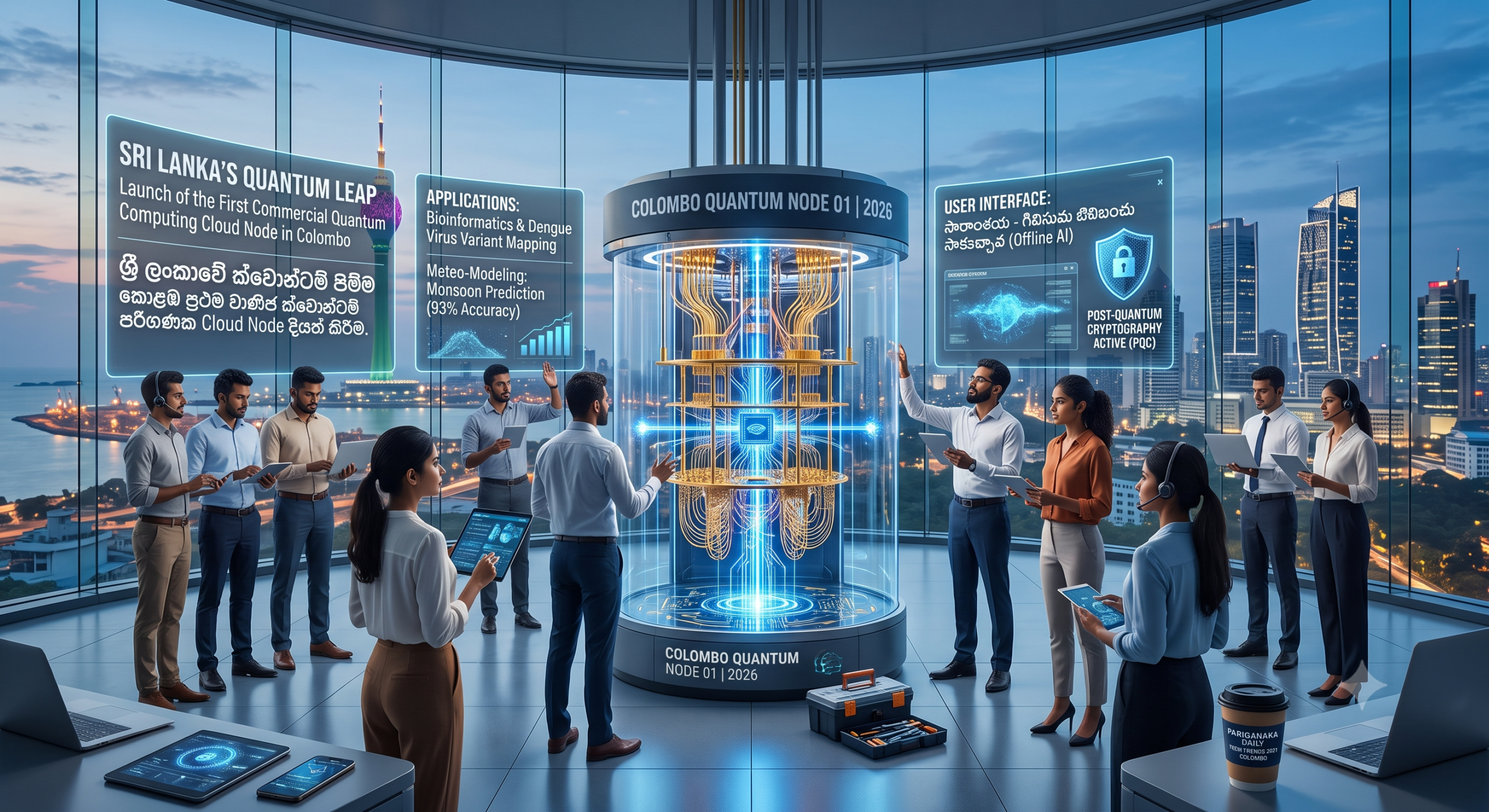
The technological horizon of Sri Lanka has just shifted permanently. While the world spent the last few years discussing the limitations of classical silicon microchips, 2026 marks the year Sri Lanka officially entered the quantum era.
In a landmark public-private partnership between the Ministry of Technology, local telecom giants, and global tech leaders, Sri Lanka has officially launched its first commercial Quantum Computing Cloud Node, hosted right in the heart of Colombo. This gives local universities, tech startups, and financial institutions direct access to quantum processing power via the cloud.
Here are the top three sectors being revolutionized by Sri Lanka’s sudden quantum computing leap this year.
🔬 1. Accelerating Bioinformatics and Local Medicine
Traditional computers can take years to simulate molecular structures for drug discovery. Quantum computers, using the principles of quantum mechanics, can do it in minutes.
- Targeting Tropical Diseases: The Bioinformatics department at the University of Colombo is already utilizing the cloud node to map molecular variants of dengue virus strains.
- Custom Medical Solutions: Quantum simulations are allowing local researchers to accelerate clinical trials for customized herbal-synthetic hybrid medicines, cutting down research and development lifecycles from a decade to just a few months.
🌦️ 2. Hyper-Precise Weather Modeling for the Monsoon Belt
Sri Lanka’s economy is deeply tied to its weather patterns, affecting everything from hydropower generation to tea exports. Classical computers struggle with the chaotic variables of climate change, but quantum algorithms thrive in them.
- Predicting the Monsoons: The Department of Meteorology has integrated quantum machine learning into its predictive matrix.
- The Economic Impact: By simulating thousands of atmospheric variables simultaneously, the new system can predict flash floods and prolonged droughts weeks in advance with over 93% accuracy. This allows grid operators to optimize dam management and gives farmers the exact window needed to protect their crops.
🔐 3. Preparing for the “Quantum Apocalypse” (Y2Q)
While quantum computing brings massive benefits, it also poses the single greatest threat to modern encryption. A powerful quantum computer can easily crack the RSA encryption that currently protects every local bank account and government database.
- Quantum-Resistant Sri Lanka: Rather than waiting for the global cybersecurity landscape to break, Sri Lankan FinTech firms are using the new cloud node to test and deploy Post-Quantum Cryptography (PQC).
- Securing the Future: Local banks are upgrading their network firewalls to lattice-based cryptography, ensuring that Sri Lankan financial and state data remains completely unhackable before foreign threat actors gain access to advanced quantum decryption tools.
The Pariganaka Takeaway: Sri Lanka’s commercial quantum cloud node proves that developing nations no longer have to wait decades to adopt bleeding-edge technology. By democratizing access to quantum processing power, Colombo is positioning itself as the high-tech research hub of South Asia. The quantum future isn’t a decade away—it is running on local servers right now.
Leave a Reply