
Published: August 8, 2026 | By Pariganaka Editorial Team
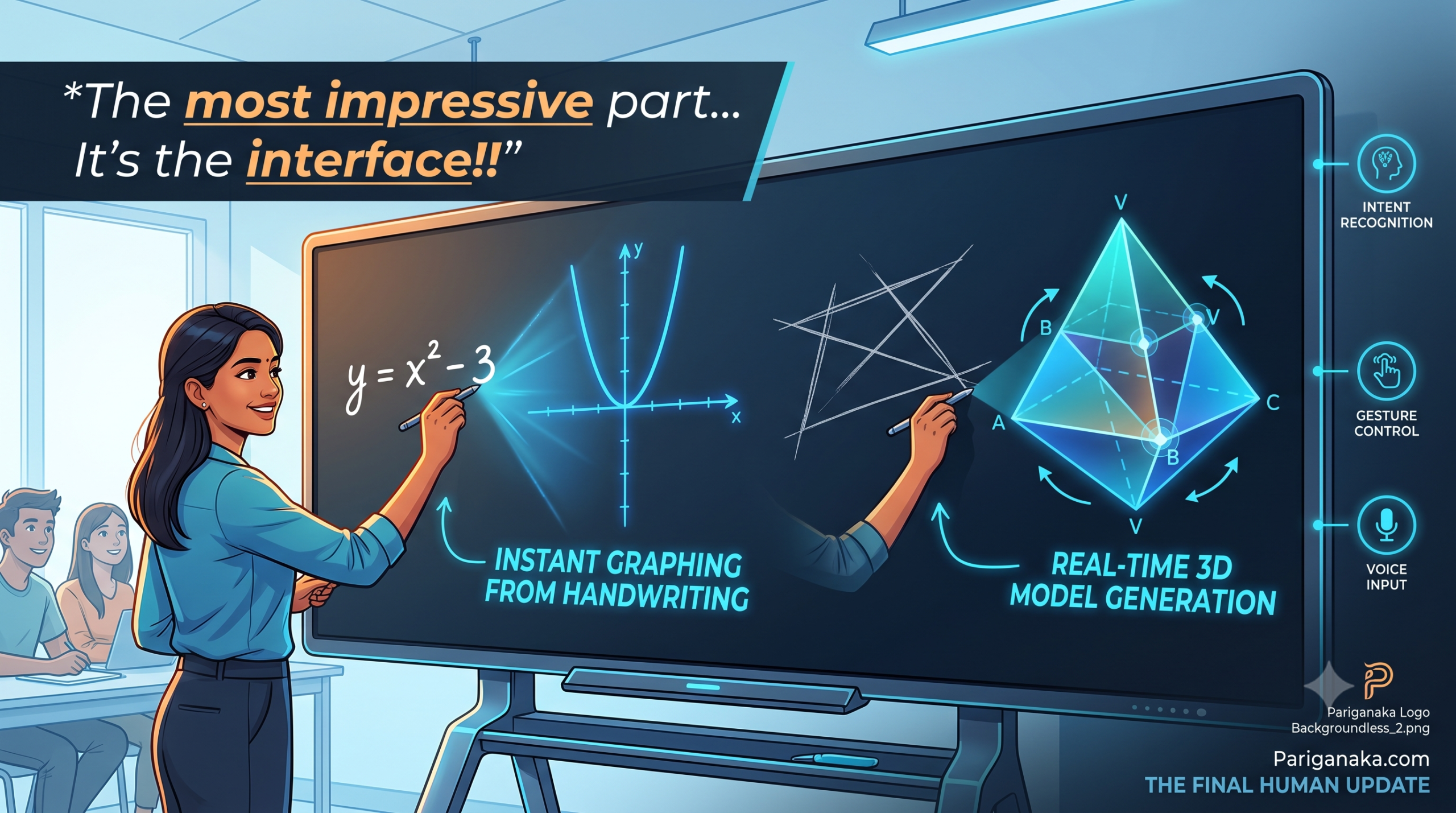
If you have scrolled through tech social media over the past few weeks, you have likely seen the viral video from the World AI Conference (WAIC) 2026 in Shanghai. The clip showcases Chinese company iFLYTEK’s new AI Blackboard in action. A presenter casually writes a math equation on the screen, and it instantly transforms into a live graph. Then, she sketches a rough, flat geometric shape, and the system instantly turns it into a fully labeled, rotatable 3D model.
The internet has been raving about the real-time 3D generation. But here at the Maha Gedara, we think the tech world is entirely missing the point.
The most impressive part of this AI blackboard isn’t the 3D model. It is the interface.
🪄 The Magic of “Zero-Friction” Teaching
To understand why this is a massive leap forward, we have to look at what is not happening in the viral demo.
The teacher is not clicking through complex drop-down menus. She is not turning her back on the students to type on a separate laptop, nor is she pre-loading a cumbersome slide deck. She simply picks up a stylus and writes $y = x^2 – 3$ directly on the digital surface. The system recognizes her intent, classifies the math, and instantly plots the expected upward parabola.
In user experience (UX) design, this is called eliminating the “representation switching cost”. By removing the friction between an educator’s thought and the digital output, the AI acts as an invisible co-pilot rather than a clunky software program.
🧠 Why the Interface is the True Breakthrough
The brilliance of this AI Blackboard lies in how it seamlessly integrates artificial intelligence into natural human behavior:
- Intent Recognition: The software does not just capture digital ink; it classifies the subject matter and intent instantly. It knows the difference between a teacher writing a quick note and a teacher trying to illustrate a spatial geometry concept.
- Manipulable Spatial Concepts: For students struggling to infer 3D structures from flat 2D lines, the interface allows them to touch, rotate, and highlight faces of the geometry in real-time. It makes abstract relationships instantly visible.
- Multi-Modal Control: The interface allows educators to refine handwriting with a single tap and even control the screen using natural voice commands.
The interface proves that the future of EdTech is not about forcing teachers to learn complex software. It is about building AI that naturally understands how humans already teach.
🇱🇰 What This Means for Sri Lanka’s AI Future
As Sri Lanka gears up for AI Week 2026 and pushes toward a multi-billion dollar digital economy, this is the exact type of “human-friendly” technology we need to adopt.
Imagine deploying these frictionless interfaces in rural Sri Lankan schools, powered by the newly announced nationwide fiber connectivity and SMART AI tokenization platforms. A teacher in a remote classroom wouldn’t need an IT degree to explain complex physics vectors or chemical molecules. The AI interface bridges the gap, allowing them to focus purely on the pedagogy while the technology handles the visualization.
The iFLYTEK AI Blackboard is a perfect reminder that the most advanced AI in the world is useless if the interface is too hard to use. The ultimate goal of technology is not to replace human educators, but to give them a canvas where their ideas can come to life instantly.
Explore the human-centric digital world with us. Pariganaka.com — The Final Human Update.
Leave a Reply