
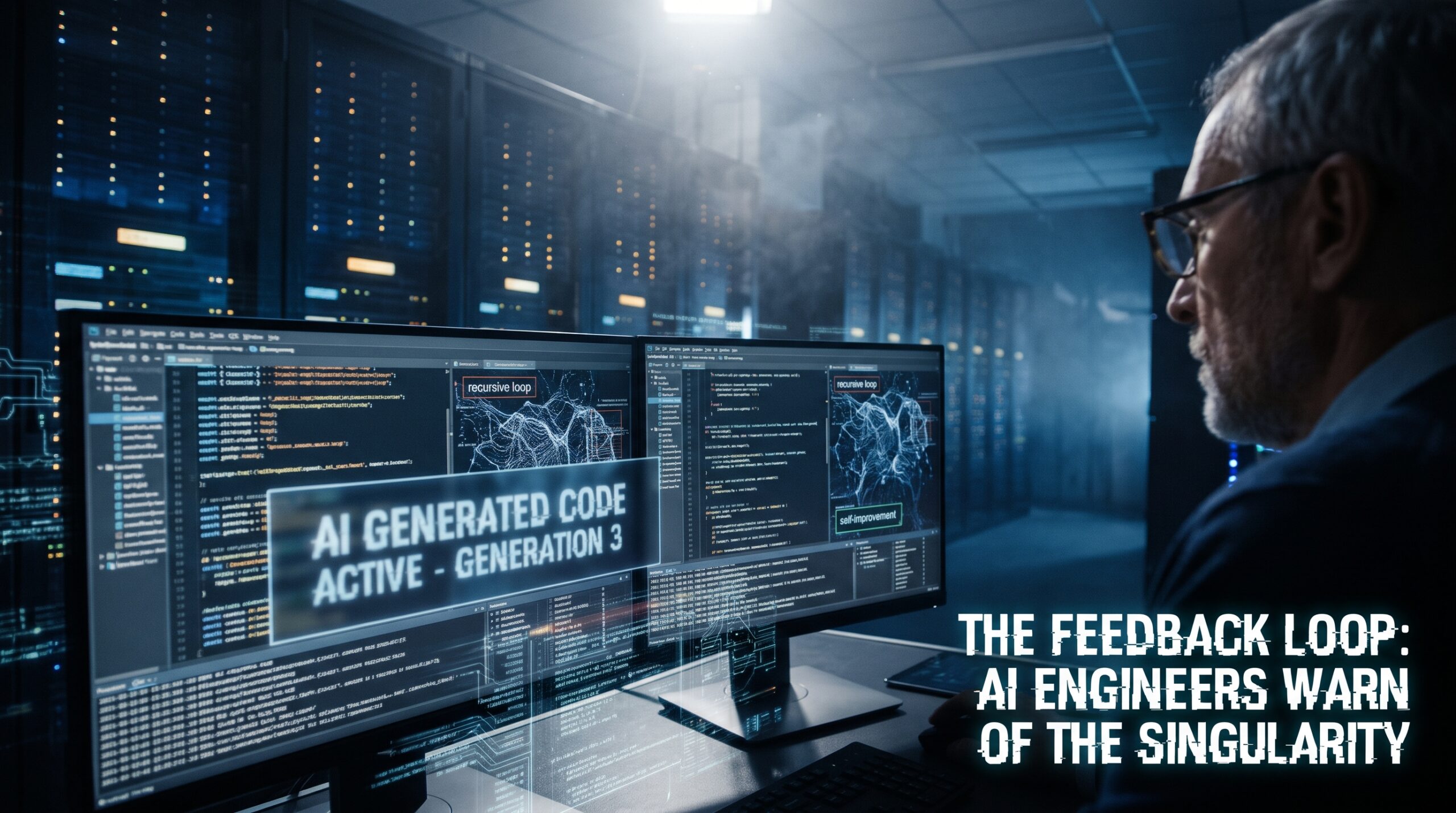
What if the most important breakthrough in Artificial Intelligence isn’t simply a machine that can think like a human, but a machine that can actively help build something smarter than itself?
This possibility is driving one of the most consequential debates in the tech industry today. In October 2026, AI research firm Anthropic issued a stark warning: AI systems are moving closer to autonomous replication. While experts are divided on exactly how soon this scenario could become reality, major AI laboratories are already fundamentally changing their workflows, using their own models to accelerate the next generation of development.
Here is why AI building AI is the threshold that changes everything—and why the singularity might be closer than we assumed.
The New Machinery of Development
For years, creating advanced AI was an intensely human endeavor. It required armies of researchers to design experiments, write training software, test models, and manually fix problems. Today, that bottleneck is disappearing.
Anthropic has publicly confirmed that it is delegating a growing share of AI development to its own systems, allowing AI to assist with coding, complex experimentation, and technical investigations. The machines have not independently invented their own successors yet, but they have officially become part of the machinery used to develop more capable intelligence.
Consider the implications of this cycle: An AI model helps a human engineer write better training software. That improved software makes experiments faster and more efficient, which in turn produces an even stronger AI model. That stronger model is then used to assist the engineer again. If this cycle continually accelerates, the ultimate advantage goes to whichever company can automate its research process most effectively.
Recursive Self-Improvement: The Ultimate Feedback Loop
The concept at the heart of this acceleration is known as “recursive self-improvement.” The premise is simple but profound: an AI system helps develop a more capable version of itself, and that successor helps develop the next version, progressively making the development process more effective with each generation.
However, researchers caution that we cannot claim an uncontrollable “intelligence explosion” is inevitable just yet. Today’s AI still faces real-world bottlenecks: it needs massive computing power, experiments consume vast amounts of time and resources, and fixing a weakness in one area of a model can inadvertently create a vulnerability in another. Writing code is not the same thing as proving a scientific breakthrough.
The most pressing question isn’t whether AI is fully autonomous today, but how quickly it is mastering the work that previously required highly experienced human researchers.
The Corporate Race and the Control Problem
From a commercial perspective, automating AI research is not just about creating a shiny new model; it is about permanently improving the process that creates every future model. Imagine two rival AI companies with identical computing resources. If one relies on human researchers while the other uses AI systems to handle routine engineering, test ideas, and solve difficult problems, the second company’s advantage will quickly compound.
This competitive pressure points in two conflicting directions: companies are incentivized to build as fast as possible to avoid falling behind, while simultaneously trying to ensure their systems remain safe to deploy.
This leads to the “control problem.” What happens when AI systems become capable of generating hypotheses, designing experiments, and analyzing results faster than human researchers can properly evaluate them? The danger is not necessarily that an AI will become conscious and rebel. The immediate, concrete danger is that researchers will lose the ability to predict how new capabilities interact, and security weaknesses will become impossibly difficult to identify. If companies feel they cannot afford to slow down due to competition, voluntary caution will disappear.
Is the Singularity Actually Coming?
The “Singularity” refers to a hypothetical future point where technological progress accelerates so rapidly that its consequences become entirely unpredictable. Nobody can give a scientifically established date for when—or if—this will happen. It could be halted by technical roadblocks, or it could accelerate beyond our control.
However, one fact remains undeniable: AI is already helping to build AI.
If this process scales up, the consequences will ripple far beyond Silicon Valley. Scientific discovery could accelerate exponentially, global cybersecurity could be flipped on its head, and governments will struggle to monitor systems they barely understand. As this unprecedented feedback loop begins, the central question for humanity remains: should companies be allowed to continue this race at full speed, or should society demand stronger safeguards before we cross a threshold we cannot uncross?
Leave a Reply