
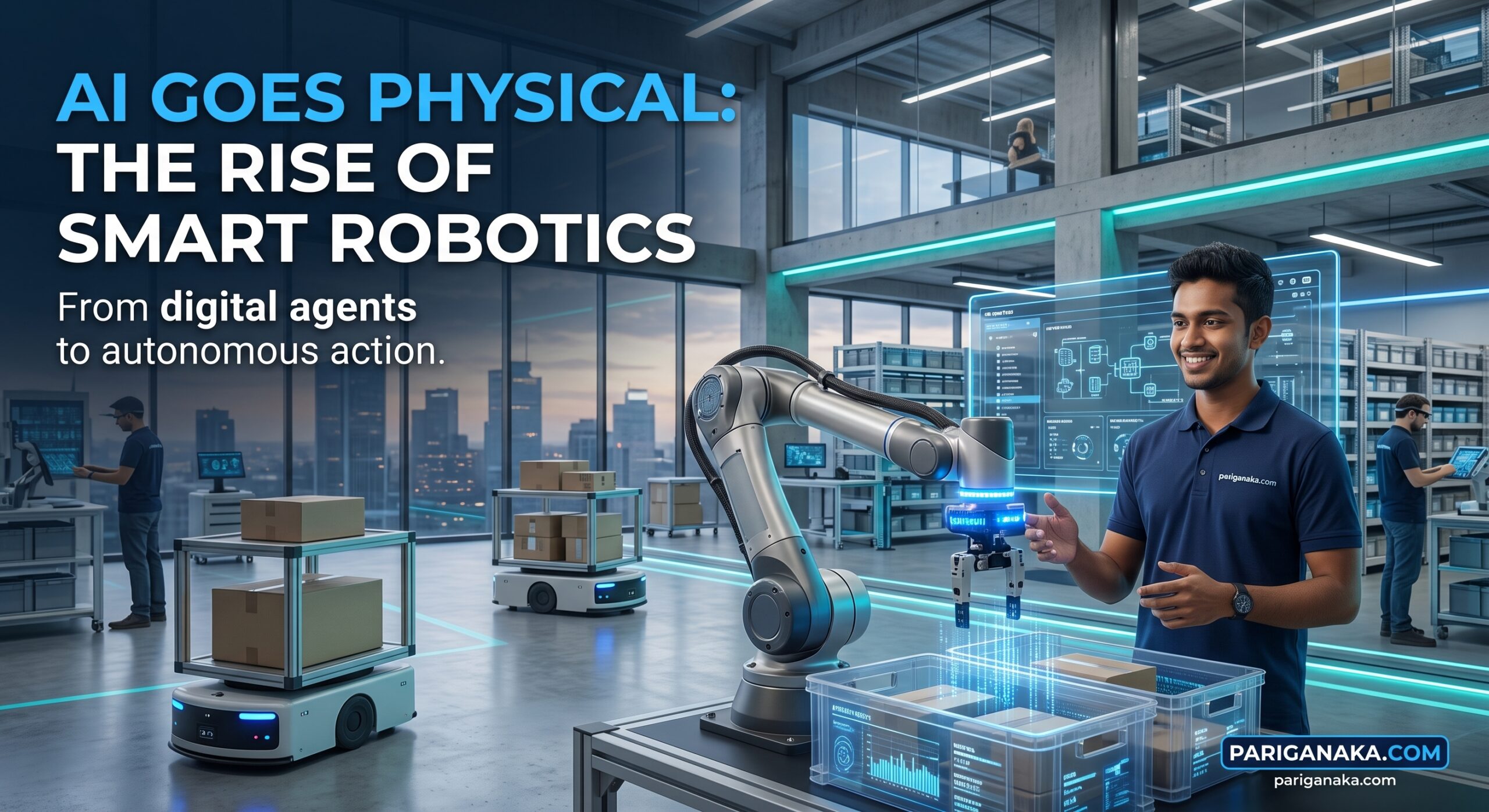
Artificial Intelligence is no longer confined to chat windows and cloud servers. By mid-2026, the technology industry has reached a massive inflection point in “Physical AI” or Embodied Intelligence. This convergence of advanced software and cutting-edge hardware is bringing AI out of the digital realm and into our warehouses, hospitals, and factories.
Moving Beyond Pre-Programmed Machines
The fundamental shift in modern robotics is the transition from automation to true autonomy.
- Unlike traditional robots that simply repeat pre-programmed instructions, physical AI systems actively perceive their environment, learn from experience, and adapt their behavior based on real-time data.
- This allows robots to bridge the gap between digital intelligence and the physical world, manipulating objects and navigating unpredictable spaces safely.
The Brains Behind the Bots: VLA Models
The secret to this newfound physical intelligence lies in how these machines process information.
- Vision-Language-Action (VLA) Models: These multimodal AI models act as the robot’s brain, allowing it to interpret what it sees, connect that visual data to natural language instructions, and execute the correct physical movement.
- Onboard Processing: By utilizing local Neural Processing Units (NPUs), these robots run AI directly on the machine with minimal delay, bypassing the need for constant cloud connectivity.
From Warehouses to Humanoids
While the robotics industry has raised over $11.5 billion in funding since 2024, the deployment reality is split into two distinct categories.
- Purpose-Built Dominance: Specialized warehouse automation is already operating at scale. Amazon recently surpassed 1 million deployed robots, which now assist with 75% of their global deliveries.
- The Humanoid Frontier: Human-shaped robots are heavily funded because they can seamlessly navigate spaces built for people without requiring expensive environmental redesigns. However, most humanoids are still in pilot testing, hindered by hardware bottlenecks like battery lives that max out at 90 to 120 minutes.
Overcoming the “Reality Gap”
Despite the massive hype, deploying intelligent robots safely remains a monumental engineering challenge.
- AI robots face a severe “reality gap.” A machine that achieves 95% accuracy in a virtual laboratory simulation often drops to 60% accuracy in the real world due to unexpected lighting, textures, or friction.
- Because industrial environments require 99.9% reliability, fixing this gap through advanced physics-based training is the industry’s top priority.
As hardware costs eventually drop, how soon do you think Sri Lankan industries will begin adopting these AI-powered robotic fleets for local logistics and manufacturing?
Leave a Reply