
Remember when learning to code meant memorizing syntax, studying languages like Python or JavaScript, and spending hours hunting down a missing semicolon?
In 2026, the landscape of software development is undergoing a fundamental transformation. According to top industry analysts, we are moving away from traditional coding and entering the era of AI-Native Software Development. At Pariganaka.com, we are exploring what this means for local developers, tech startups, and the future of digital creation in Sri Lanka.
1. From “Writing Code” to “Expressing Intent”
The biggest paradigm shift this year is how developers interact with machines. You no longer tell the computer how to build something line by line; you tell the AI what you want the final outcome to be.
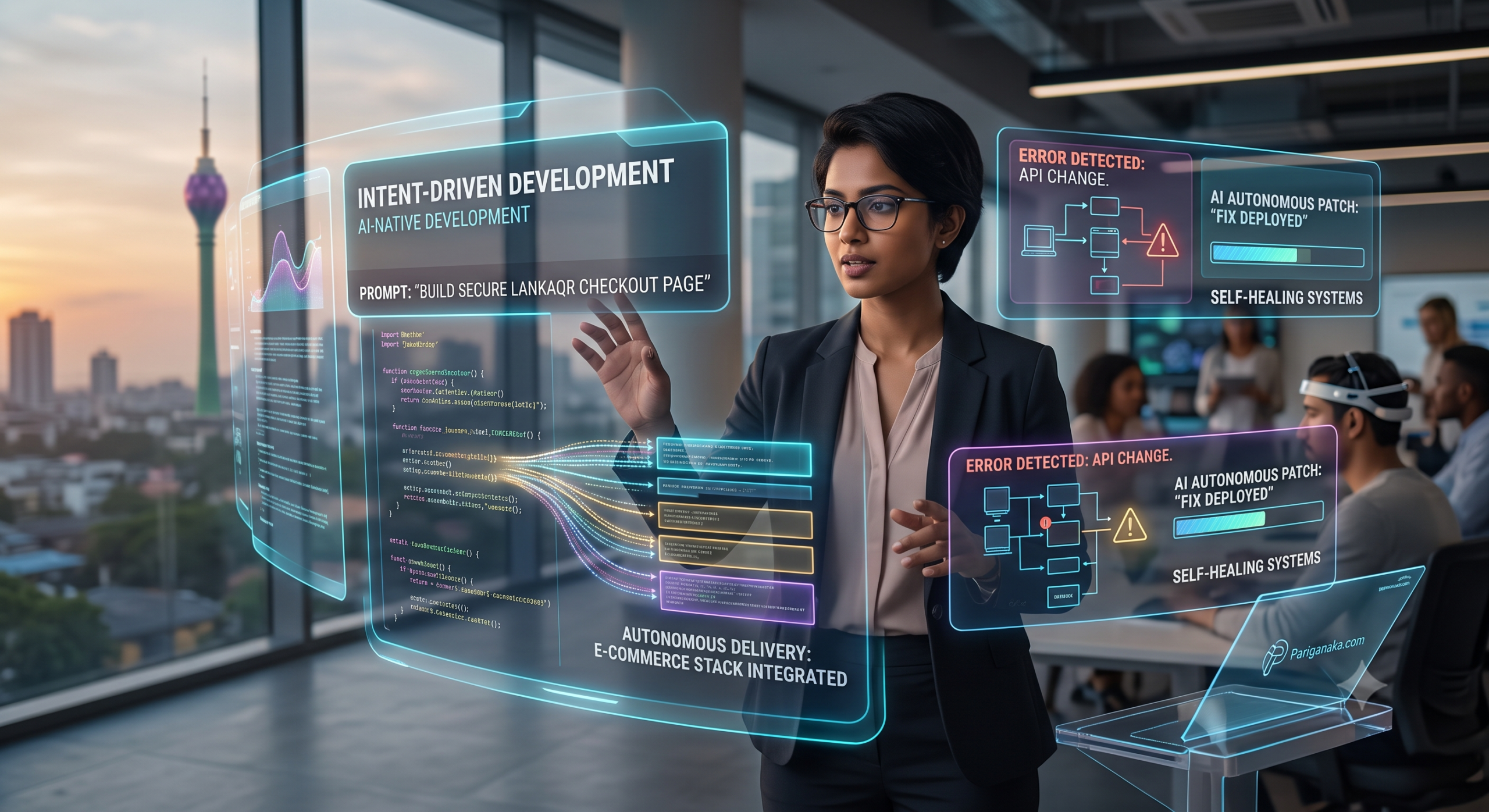
- Intent-Driven Development: A developer in Colombo can now articulate a desired outcome—for example, “Build a secure, mobile-responsive e-commerce checkout page that integrates with LankaQR and local bank APIs.”
- Autonomous Delivery: The underlying AI agent doesn’t just provide a code snippet; it autonomously writes the entire stack, integrates the necessary APIs, runs automated security tests, and pushes it to deployment. The developer’s job shifts from “typist” to “orchestrator” and “auditor.”
2. Self-Healing and Self-Assembling Systems
Software is no longer static. In the past, when an app crashed or an API changed, a human developer had to investigate the bug, write a patch, and manually deploy the fix.
- The Living Application: In 2026, enterprise backbones are evolving into modular, living ecosystems. When an error occurs, autonomous AI agents in the background can identify the root cause, write a fix, test it against the existing codebase, and deploy the patch in real-time, often before the end-user even notices a glitch.
- The Death of Maintenance? While human oversight is still required, the routine, tedious work of software maintenance is largely being outsourced to silicon-based AI workers.
3. What This Means for the Sri Lankan IT Sector
Sri Lanka has a booming tech export and software engineering sector. How does our local industry adapt to a world where AI writes the code?
- The Rise of the “AI Output Manager”: The competitive edge for local tech firms will no longer hinge on manual coding speed. The most valuable skill in 2026 is governance. Companies need professionals who understand architecture, can audit AI-generated code for security flaws (like zero-trust compliance), and can manage teams of AI agents.
- Democratizing Innovation: Because the barrier to creating software has been drastically lowered, small business owners and non-technical founders in Sri Lanka can now build custom internal apps and digital solutions simply by describing their needs to an enterprise AI platform.
Quick Guide: Traditional vs. AI-Native Development
| Feature | Traditional Coding (Past) 💻 | AI-Native Development (2026) 🤖 |
| Developer Role | Writing syntax line-by-line. | Prompting intent and orchestrating outcomes. |
| Bug Fixing | Manual debugging and patching. | Self-healing and autonomous AI patching. |
| Barrier to Entry | High (Requires learning programming languages). | Low (Requires logical thinking and clear communication). |
| Core Value | Speed of writing code. | Quality of governance and system architecture. |
The Bottom Line:
AI is fundamentally eating software. It is no longer just an assistant or a sophisticated autocomplete tool; it is the backbone of the digital economy. For Sri Lankan developers and businesses, this isn’t a threat—it is an incredible opportunity to stop focusing on the plumbing and start focusing on innovation.
Adapt your skills, embrace the new tools, and keep following Pariganaka.com to stay ahead of the digital curve!
Leave a Reply