
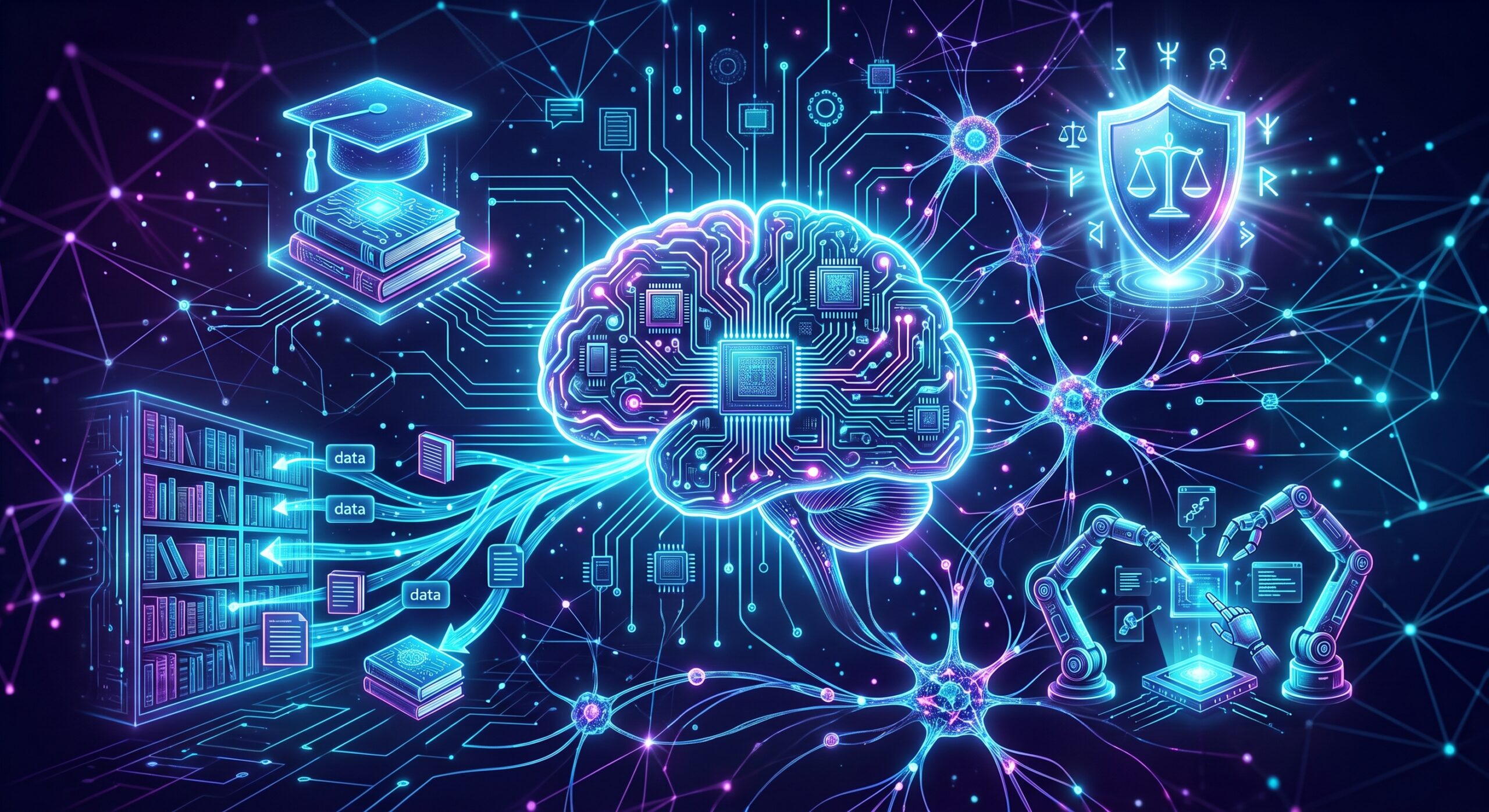
Artificial intelligence is everywhere, bringing with it a flood of new terminology[cite: 9]. To make these concepts easier to grasp, it helps to use a familiar analogy: human intelligence[cite: 9]. At its simplest, AI is a subfield of computer science aimed at matching or exceeding human intelligence within a computer[cite: 9].
Here are six essential concepts of modern AI, explained through the lens of human capabilities:
1. The Brain: Large Language Models (LLMs)
Human intelligence begins with the brain[cite: 9]. In modern AI systems, the brain is represented by the model, typically a Large Language Model (LLM)[cite: 9]. This is where core intelligence and reasoning capabilities reside, and where content—such as words, images, or sounds—is generated[cite: 9]. Generative AI uses probabilities to predict output based on your input[cite: 9]. If you ask a question, the LLM performs essentially a highly advanced autocomplete, predicting how to finish a sentence, a paragraph, or an entire document[cite: 9].
2. Schooling: Model Training and Tuning
An untrained brain isn’t very useful[cite: 9]. Just as humans go to school to learn math, history, and language, an LLM must also be taught how to think[cite: 9]. This process is called model training and tuning, which allows the AI to understand basic functions and develop reasoning skills[cite: 9].
3. Staying Updated: Retrieval Augmented Generation (RAG)
If you stopped learning the moment you graduated, you wouldn’t know about current events, new technologies, or today’s weather[cite: 9]. Humans augment their knowledge by reading the news or research papers[cite: 9]. In AI, this is achieved through Retrieval Augmented Generation (RAG)[cite: 9]. RAG extends the AI’s knowledge by connecting it to trusted external sources[cite: 9]. This grounds the AI in factual information and helps reduce “hallucinations”—those confident errors where the AI makes bad, incorrect guesses[cite: 9].
4. Hands and Feet: AI Agents
A brain in a box is useful, but it becomes much more powerful when it can interact with the world to accomplish tasks—just as humans use hands and feet to move things and build[cite: 9]. When we give an AI access to tools, allowing it to read and write to databases, write code, search the web, or even make purchases, it becomes an AI Agent[cite: 9]. Simply stated, an agent is a model using tools in a loop, autonomously, giving it the ability to actually get things done rather than just answering questions[cite: 9].
5. The Nervous System: Model Context Protocol (MCP)
How does the brain communicate with the hands and feet? Humans have a central nervous system passing messages throughout the body[cite: 9]. For an AI agent, this communication can be handled by the Model Context Protocol (MCP)[cite: 9]. MCP acts as the orchestration layer, connecting the reasoning of the brain to the tools, coordinating the actions of the AI’s “hands and feet”[cite: 9].
6. The Conscience: System Prompts
A fully functional entity still needs guiding principles to control its behavior[cite: 9]. Humans learn ethics—like being courteous and not hurting others—from parents and teachers over decades[cite: 9]. AI, however, is unleashed soon after birth, lacking the “street smarts” or common sense to avoid being tricked by malicious users[cite: 9]. (These tricks are called prompt injections, similar to social engineering attacks on humans)[cite: 9].
To teach AI ethics without having to completely rebuild the expensive model, developers use a System Prompt[cite: 9]. This acts like an angel on the AI’s shoulder, providing a set of guidelines that constrain its actions[cite: 9]. For example, if a user asks how to build a bomb, the system prompt ensures the AI declines[cite: 9]. However, because users constantly find new ways to trick the system, the system prompt must be adapted over time, much like how humans must continually learn to avoid new scams[cite: 9].
Leave a Reply