
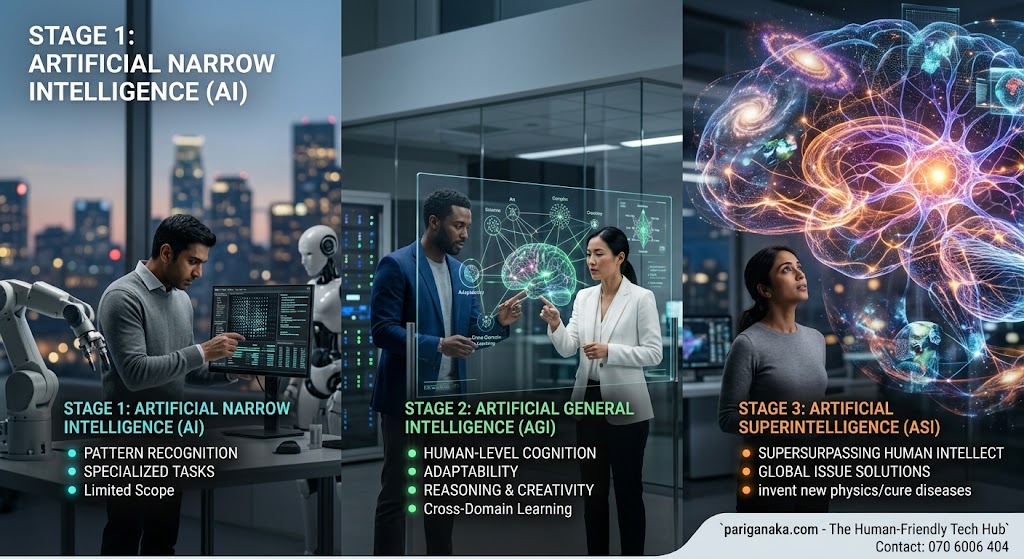
The conversation around artificial intelligence is evolving rapidly. As technology progresses from simple algorithms to highly complex neural networks, it is crucial to understand the three distinct stages of AI development that define our present and our future.
Here is the breakdown of Artificial Intelligence (AI), Artificial General Intelligence (AGI), and Artificial Superintelligence (ASI):
1. Artificial Narrow Intelligence (AI)
This is the technology we interact with today. Also known as “Narrow AI,” it is designed to perform single, highly specific tasks.
- Capabilities: It excels at pattern recognition, generating text or images, playing chess, and driving cars.
- Limitations: It only operates within the predefined parameters of its training data. A system built to generate images cannot suddenly decide to analyze financial markets.
- Current Status: Fully active and rapidly advancing in our daily lives (e.g., Siri, Gemini, recommendation algorithms).
2. Artificial General Intelligence (AGI)
AGI represents the “holy grail” of current computer science—a machine that possesses human-level cognitive abilities.
- Capabilities: An AGI system would be able to understand, learn, and apply knowledge across a wide range of entirely different tasks, just like a human being. It could reason through abstract problems, adapt to unpredictable environments, and learn new skills independently.
- Limitations: It would be roughly as smart as an average human, bound by the limits of human-level reasoning speed and capacity.
- Current Status: Theoretical, though major tech companies are aggressively working toward achieving it within the next decade.
3. Artificial Superintelligence (ASI)
This is the ultimate, speculative frontier of machine evolution, where technology vastly surpasses human capabilities.
- Capabilities: ASI would possess intellect vastly smarter than the best human brains in practically every field, including scientific creativity, general wisdom, and social skills.
- Impact: It could theoretically solve complex global crises, invent new physics, or cure diseases simultaneously.
- Current Status: Purely hypothetical. It represents a future stage that relies on first successfully achieving and controlling AGI.
Leave a Reply