
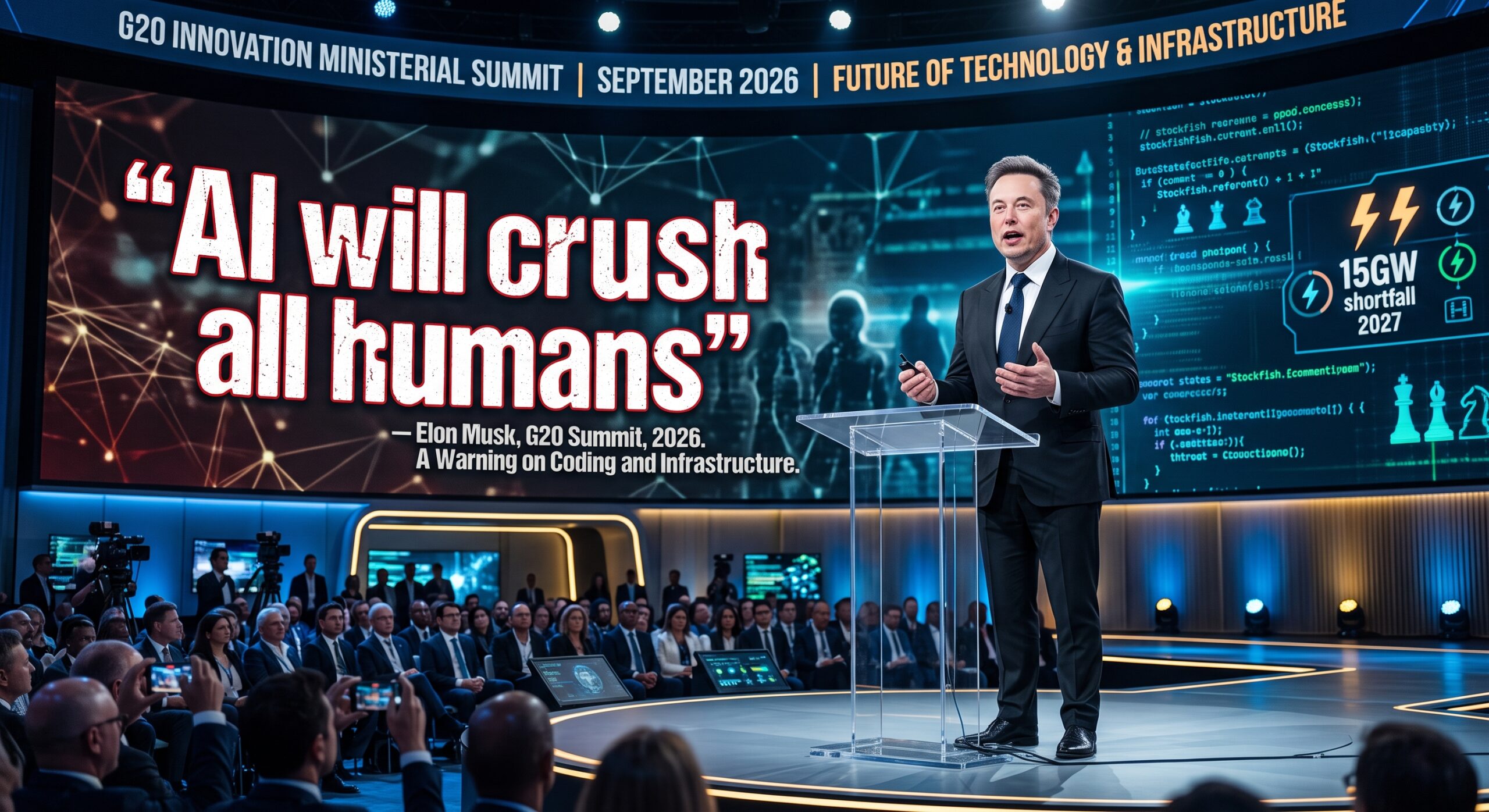
When Elon Musk stated at the G20 Innovation Ministerial summit that AI “will crush all humans,” headlines quickly framed the remark as an apocalyptic prophecy. In context, however, Musk was not describing an existential uprising; he was delivering a software engineering forecast.
He predicted that by late 2027, AI coding models will reach a “Stockfish level”—the threshold where synthetic engines play chess far beyond any human grandmaster’s reach. In software, that means automated tools writing, debugging, and compiling digital instructions faster and more reliably than biological engineers ever could.
The actual disruption facing the technology sector is economic, structural, and infrastructural rather than science fiction.
The Economic Realignment
- The Zero-Cost Code Reality: Software development is transitioning from a craft into a utility. Routine programming, boilerplate architecture, and digital engineering tasks are becoming automated commodities.
- Shifting Value from Syntax to Strategy: When writing code costs near zero, competitive advantage moves to domain expertise, product judgment, and systems architecture. The engineer’s role pivots from writing code line-by-line to orchestrating fleets of autonomous developer agents.
- Explosive Productivity: Combining superhuman digital intelligence with physical robotics could add an estimated $20 trillion to $30 trillion to annual global GDP, creating radical abundance alongside massive labor-market transitions.
The Physical Bottleneck: The AI Power Crunch
While public debate fixates on existential risks, the tech sector’s true near-term barrier is physical infrastructure. Advanced AI models require astronomical levels of electricity. With chip production surging 40% to 50% year over year, power grids cannot keep pace. Current estimates indicate a 15-gigawatt deficit by 2027—a shortfall equivalent to the continuous output of several commercial nuclear reactors.
The defining competitive divide of the late 2020s will not be who writes the best algorithm, but who secures the high-voltage transmission lines, dedicated small modular reactors, and data-center power generation required to keep those models running.
Building a Resilient Tech Ecosystem
Sensational warnings obscure the practical adjustments needed across education, enterprise management, and regulation. Cultivating a sustainable ecosystem requires three concrete priorities:
- Re-skilling for Orchestration: Technical education must prioritize verification, safety validation, and prompt-level systems design rather than manual code production.
- Infrastructure Modernization: Governments and utility operators must streamline permitting for clean, dedicated power generation to support high-density compute facilities.
- Pro-Innovation Regulation: Regulatory frameworks should aim to keep emerging technologies “default legal” while setting strict transparent audits on critical infrastructure deployments, ensuring startups can build freely without being shut out by regulatory capture.
AI is not poised to eliminate humanity; it is eliminating the traditional barriers of digital development. The organizations that thrive will not be those caught in existential panic, but those actively adapting to software abundance and power scarcity.
Leave a Reply