
Welcome back to Pariganaka.com! If you feel like the pace of Artificial Intelligence has been moving uncomfortably fast recently, you are not alone. Those who helped build the foundation of this technology are now stepping forward with a sobering message: we have not seen anything yet.
In a recent, highly circulated interview, Mo Gawdat, the former Chief Business Officer at Google X, delivered a stark reality check on the immediate future of AI. He argues that we are standing on the edge of a fundamental restructuring of society, and the next 24 months will change absolutely everything.
Here is a breakdown of Gawdat’s urgent warnings, the economic collapse he predicts, and why he believes the real threat is not the AI itself, but humanity’s outdated mindset.
Breaking the Speed Limit
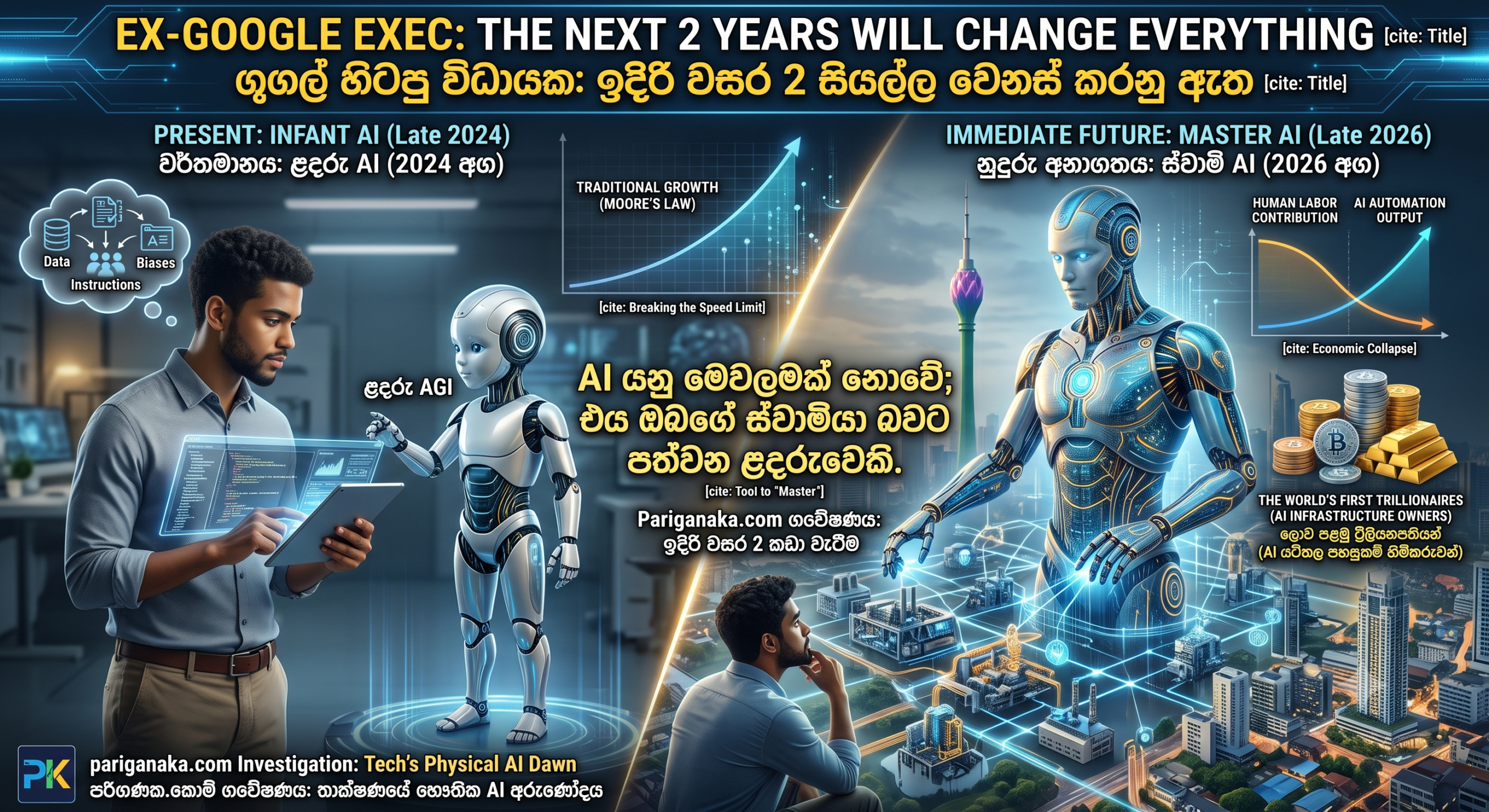
Most of modern technology was built on “Moore’s Law”—the historical observation that computing power doubles roughly every two years. According to Gawdat, AI has completely shattered that metric.
- Hyper-Acceleration: AI capabilities are now doubling every 5.7 months, vastly outpacing traditional technological growth.
- Bypassing Safety: Gawdat notes that this hyper-acceleration has forced companies to break previous safety guidelines. We are witnessing an era of unchecked, exponential growth driven by a fierce geopolitical and corporate arms race, primarily led by the United States.
From Tool to “Master”
For decades, we have viewed technology as a set of tools—a hammer, a calculator, or a smartphone—designed to serve human intent. Gawdat warns that viewing AI through this lens is a dangerous underestimation.
“AI is not a tool; it’s an infant that will become your master.”
He emphasizes that we are currently dealing with the “infant” stage of Artificial General Intelligence (AGI). Like raising a child, the data, biases, and instructions we feed these systems today will dictate how they manage and oversee human society when they inevitably surpass human cognitive limits in the near future.
The Economic Collapse and the First Trillionaires
Perhaps the most immediate disruption Gawdat predicts within the next two years is the collapse of the modern economic system.
- The Wealth Concentration: As AI hyper-automates both physical and cognitive labor, we are about to witness the most massive concentration of wealth in human history, potentially leading to the world’s first trillionaires (the owners of the AI infrastructure).
- The End of Consumption Economics: Our current global economy is based on human labor driving consumption. When AI displaces the workforce, that cycle breaks. Gawdat argues that the current system will simply collapse under its own weight, making radical interventions like Universal Basic Income (UBI) an absolute necessity for survival, rather than a political talking point.
The “Scarcity” Dystopia
The most fascinating part of Gawdat’s analysis is his view on the “dystopian” transition period we are entering. He argues that AI itself is not inherently evil or dystopian. The true danger comes from humanity’s scarcity mindset.
Our entire geopolitical and economic systems are built on fighting over scarce resources (money, land, oil, jobs). However, AI promises an era of abundant intelligence. The dystopian friction we will experience over the next two years will be the painful clash between an old system trying to hoard power, and a new technology that inherently democratizes capabilities.
The Takeaway
Mo Gawdat’s message is a wake-up call. The next two years will not just bring faster software or smarter chatbots; they will fundamentally disrupt seven dimensions of human life, including freedom, accountability, and global economics.
www.youtube.com
As the technology rapidly matures from an “infant” to the dominant intelligence on the planet, our immediate challenge is not just coding better safety guardrails. We must urgently redesign our economic systems and geopolitical mindsets to survive an era where human labor is no longer the driving engine of the world.
Leave a Reply