
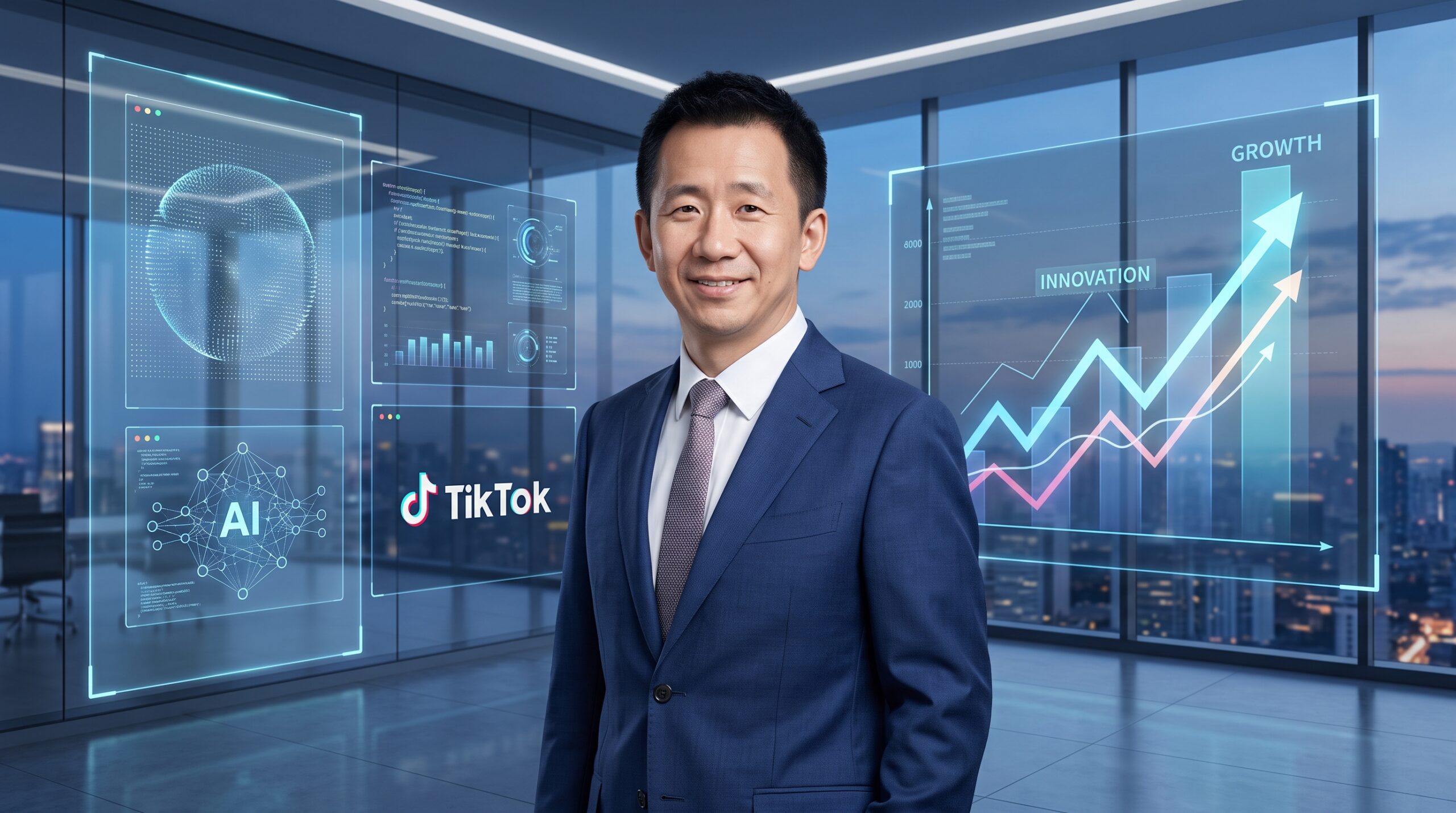
The landscape of extreme wealth in Asia has officially shifted from traditional infrastructure to next-generation technology. ByteDance founder Zhang Yiming has surpassed Indian conglomerate tycoon Gautam Adani to become the richest person in Asia.
The 43-year-old tech entrepreneur’s fortune has surged past the $105 billion mark, according to the Bloomberg Billionaires Index, crowning him the wealthiest individual in the region for the first time. Zhang currently ranks 18th on the global billionaire list. His ascent marks a historic rebound for the reclusive founder and underscores the massive financial weight of the global artificial intelligence boom.
From $13 Billion to $105 Billion: The AI Wealth Surge
Zhang’s wealth trajectory has been nothing short of extraordinary. When Bloomberg first began tracking his fortune in March 2019, his net worth stood at $13 billion. In just seven years, his wealth has multiplied more than eightfold.
The most recent spike in his net worth—a massive $12 billion jump in September 2026 alone—was triggered after Bloomberg analyzed updated private valuations reported by major investment firms, including BlackRock, Fidelity Investments, and T. Rowe Price. Because ByteDance is a closely held private company and not publicly traded, the Bloomberg Billionaires Index applies a 10% risk discount to its valuation.
While TikTok remains ByteDance’s most famous global export, analysts attribute Zhang’s recent wealth explosion directly to the company’s aggressive, sustained investments in artificial intelligence.
Doubling Down on AI Amidst Global Turbulence
Zhang’s rise to the top of Asia’s wealth rankings comes after years of intense regulatory and geopolitical scrutiny, particularly in the United States, where TikTok faced existential threats and congressional hearings. Despite the turbulence, Zhang maintained his strategic focus.
Lian Jye Su, chief analyst at research firm Omdia, noted that Zhang made a well-placed bet by continuing to double down on AI investment even while TikTok’s CEO faced aggressive questioning by the US Congress. “He plays his cards right,” Su stated, pointing out that Zhang stayed the course on his technological vision.
ByteDance has successfully transitioned heavily toward generative AI, developing powerful tools such as the Doubao AI chatbot—currently one of China’s most widely used AI assistants—and the Seedance video-generation model. Furthermore, analysts suggest that ByteDance is uniquely positioned to capitalize on its vast trove of social media data to train sophisticated, proprietary AI models.
The Shift: Tech Wealth Overtakes Traditional Industry
Zhang unseating Gautam Adani signals a broader economic paradigm shift in Asia. Adani, whose net worth currently sits at $105 billion (ranking 20th globally), built his empire on traditional sectors like energy, infrastructure, and retail. Adani’s wealth had peaked at $120 billion in June but recently declined due to an MSCI index rebalancing and a broader stock selloff linked to higher oil prices and bond yields.
By surpassing Adani, as well as India’s Mukesh Ambani (who holds an estimated $81.3 billion), Zhang’s milestone illustrates how fortunes generated by consumer platforms and the ongoing AI boom are rapidly overtaking established wealth rooted in traditional industries.
While AI presents ByteDance’s biggest opportunity beyond short-form video, it is not without risks. The company faces fierce domestic competition within China’s rapidly evolving AI market, and massive capital expenditures on AI infrastructure have heavily impacted net profits.
Nevertheless, Zhang Yiming’s strategic pivot from social media algorithms to foundational AI models has solidified his status not just as a tech pioneer, but as the most financially powerful individual in Asia.
What are your thoughts? Does ByteDance’s massive private valuation signal that AI companies will permanently dominate the top spots on global wealth indexes over traditional energy and infrastructure giants?
Leave a Reply