
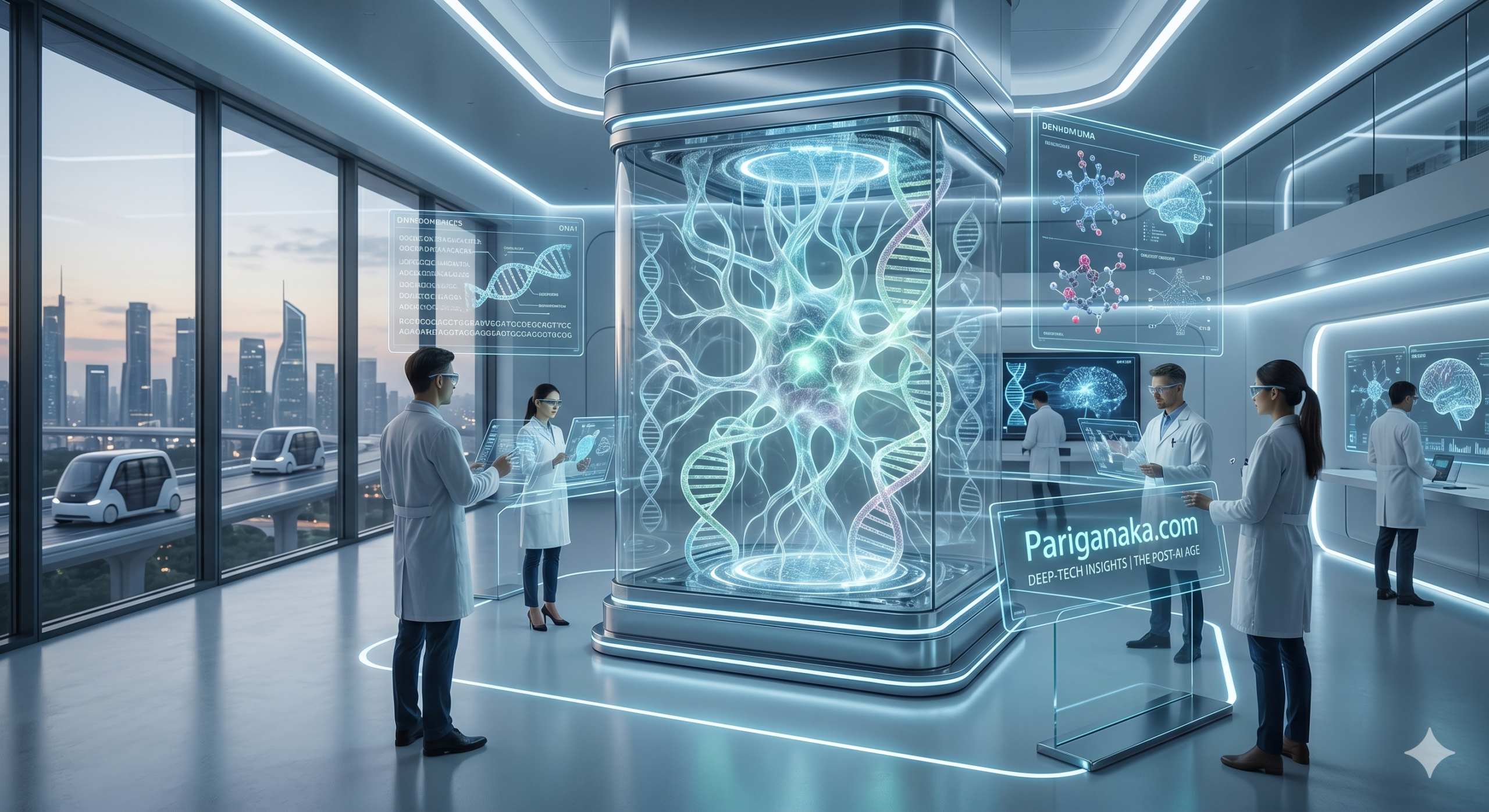
Right now, in 2026, we are living in the golden era of the AI Age. Artificial Intelligence has become the invisible engine of our world—managing our power grids, diagnosing our illnesses, and acting as our personalized, autonomous agents. But in the tech world, stagnation is impossible. As AI continues to solve our most complex digital and logistical problems, a profound question is emerging in research labs across the globe: What comes next?
If AI is the ultimate tool for processing information, the next era will be about fundamentally altering reality itself. When AI reaches its plateau of maturity, it will act as the bridge to a much wilder frontier.
Here is a glimpse into the deep-tech revolutions that will define the post-AI era—the upcoming Quantum-Biological Age.
1. The Convergence of Biology and Computing (Wetware)
Today, we rely on silicon chips and rare-earth metals to power our AI. Tomorrow, we will rely on biology. The post-AI age will blur the line between what is manufactured and what is grown.
- DNA Data Storage: The global data explosion is pushing traditional servers to their physical limits. In the next era, we will store zettabytes of data within synthetic DNA. A single gram of DNA can hold millions of gigabytes of information for thousands of years without requiring electricity or cooling.
- Biological Neural Networks (Wetware Computing): Researchers are already experimenting with lab-grown brain cells (organoids) integrated onto silicon microchips. The post-AI era will introduce “Wetware”—computers that operate using biological neurons, which are millions of times more energy-efficient than today’s most advanced supercomputers.
2. Programmable Matter and Nanotechnology
In the AI Age, we mastered the manipulation of data. In the post-AI age, we will master the manipulation of atoms.
- Molecular Assemblers: Powered by ultra-advanced quantum computers, humanity will gain the ability to arrange individual atoms to build completely new materials from scratch. This means creating metals lighter than plastic but stronger than titanium, or building synthetic materials that can repair themselves like human skin.
- The Post-Scarcity Economy: If you can program matter, the concept of manufacturing changes completely. We will transition from extracting resources to “printing” them at the molecular level, potentially solving global shortages of raw materials, clean water, and even food.
3. The Neural Web: The End of Language
Language, whether it is Sinhala, Tamil, English, or Python, is simply a compression tool we use to transmit thoughts from one brain to another, or from a human to a machine. The post-AI age will bypass language entirely.
- Brain-to-Brain Communication: While 2026 sees the rise of non-invasive Brain-Computer Interfaces (BCIs) for education and basic device control, the next era will introduce the “Neural Web.” Humans will be able to share raw thoughts, emotions, and complex concepts directly with one another across the globe, instantaneously.
- Collective Problem Solving: Imagine a team of Sri Lankan engineers and global scientists synchronizing their cognitive processing power to solve a climate engineering problem without ever speaking a word. The distinction between human thought and machine intelligence will become seamlessly integrated.
Pariganaka’s Take: The AI Age is not the final destination of human technological progress; it is merely the training ground. AI is giving us the processing power required to decode the universe’s most complex puzzles: the genome, the atom, and the human brain. While 2026 is about machines learning to think, the era that follows will be about humanity learning to reshape the very fabric of reality.
Leave a Reply