
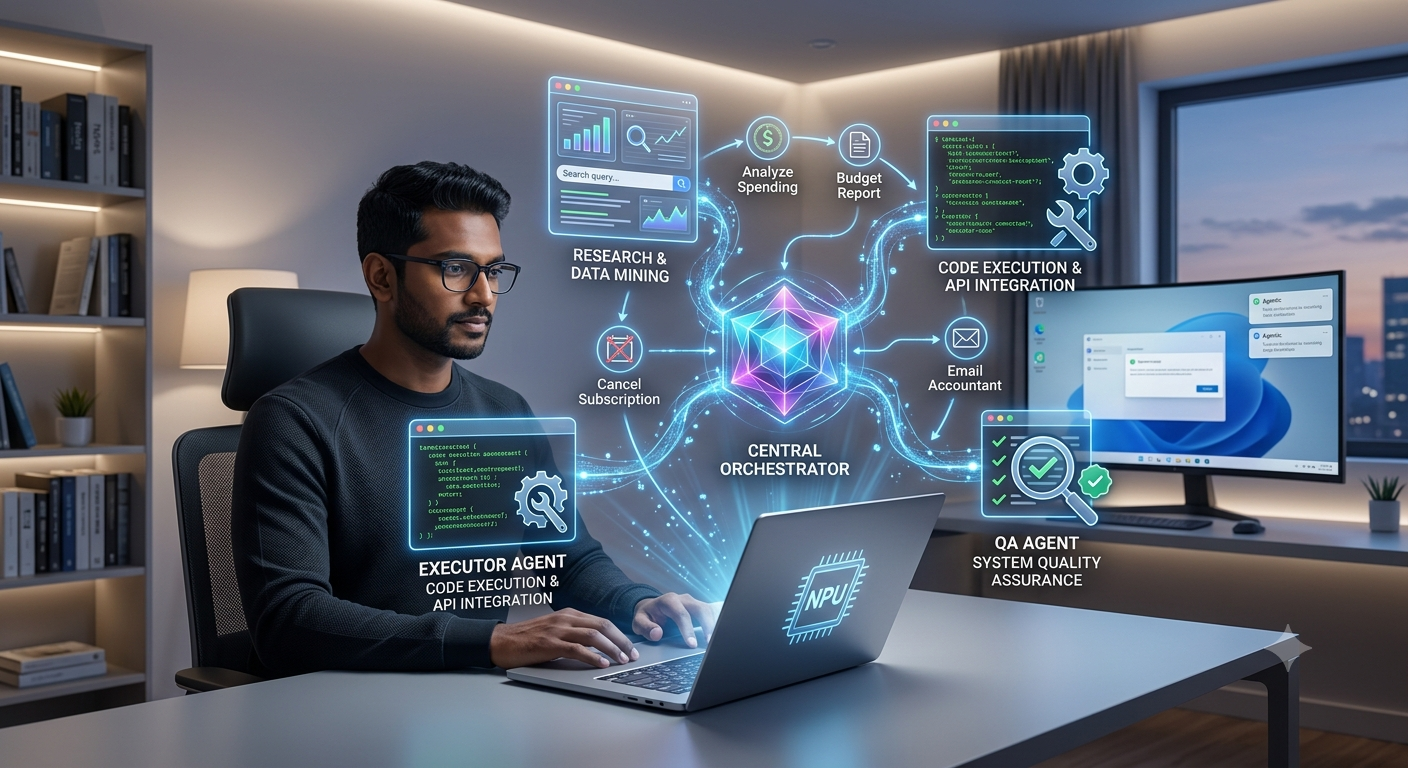
If 2024 and 2025 were defined by the hype of Generative AI and chatbots answering our prompts, 2026 is officially the year of Agentic AI. The tech landscape has shifted fundamentally from software that simply suggests text or code to independent, multi-agent AI ecosystems that execute entire multi-step workflows on our behalf.
For tech enthusiasts, developers, and everyday users following Pariganaka.com, understanding this shift is essential as it redefines how we interact with both software and hardware.
What is Agentic AI?
Traditional generative AI requires step-by-step human intervention: you type a prompt, look at the output, correct it, paste it into another tool, and hit send.
Agentic AI operates on intent rather than explicit commands. You give the AI an ultimate goal (e.g., “Analyze my monthly spending, write a budget report, file my subscription cancellations, and email the summary to my accountant”), and the system autonomously plans, troubleshoots, and executes the entire process.
The Generative vs. Agentic Shift
| Feature | Generative AI (2024–2025 Era) | Agentic AI (2026 Present) |
| Core Function | Content creation and question answering | Workflow execution and decision-making |
| User Input | Detailed, iterative prompts for every step | Single expression of high-level intent |
| Operation | Passive (waits for your next prompt) | Autonomous (runs 24/7 in the background) |
| System Architecture | Single standalone models/chatbots | Collaborative Multi-Agent systems |
The Rise of Multi-Agent Collaboration
The true magic behind this 2026 paradigm shift is the concept of Multi-Agent Systems. Instead of one massive AI model trying to do everything, software now deploys distinct, specialized sub-agents that talk to each other to complete a task.
- The Orchestrator: Receives your high-level goal, breaks it down into small tasks, and assigns them.
- The Researcher: Queries databases, fetches real-time web documentation, or analyzes log files.
- The Executor: Writes the required code, updates the database, or uses API integrations to make changes across your applications.
- The Quality Assurance Agent: Tests the final output for security flaws, bugs, or errors before finalizing the task.
This modular approach ensures that if one step fails, the AI doesn’t just crash—it automatically re-allocates the task to a different agent to self-heal and find a workaround.
Silicon of 2026: Hardware Built for Agents
This shift in software architecture is deeply tied to the hardware rolling out this year. Running multi-agent loops continuously in the background requires hardware that prioritizes local efficiency over massive cloud reliance.
- Next-Gen Mobile & Laptop Chips: The widespread release of processors like Intel’s Panther Lake and Qualcomm’s Snapdragon X2 Elite has pushed local NPU performance to new heights. These chips are engineered to run compact, highly efficient local AI models continuously without draining your laptop’s battery in an hour.
- Spatial Computing & Wearables Expansion: As AI transitions into background workflows, we are seeing a massive shift away from strictly screen-confined smartphones. Lightweight smart glasses and multi-modal audio wearables are taking center stage, utilizing on-board AI to interpret physical environments and execute tasks based on what you see and hear in real-time.
What This Means for You
We are moving away from the era of “writing code” and entering the era of orchestrating systems. For developers, your competitive edge is no longer just how fast you can type code, but how effectively you can build, govern, and audit AI agent pipelines. For general consumers, your OS and daily productivity apps are turning into highly specialized, invisible assistants that proactively take things off your to-do list.
As 2026 progresses, the tech that once felt experimental is quietly settling into our everyday routines—proving that the most impactful technology is the kind that works so seamlessly, you barely notice it’s there.
Leave a Reply