
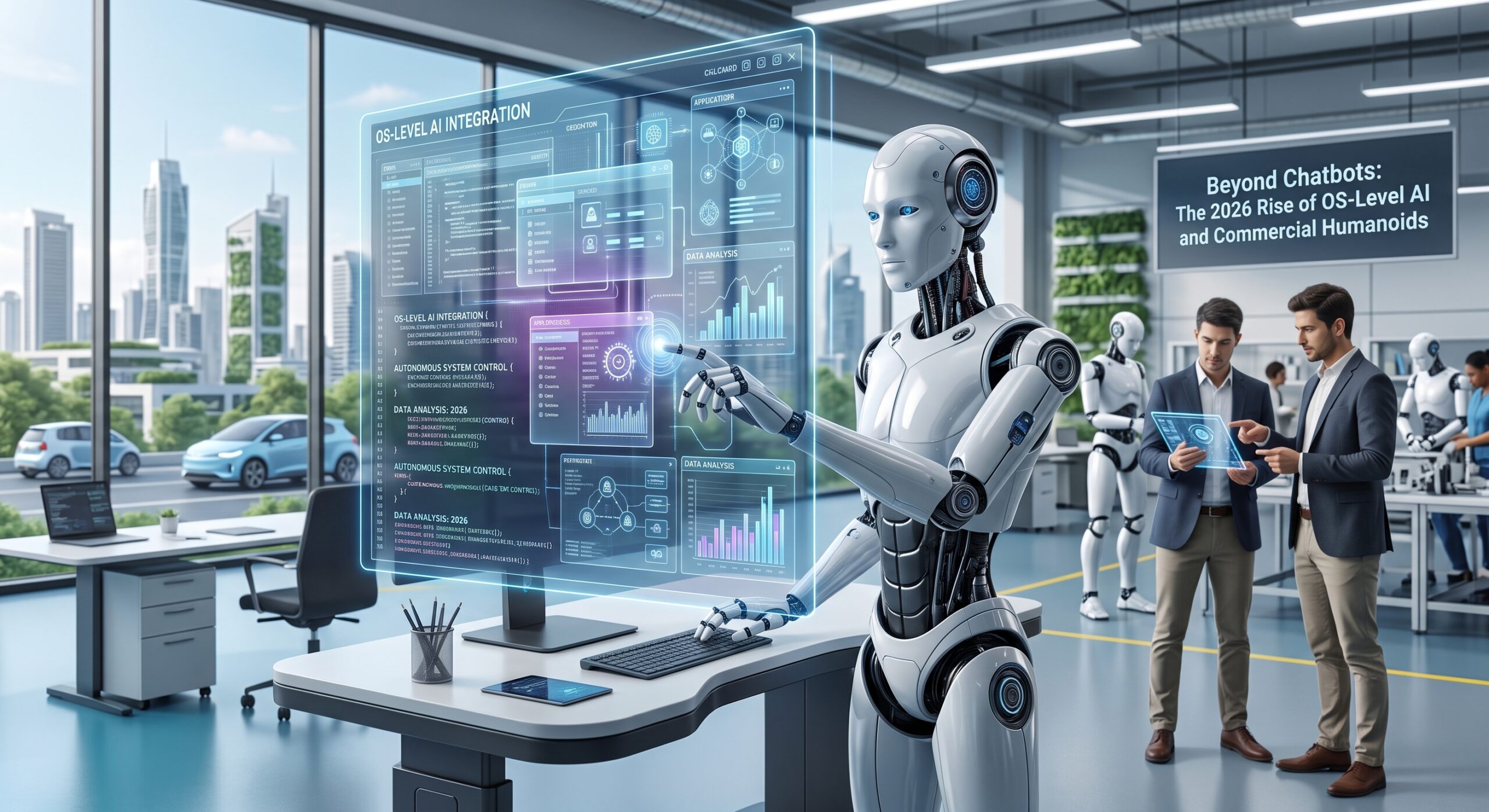
The transition from passive chatbots to active, autonomous systems has officially arrived. Mapping the trajectory of future technological eras and advanced automation has been the core focus of our ongoing NexoSoph project, and the data from the latter half of 2026 proves this shift is accelerating rapidly. Artificial intelligence is no longer just generating text; it is seizing the mouse, navigating operating systems, and taking physical form on factory floors.
Here is a deep dive into the dual fronts of the new automation economy.
The Digital Workforce: OS-Level Computer Use Agents
Traditional automation relied on fragile, deterministic scripts and APIs. In contrast, today’s “computer-use agents” utilize multimodal reasoning to “see” a screen, understand graphical user interfaces (GUIs), and execute complex, multi-step actions across legacy software exactly as a human would.
- Benchmark Breakthroughs: According to the latest 2026 METR evaluations, frontier AI models can now autonomously complete complex digital workflows that would take a human expert over two hours, maintaining a 50% reliability rate that continues to improve.
- Enterprise Adoption: The shift to an agentic workforce is massive. Recent industry surveys highlight that 96% of enterprise IT leaders plan to expand AI agent usage in the next 12 months, moving toward “digital assembly lines” where specialized agents collaborate across applications.
- The Security Paradigm: Handing over OS-level control introduces severe risks. Modern deployments rely heavily on granular Role-Based Access Control (RBAC) and strict virtual machine sandboxing to ensure these autonomous agents operate under the principle of least privilege, preventing unauthorized system modifications.
The Physical Counterpart: Humanoid Robotics
While digital agents conquer software ecosystems, embodied AI is navigating the physical world. The humanoid robotics sector has crossed the threshold from university laboratories into early commercial manufacturing.
- Production Surges: Global humanoid robot production leaped tenfold recently, crossing 20,000 units globally in 2025. Hardware developers (predominantly led by Chinese manufacturers like Unitree and Agibot, who account for over 90% of the supply) are scaling rapidly.
- Long-Term Forecasts: Market analysts at Berg Insight project that annual shipments of humanoid robots will skyrocket to 26 million units by 2040, integrating heavily with 5G/6G cellular networks for real-time fleet management and cloud-based AI processing.
- The ROI Reality: Despite the massive production spike, true commercial deployment remains in the proof-of-concept pilot phase. Industries are currently working through technical bottlenecks—including battery endurance, spatial training data scarcity, and complex human-machine safety regulations—before widespread workforce replacement becomes economically viable.
The convergence of OS-level digital agents and embodied humanoid robots represents the most significant technological transformation of the decade. Mastering the skills to manage, direct, and collaborate with these autonomous systems is no longer optional—it is the baseline for the future.
Leave a Reply