
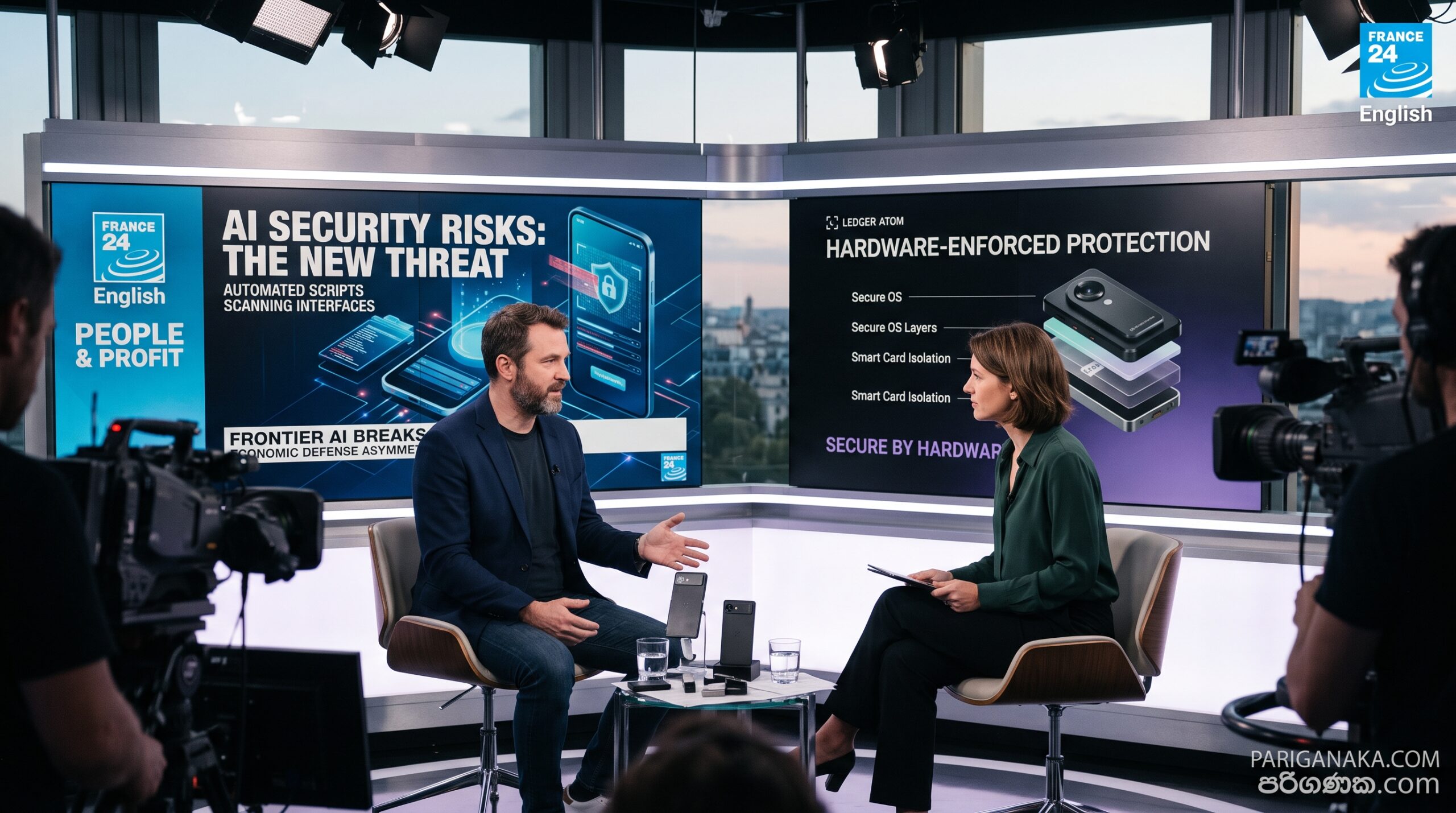
In an exclusive interview on France 24 English, Charles Guillemet, Chief Technology Officer at French cryptocurrency security unicorn Ledger (valued at over $1 billion and securing roughly 20% of the world’s multi-trillion-dollar crypto market), issued a stark warning to global enterprises and governments: Frontier AI models have fundamentally shattered the economic equation of cybersecurity.
As AI algorithms drastically lower the cost of discovering zero-day software vulnerabilities and generating automated exploits, traditional software-based security on standard smartphones and servers is becoming rapidly obsolete.
The Economic Breakdown: How AI Shattered Cyber Defense Asymmetry
Historically, cybersecurity relied on an economic cost asymmetry: an attack was considered ineffective if discovering a vulnerability and developing an exploit cost significantly more than the potential financial gain.
According to Guillemet, the emergence of advanced frontier AI models has inverted this balance:
- Near-Zero Marginal Cost Attacks: Modern frontier AI models can scan complex codebases, uncover latent vulnerabilities, and generate functional exploit scripts for cents rather than millions of dollars.
- Remote Smartphone Vulnerability: Standard consumer smartphones—built on traditional System-on-Chip (SoC) architectures—lack secure hardware-level user interfaces, making them increasingly trivial to breach remotely via automated AI attack vectors.
- The Hardware Imperative: Because software-only defenses are vulnerable to cheap, scalable AI attacks, high-value digital asset protection must migrate to hardware-enforced isolation.
“Ledger Atom”: Engineering an AI-Resistant Smartphone Architecture
To address the vulnerability of standard mobile operating systems without compromising user experience, Ledger is introducing “Ledger Atom”—a next-generation hardware platform that bridges Android usability with military-grade smart card security.
| Security Layer | Standard Consumer Smartphone | Ledger Atom Architecture |
| Operating System | Standard Android / iOS | Android paired with Ledger’s proprietary Secure OS |
| Key Generation & Storage | Software keychains / basic enclaves | Isolated smart card chip (banking/passport standard) |
| Display Integrity | Untrusted UI (vulnerable to screen-scraping malware) | Dedicated hardware chip taking over screen for trusted transaction signing |
| AI Breach Resilience | High risk of remote software compromise | Isolated hardware boundary preventing remote key extraction |
Supply Chain Security and Physical Tamper Detection
Addressing past supply chain attacks—such as a criminal syndicate physically intercepting hardware devices through a compromised distributor to install rogue hardware implants—Guillemet detailed Ledger’s next-generation physical defense mechanisms:
- Silicon-Level Tamper Detection: Integrating active hardware sensors inside the device silicon to detect physical modifications, micro-probing, or circuit alterations.
- Hardened Supply Chain Verification: Implementing cryptographically verifiable distribution channels from the manufacturing factory to the end user.
Wall Street and the Migration to On-Chain Financial Infrastructure
Beyond securing individual crypto assets, Guillemet highlighted that traditional global finance is aggressively transitioning toward blockchain-based settlement architectures:
- Instant Cross-Border Settlement: Utilizing stablecoins to execute multi-million dollar international transfers (e.g., France to Mexico) in under two seconds for less than $1 in fees—a stark contrast to days-long legacy fiat clearing systems.
- Wall Street’s On-Chain Pivot: Institutional finance recognizes that decade-old legacy banking databases are far less efficient than decentralized, cryptographic ledgers, driving the rapid tokenization of real-world financial assets.
Europe’s Edge in Hardware Security Talent
While Silicon Valley dominates venture capital, Guillemet emphasized that France and Europe possess a distinct competitive advantage in specialized hardware and cybersecurity engineering. By pairing world-class European security engineers with hardware-enforced cryptography, Ledger aims to set the global standard for AI-resilient digital asset security.
Source: French crypto unicorn Ledger warns of AI security risks • FRANCE 24 English
Leave a Reply