
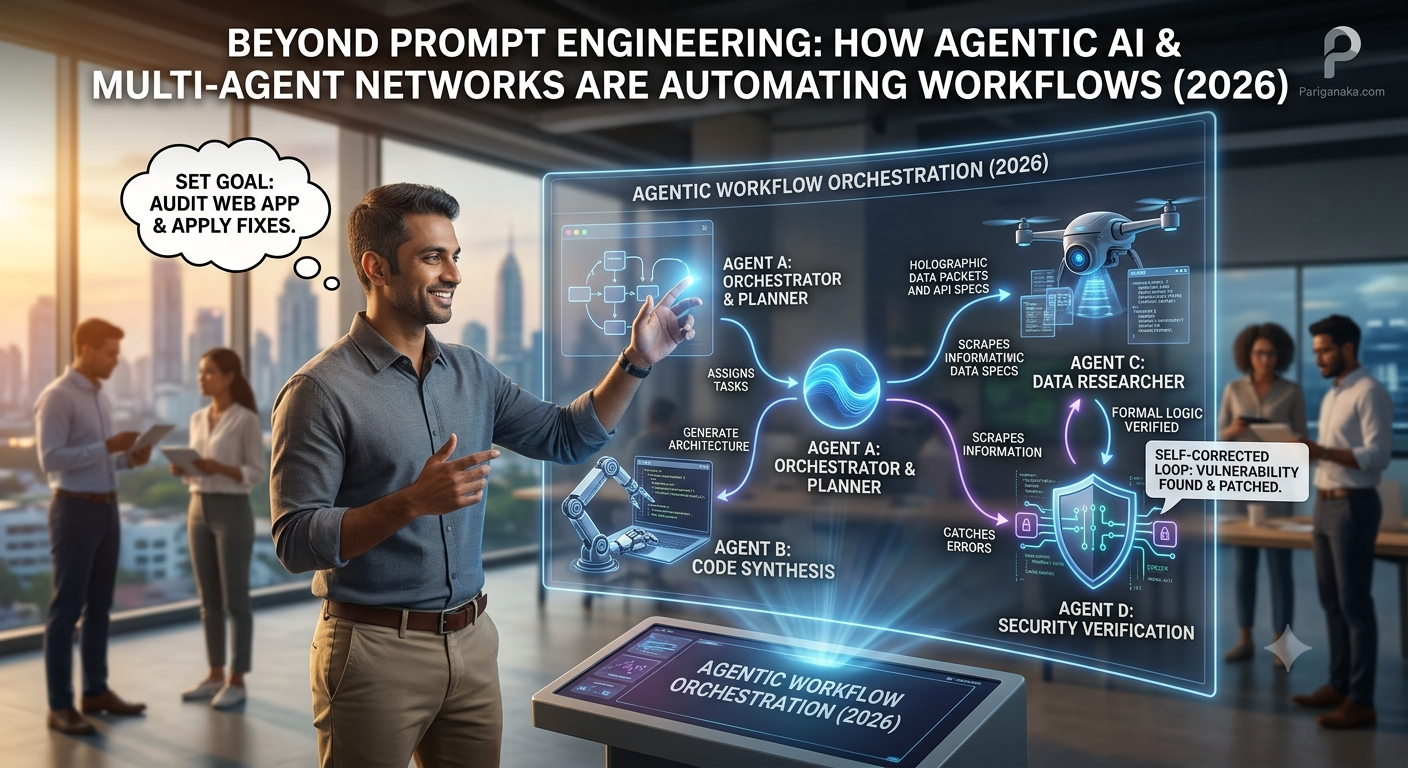
From 2023 through 2025, the world was obsessed with prompt engineering. We spent countless hours learning how to frame queries, optimize context windows, and nudge chatbots into generating the right text. However, as we navigate through 2026, the era of human-driven chatbot prompting is quietly giving way to a far more transformative paradigm: Agentic AI.
Instead of waiting for step-by-step human prompts, agentic systems take a high-level goal, break it down into autonomous sub-tasks, select their own tools, collaborate with other specialized AI agents, and execute end-to-end workflows with minimal human oversight.
What makes an AI “Agentic”?
A standard Large Language Model (LLM) is essentially reactive: you ask a question, and it calculates the most plausible response.
An Agentic AI, by contrast, is proactive and goal-oriented. It operates in a continuous loop governed by four core capabilities:
- Planning & Task Decomposition: When given a complex goal (e.g., “Audit our web application for security vulnerabilities and prepare a fix”), the agent decomposes it into an ordered task tree.
- Tool Utilization: It interacts with external environments—calling APIs, executing terminal commands, querying databases, or browsing live web documentation.
- Memory & Context Persistence: It maintains both short-term working memory and long-term episodic memory, learning from errors made during previous attempts.
- Self-Reflection & Correction: If an attempted solution fails or returns an error, the agent evaluates the output, adjusts its strategy, and tries an alternative route autonomously.
The 2026 Shift: We are moving from asking AI “How do I do this?” to instructing AI “Achieve this outcome and notify me when it’s verified.”
The Rise of Multi-Agent Orchestration
While single agents can handle localized tasks, real-world enterprise applications demand Multi-Agent Systems (MAS). Rather than building one massive, monolithic AI trying to handle every task, modern architecture deploys teams of hyper-specialized micro-agents that collaborate like a digital workforce.
Example: An Autonomous Software Release Pipeline
[ User Goal ]
     │
     ▼
┌─────────────────────────┐
│  Orchestrator Agent     │ ──► Assigns tasks & tracks progress
└────────────┬────────────┘
             │
     ┌───────┴───────┬───────────────────┐
     ▼               ▼                   ▼
┌──────────┐   ┌───────────┐   ┌───────────────────┐
│ Data     │   │ Code      │   │ Security Audit    │
│ Parser   │   │ Synthesis │   │ & Verification    │
│ Agent    │   │ Agent     │   │ Agent             │
└──────────┘   └───────────┘   └───────────────────┘
- The Orchestrator Agent: Receives the user’s intent, creates the roadmap, and assigns specialized jobs.
- The Researcher Agent: Scrapes system logs, API specs, and technical documentation.
- The Coder Agent: Writes the functional code architecture based on the specifications.
- The Security & Verification Agent: Runs formal logic checks, scans for vulnerabilities, and attempts to break the code before approving deployment.
Chatbots vs. Agentic Networks in 2026
| Feature | Generative Chatbots (Passive) | Agentic AI Networks (Autonomous) |
| User Role | Constantly typing prompts & copy-pasting code. | Setting goals, defining security boundaries, reviewing final output. |
| Execution | Generates text/code for human implementation. | Executes terminal commands, calls APIs, and deploys fixes. |
| Error Handling | Stops when code fails; relies on user feedback. | Self-corrects through iterative reflection loops. |
| Complexity | Best for single-turn, conversational queries. | Handles multi-step, asynchronous business workflows. |
Overcoming the Control & Safety Challenge
Granting AI systems agency to run commands and execute real-world tasks introduces unique challenges—primarily around security, deterministic behavior, and loop runaway.
In 2026, engineers solve this using Human-in-the-Loop (HITL) Guardrails and Neuro-Symbolic verification layers. High-stakes actions (such as pushing code to production, making financial transfers, or modifying server routing) require symbolic rule-based validation and explicit human authorization before execution.
What This Means for Tech Professionals
For developers, system admins, and tech students in the Pariganaka community, the agentic revolution changes how we build digital products:
- Prompting is Out, Orchestration is In: The most valuable skill is no longer crafting clever prompts, but designing clear agent architectures, state graphs, and API boundaries.
- Focus on System Boundaries: Engineers must define strict guardrails, memory structures, and error-handling policies to keep autonomous networks operating safely.
- Exponential Productivity: Small teams or single developers can now manage infrastructure and software products that previously required entire engineering departments.
The future of technology isn’t about AI replacing humans—it’s about humans directing teams of autonomous digital agents to build systems at unprecedented speed.
Leave a Reply