
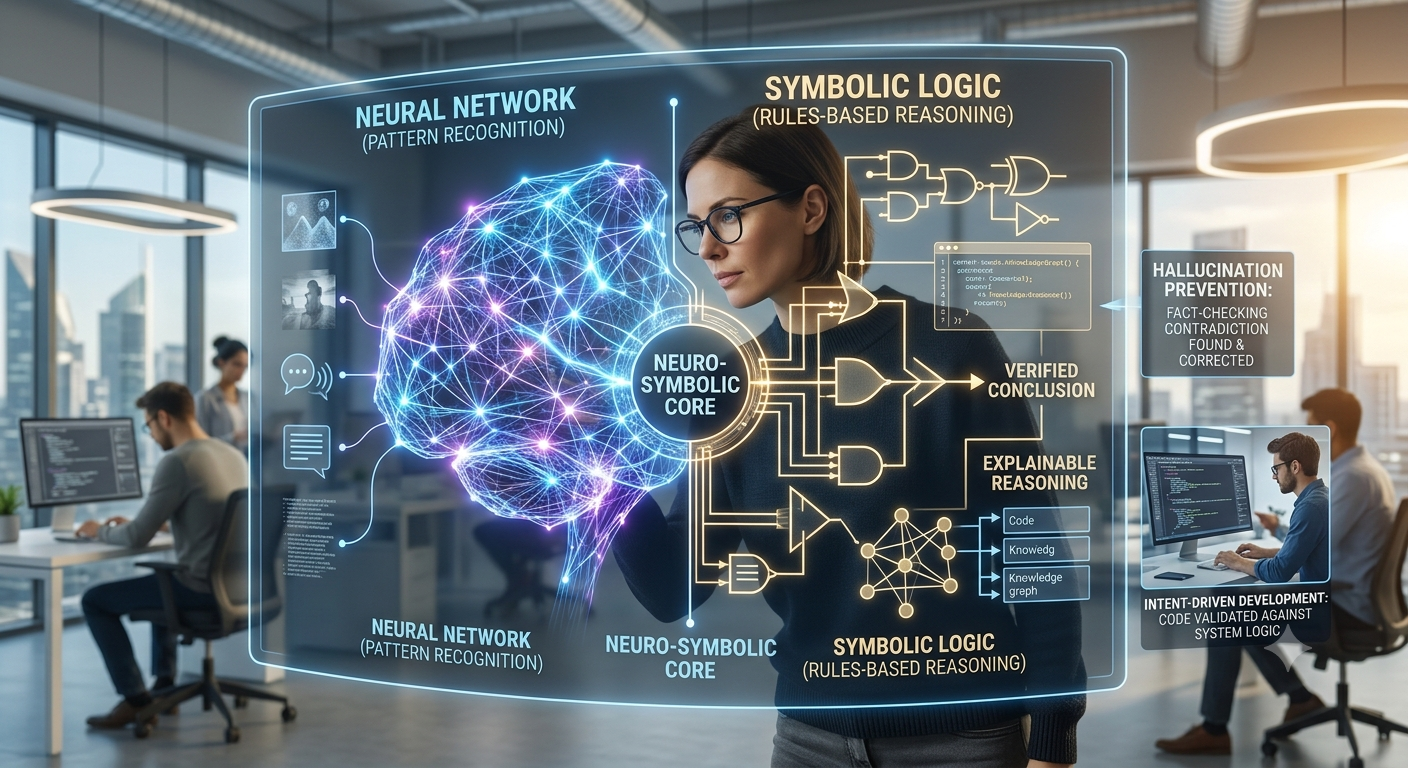
The rapid evolution of artificial intelligence has brought incredible breakthroughs, but it has also highlighted a fundamental paradox. Today’s massive deep learning models and Large Language Models (LLMs) are exceptionally good at pattern recognition, creative writing, and human-like conversation. However, they frequently stumble when faced with strict mathematical logic, deterministic rules, and the tendency to “hallucinate” incorrect data.
As we move through 2026, the tech industry is actively solving this limitation by pivoting toward a powerful hybrid paradigm: Neuro-Symbolic AI. For developers, tech professionals, and readers tracking the bleeding edge on Pariganaka.com, this architectural shift represents the leap from AI that merely “guesses” the next word to AI that genuinely reasons.
The Dual Approach: Combining Intuition with Logic
To understand Neuro-Symbolic AI, it helps to think of it as combining the two halves of a human brain: one side driven by intuition and perception, and the other by strict logic and structured knowledge.
- The Neural Component (Data-Driven Learning): This utilizes standard deep learning neural networks. It excels at processing unstructured data like recognizing faces in photos, parsing natural language queries, or spotting trends across billions of data points. It operates on statistical probabilities.
- The Symbolic Component (Rules-Based Logic): This relies on classical computer science principles—logic trees, knowledge graphs, and explicit “if-then” rules. It doesn’t guess; it knows that $A + B = C$ because the rule is mathematically hardcoded into its knowledge base.
By fusing these two approaches, Neuro-Symbolic systems use neural networks to understand the messy, real-world context of a user’s prompt, and then hand that understanding over to a symbolic engine to execute tasks with absolute, verifiable accuracy.
Why 2026 Demands Neuro-Symbolic Architecture
The reliance on pure deep learning has hit a wall in critical enterprise environments. Neuro-symbolic systems are stepping in to fix three massive pain points:
1. Eliminating Hallucinations
In creative writing, a minor hallucination is harmless. In medical diagnostics, legal tech, or financial auditing, it is catastrophic. A Neuro-Symbolic AI uses its symbolic layer as a “fact-checker” or guardrail. If the neural network generates a factually incorrect claim or an impossible mathematical result, the symbolic logic engine catches the contradiction against a verified database and corrects it before the user ever sees it.
2. Radical Explainability (The “Why” Factor)
Deep learning models are notoriously complex “black boxes”—even their creators cannot always explain exactly why a model reached a specific conclusion. This lacks the transparency required by modern regulatory frameworks. Neuro-Symbolic AI provides a clear, step-by-step audit trail. Because the symbolic layer maps out its decisions using explicit logic gates, it can explain its reasoning in plain English or code.
3. Intent-Driven Development and Verified Coding
For developers, this technology is revolutionizing how code is written. Instead of just asking an AI assistant to generate a script and hoping it works, Neuro-Symbolic tools power Intent-Driven Development. You declare your high-level intent, the neural network drafts the code architecture, and the symbolic engine runs a formal mathematical verification to prove the code is secure, bug-free, and compliant with system logic before deployment.
Real-World Applications Transforming the Market
We are seeing this hybrid tech quietly take over high-stakes industries this year:
- Autonomous IT Infrastructure: Managing complex server networks, DNS routing, and Cloudflare security rules requires zero margin for error. Neuro-symbolic agents can look at fluctuating traffic patterns (neural) and apply strict cybersecurity protocols (symbolic) to self-heal networks in real time.
- Next-Gen EdTech & Tutoring: Automated tutoring systems are evolving. Instead of just reciting text, they use symbolic knowledge graphs to map out a student’s exact curriculum, systematically identifying and addressing foundational knowledge gaps with mathematically precise accuracy.
- Smart Automation Pipelines: Processing legal contracts or enterprise workflows where rules are rigid but the incoming documents are formatted differently every time.
What This Means for the Pariganaka Community
The era of assuming AI is just a trend built on unpredictable chatbots is officially over. The industry is demanding reliability, predictability, and verifiability.
As a tech professional or student in 2026, keeping your skills aligned with Neuro-Symbolic systems and structured data frameworks (like knowledge graphs and ontologies) will give you a significant competitive edge. The future belongs to systems that can both learn from the world and think within the rules.
Leave a Reply