
For the past decade, buying a new smartphone usually meant checking two things: how good is the camera, and how fast is the processor. But as we navigate through the second half of 2026, the era of minor “spec bumps” is officially over.
Smartphones have crossed a performance threshold where simply having a faster chip no longer wows the consumer. Instead, the industry is pivoting toward entirely new form factors, radical off-grid connectivity, and intelligent software that lives directly in your pocket.
Here are the four massive trends shaping the global and Sri Lankan smartphone market this year.
🧠 1. On-Device AI: The End of Cloud Dependency
Until recently, whenever you asked your phone’s AI a complex question or used a generative photo editor, your data was sent to a server in the cloud to be processed. In 2026, that is changing completely.
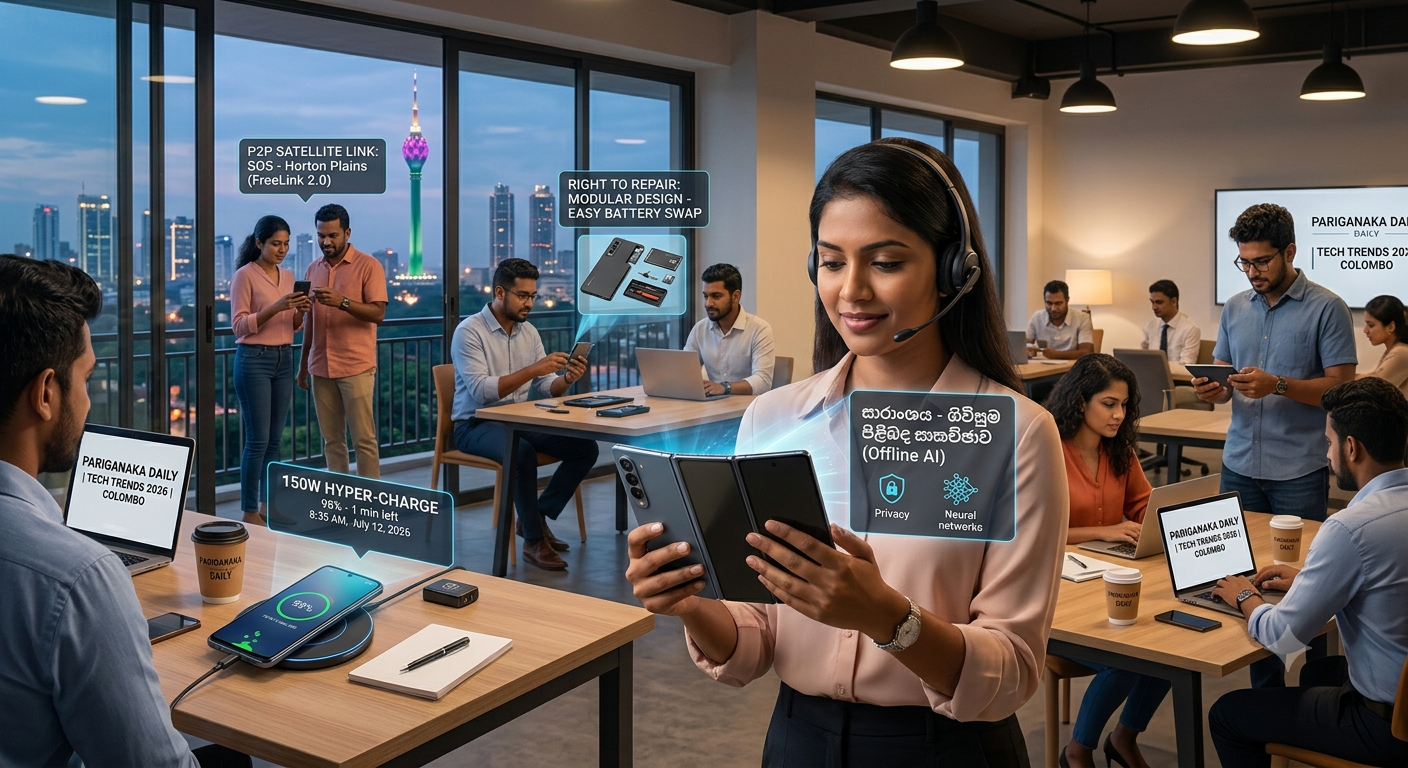
- Offline Intelligence: Powered by next-generation chips like Qualcomm’s Snapdragon 8 Elite and Apple’s A19 Pro, sophisticated AI models (like Google’s Gemini Nano) are now running locally on the device.
- What it means for you: This translates to zero latency and massive privacy improvements. Your phone can now summarize local Sinhala or Tamil voice recordings in real-time, instantly rewrite your emails, and generate complex images without needing an active Wi-Fi or 5G connection.
🔋 2. “Mega Batteries” and 10-Minute Charging
As phones take on heavy AI processing tasks, battery anxiety has become a major pain point. Manufacturers are combating this with aggressive hardware innovations.
- 150W+ Hyper-Charging: Waiting an hour for your phone to charge is becoming a thing of the past. Mid-range and flagship devices are now normalizing 150W+ wired charging, capable of taking a phone from 0% to 100% in under 10 minutes.
- High-Density Power: Devices like the newly released TECNO Spark 50 are proving that massive 7000mAh batteries can now fit into slim profiles. More importantly, battery degradation algorithms have improved, ensuring these cells maintain 80% of their health even after five years of heavy use.
📡 3. Off-Grid and P2P Satellite Connectivity
Dropping out of coverage zones when traveling outside of Colombo or hiking in the central highlands is becoming less of a barrier thanks to new direct-to-device communication protocols.
- Beyond Cellular Towers: Premium and even upper-mid-range phones in 2026 are increasingly integrating satellite SOS and two-way messaging capabilities.
- Peer-to-Peer (P2P) Tech: Brands are introducing technologies like “FreeLink 2.0,” which allows phones to communicate directly with one another over Bluetooth/radio waves up to 1.5 kilometers away, entirely bypassing the need for a local carrier network.
🪛 4. The Foldable “New Normal” and the Right to Repair
Foldable phones are no longer delicate, expensive experiments. In 2026, they have matured into mainstream, daily-driver devices.
- Zero Crease, High Durability: The latest generation of foldables has practically eliminated the visible screen crease, fortified their hinges against dust (IP64 to IP68 ratings), and driven down manufacturing costs to make them accessible to the average consumer.
- The Repair Revolution: Driven by global “Right to Repair” legislation, major phone brands are finally abandoning the trend of glued-together glass slabs. 2026 smartphones are being built with modularity in mind, allowing independent repair shops in Sri Lanka to easily and legally swap out dying batteries and cracked screens without software lockouts.
The Pariganaka Takeaway:
If you are upgrading your phone in 2026, you are not just buying a communication device; you are buying a highly secure, offline AI hub. With foldables becoming the standard, batteries charging in minutes, and off-grid communication keeping us connected anywhere, the smartphone is evolving from a mere tool into an autonomous digital assistant.
Leave a Reply