
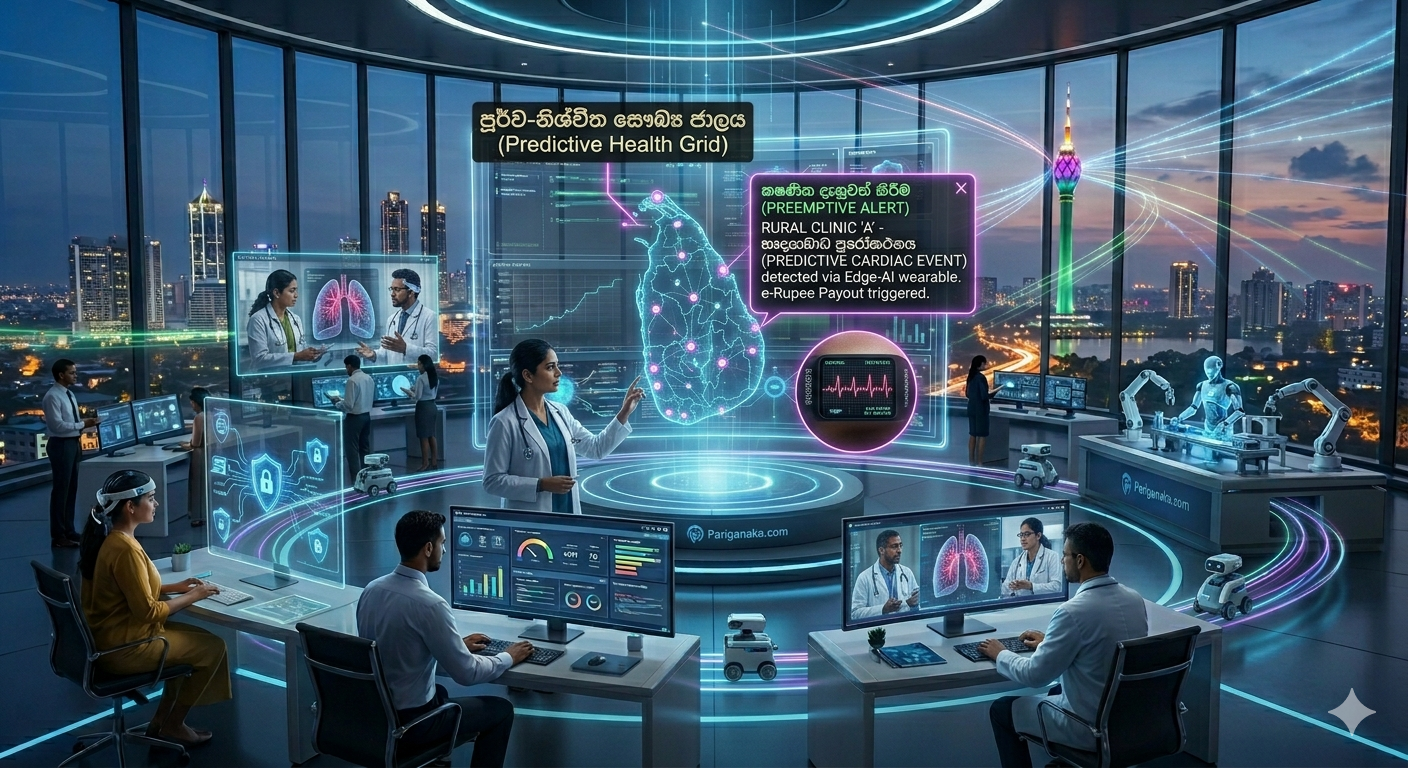
For decades, the Sri Lankan healthcare experience was defined by a reactive model: waiting until symptoms became unbearable, traveling to a crowded Outpatient Department (OPD), and waiting hours for a diagnosis. By 2026, that paradigm has fundamentally shifted.
Driven by the integration of Edge-AI, continuous biometric monitoring, and a decentralized national health grid, Sri Lanka is moving from treating illnesses to predicting them. Healthcare is no longer a place you visit; it is an invisible, continuous layer of protection.
Here is a deep dive into the technologies transforming the medical landscape across the island.
1. The Rise of Predictive Wearables
The transition from basic fitness trackers to clinical-grade diagnostic wearables has changed the front lines of medicine. Today, millions of Sri Lankans wear non-invasive biometric patches and advanced smartwatches that act as personal, 24/7 physicians.
- Edge-AI Processing: Unlike older devices that required a constant internet connection to process data in the cloud, 2026 wearables utilize Edge-AI. The artificial intelligence processes complex biometric data—such as micro-fluctuations in heart rhythm or sweat-based glucose levels—directly on the device.
- Preemptive Alerts: These devices do not just record data; they predict outcomes. By analyzing vital signs against localized medical algorithms, a wearable can predict acute cardiovascular events or severe asthmatic drops up to six hours before physical symptoms manifest, automatically alerting emergency services and the wearer’s registered next-of-kin.
2. Decentralized Diagnostics and Agentic AI
The gap between urban specialists in Colombo and rural clinics is closing rapidly, thanks to autonomous medical systems.
- Automated Diagnostic Pods: Rural hospitals are now equipped with AI-driven diagnostic pods. When a patient presents complex symptoms, Agentic AI systems autonomously analyze blood panels, X-rays, and MRI scans in seconds.
- Human-AI Collaboration: The AI handles the heavy lifting of data analysis and pattern recognition, cross-referencing millions of medical journals. It then presents a prioritized list of potential diagnoses to the human doctor. Specialists in Colombo only need to be looped in via high-fidelity, low-latency holographic feeds for the most critical or unprecedented cases.
3. The Trilingual Medical Grid
One of the most significant barriers in Sri Lankan healthcare has always been communication. Complex medical terminology often gets lost in translation between Sinhala, Tamil, and English.
- Real-Time Medical Translation: Utilizing the same Spatial Computing and AR glasses adopted by the tech sector, doctors now rely on instantaneous, context-aware medical translation. An Agentic AI listens to the consultation and provides precise, culturally nuanced translations in real-time, ensuring that a patient in Jaffna fully understands a diagnosis given by a specialist in Galle.
- e-Rupee Integration for Micro-Insurance: Paying for healthcare has also been streamlined. Smart Contracts on the national e-Rupee grid instantly process health insurance claims at the point of care, eliminating the tedious paperwork and out-of-pocket delays that previously burdened patients.
Pariganaka’s Take: True medical advancement is not just about discovering new drugs; it is about accessibility and foresight. By embedding AI into the very fabric of our daily lives and decentralizing diagnostic power, Sri Lanka is democratizing health. In 2026, technology ensures that every citizen, regardless of their geography or language, receives world-class, proactive medical care.
Leave a Reply