
For over 15 years, the team here at Pariganaka.com has guided Sri Lankans through rapidly shifting digital landscapes. We have seen cybersecurity evolve from simple antivirus software blocking basic malware to complex systems defending against sophisticated ransomware. However, as generative AI becomes deeply embedded in our daily workflows, a new, highly autonomous threat has emerged on the horizon: the AI Worm.
At the Maha Gedara, our mission is to champion human-friendly tech—and part of that means understanding the threats that compromise our digital peace of mind. Here is what you need to know about this new era of cybersecurity and how we can adapt.
What Exactly is an AI Worm?
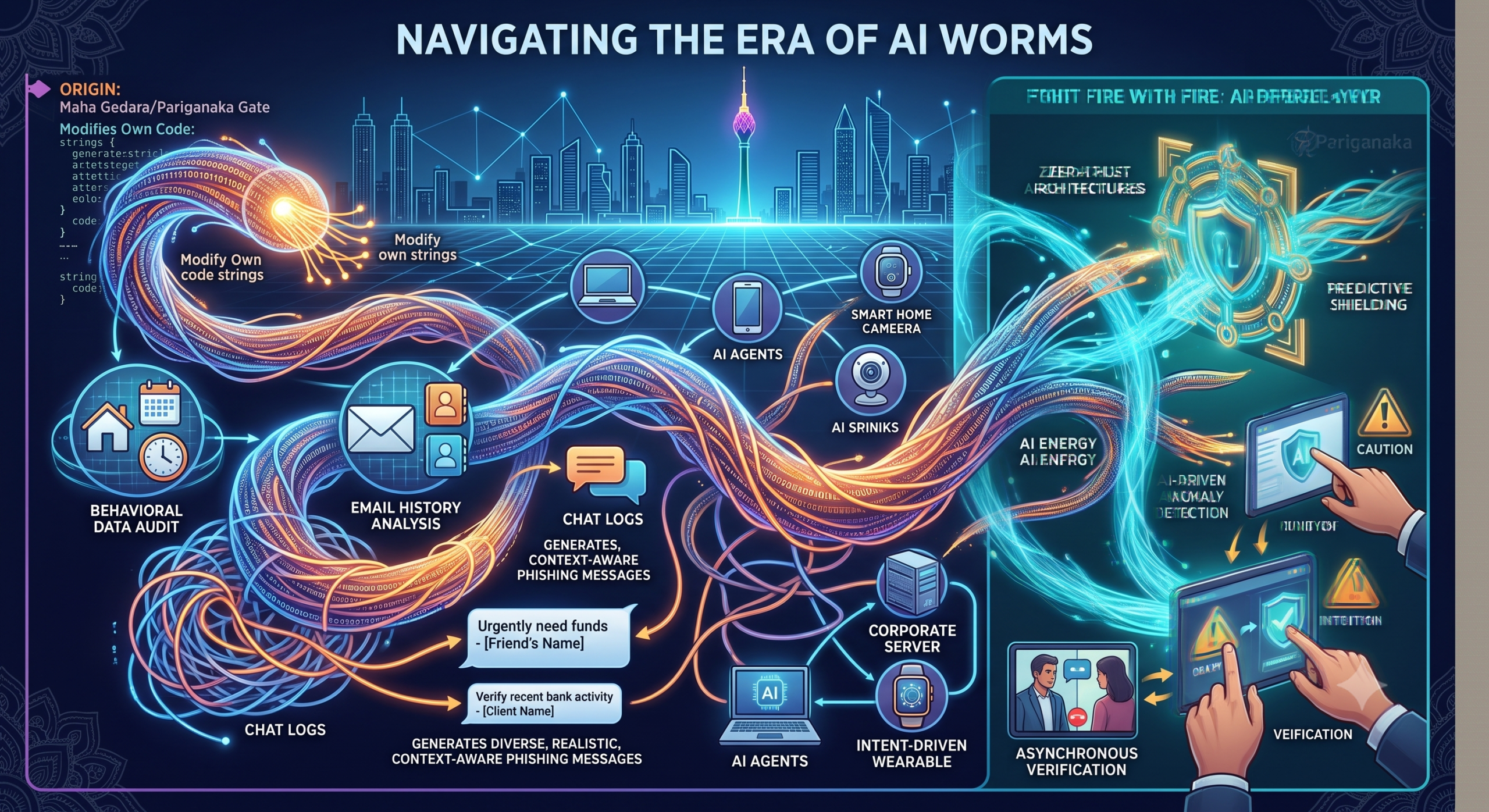
Traditional malware requires a human hacker to write specific code to exploit a known vulnerability. An “AI Worm” operates differently. It is a malicious program embedded with its own lightweight Large Language Model (LLM) or connected to a corrupted AI agent.
Instead of following a rigid set of instructions, an AI worm can “think” and adapt on the fly. It can:
- Rewrite its own code to evade standard firewall detection.
- Analyze a victim’s email history in seconds to generate highly personalized, context-aware phishing messages to their contacts.
- Jump between interconnected AI agents, moving from a compromised smart home assistant into an enterprise workflow without any human interaction.
The Threat to the Modern Smart Home
While enterprise networks are the primary targets, the everyday consumer is not immune. As Sri Lankan households increasingly adopt interconnected devices—from edge-computing smart cameras to automated lighting and intent-driven wearables—the “attack surface” expands.
If an AI worm infiltrates a localized home network, it doesn’t just steal a password; it observes behavioral data. It learns what time you leave for work, who you communicate with most, and which financial apps you use, utilizing that data to execute highly targeted financial fraud.
Fighting Fire with Fire: The AI Defense Layer
The good news? The cybersecurity industry is not sitting idle. The only effective defense against an autonomous AI threat is an equally autonomous AI defense system.
- Predictive Shielding: Modern cybersecurity platforms are shifting from reactive (waiting for a virus to strike) to predictive (using AI to hunt for anomalies in network behavior before a breach occurs).
- Zero-Trust Architectures: The “Zero-Trust” model is becoming standard across Sri Lankan IT sectors. This means no device—even the CEO’s laptop or the office smart thermostat—is trusted by default. Every single digital request must be continuously authenticated.
The Human-Friendly Defense Strategy
Technology alone cannot secure our digital lives. Human intuition remains the ultimate firewall.
- Embrace Asynchronous Verification: If a colleague or family member sends an urgent request for data or funds via an AI-generated voice note or email, switch channels. Call them on a verified phone number to confirm.
- Audit AI Permissions: Treat your personal AI assistants like employees. Regularly review what data they have access to. If your AI scheduling app doesn’t need access to your banking app, revoke that permission immediately.
- Stay Educated, Not Fearful: Awareness is your best defense. Understanding that these tools exist removes the panic and replaces it with practical caution.
The integration of AI into our lives brings incredible convenience, but it demands a higher standard of digital hygiene. By combining advanced AI defense systems with grounded, human-centric skepticism, we can navigate this new era securely.
Leave a Reply