
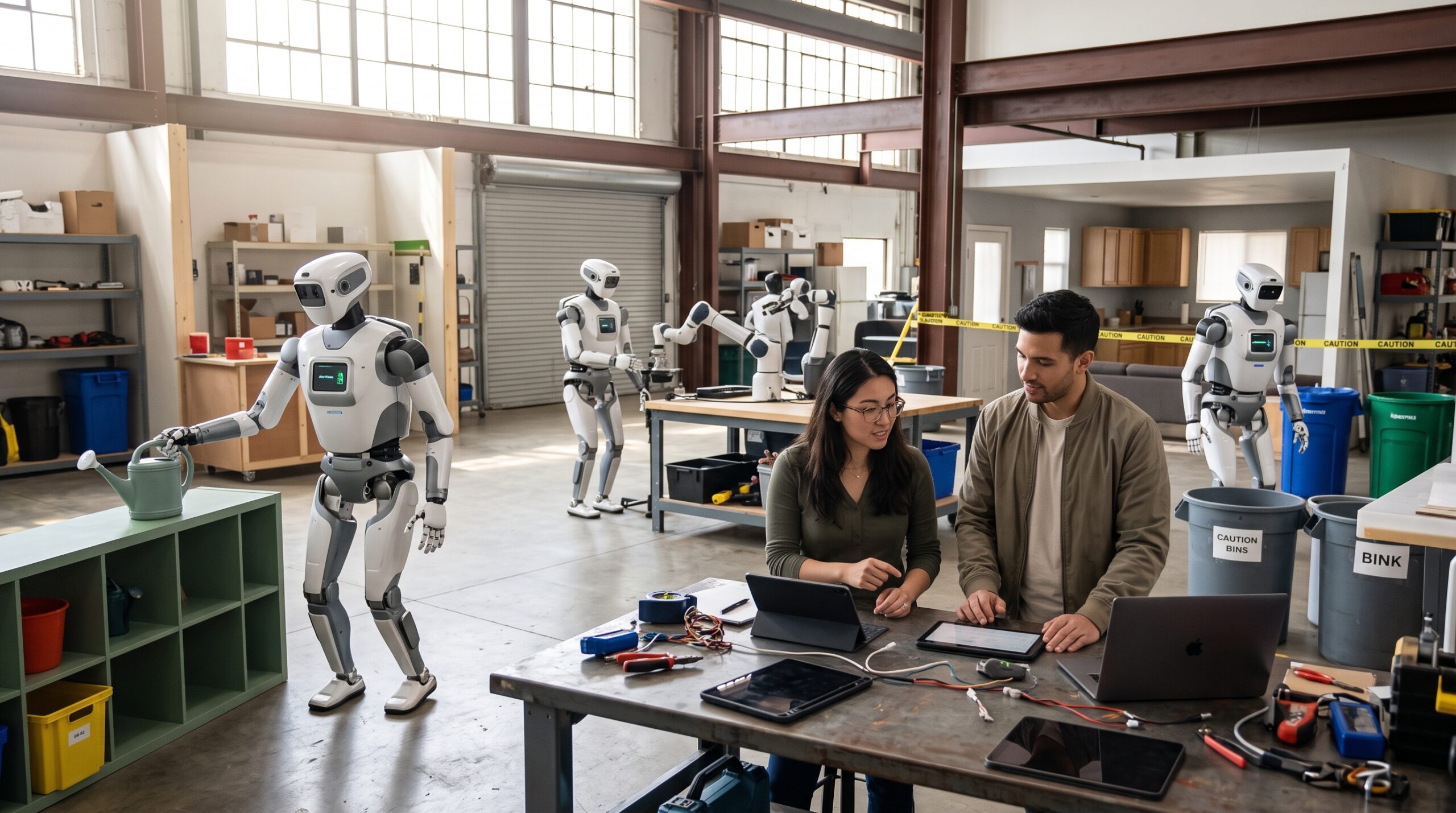
For most of its history, Artificial Intelligence has lived behind glass. It could see for us, write for us, and solve complex problems digitally, but it couldn’t physically reach out and act upon the world.
Google is now trying to close that gap. By combining advanced language and reasoning models with physical machines, the goal is to create “Embodied Intelligence”—AI that understands the physical world by operating inside it.
The Physics Problem: Why Embodied AI is So Hard
Language models can reason about picking up a coffee cup without ever touching one. But ask a robot to perform that same simple action, and the task becomes a chain of complicated physics problems.
The robot must estimate distance, approach from the correct angle, determine grip strength, and compensate for the ceramic’s weight as it lifts. The physical world is filled with variables that change constantly: an uneven table, an unexpectedly full cup, or a person walking by. While humans have nervous systems that constantly feed us physical data so we can adjust our muscles instinctively, a robot must calculate all of this on the fly.
The Brains: Gemini Robotics 2 Architecture
To bridge this gap, Google has developed a multi-layered intelligence stack designed to translate high-level reasoning into physical motion:
- Gemini Robotics ER2 (The Reasoning Layer): This higher-level system interprets the environment, breaks a larger task down into manageable steps, tracks progress, and adjusts the plan when reality doesn’t behave as expected.
- Gemini Robotics 2 (The Action Model): The core model takes visual information and language instructions, translating them into the specific movements required to perform a task.
- Gemini Robotics On-Device 2: This model runs directly on the robot. Physical machines cannot always afford the latency of waiting for a remote server’s response. Operating locally allows the robot to react to shifting weights or sudden obstacles in real-time.
The Body: Meeting Apptronik’s Apollo 2
Intelligence is only useful if it has a capable body. That’s why Google is working closely with platforms like the Apptronik Apollo 2, a full bipedal humanoid robot.
Because human environments (stairs, shelves, doors) are built for human proportions, a humanoid structure is incredibly versatile. However, coordinating a whole body is vastly more complex than programming a single robotic arm in a factory. Walking changes the robot’s center of mass, and every object it picks up alters its balance.
The Dexterity Gap
While walking is hard, hands are the ultimate test of physical intelligence. Current benchmarks reported by Google show there is still a long way to go to reach human-level consistency:
| Task | Success Rate |
| Unscrewing a lightbulb | ~92% |
| Tying a knot in a trash bag | ~44% |
| Screwing a bulb back in | ~36% |
| Sweeping debris into a dustpan | ~32% |
These numbers highlight the massive difference between a staged, successful demo and genuine real-world reliability.
The Data Flywheel and Robot Parks
Language models achieved greatness because they trained on the internet, which offers billions of text examples. A robot, however, cannot learn how much force a drawer requires just by reading about it; it needs physical data.
To solve this massive data bottleneck, Apptronik has established “Robot Parks”—training facilities (like one in Austin, Texas) where fleets of Apollo robots operate across different environments. In these parks, deployment is simultaneously data collection. If one robot drops an object, that failure becomes a training example. Because Google’s on-device models are designed to transfer skills across different robot bodies in just a few hours (using fewer than 200 examples), the experience gathered by one machine can eventually improve an entire wider fleet.
Multi-Robot Coordination and Safety
The endgame of this technology isn’t just a 1-to-1 replacement of a human worker; it’s making physical work programmable. With systems like Gemini Robotics ER2, multiple robots can coordinate to divide labor and space, recognizing each other’s physical strengths and stepping in for one another to achieve a shared goal.
But with physical capability comes physical risk. A chatbot making a mistake generates a bad answer; a robot making a mistake can damage equipment or injure someone. To address this, Google is evaluating these systems against the Asimov Agentic Benchmark, which tests if an embodied reasoning system can handle unsafe instructions, recognize tasks it cannot complete safely, and request human intervention. Knowing when not to act is just as crucial as knowing how.
The Path to Physical AGI
Google’s ambition goes far beyond building a useful warehouse assistant. They view Gemini Robotics 2 as a milestone toward “solving AGI in the physical world.” True general intelligence means more than just understanding the world digitally—it requires participating in it, manipulating it, and managing the unpredictable variables of reality.
Leave a Reply