
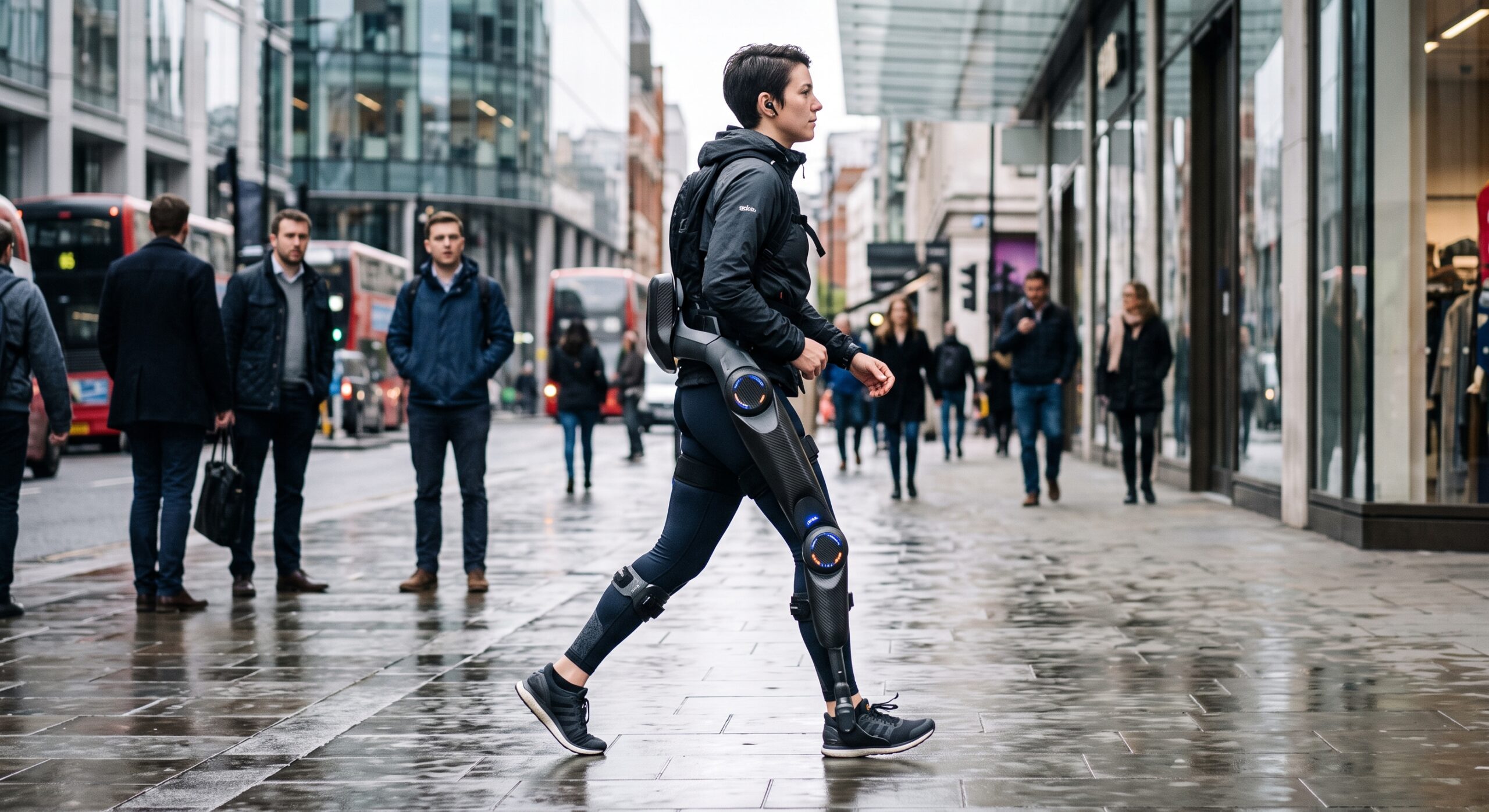
For over 15 years, Pariganaka.com has tracked the evolution of digital information and emerging technologies, watching innovations move from lab prototypes to everyday realities. The latest leap in technology isn’t happening on a screen, but on the streets. In 2025, China shipped approximately 26,000 exoskeleton robots. Surprisingly, over 70% of these were consumer walking assist devices rather than specialized hospital rehabilitation machines. Robotic legs are officially moving beyond clinical settings and into ordinary life.
The Consumerization of Mobility
The traditional approach to lower-limb failure has been to put the user in a wheelchair. While modern powered chairs are remarkably capable and energy-efficient on smooth ground, they still face limitations with stairs, narrow spaces, curbs, and standing-height tasks. Exoskeletons attack these problems by preserving the basic human shape, allowing users to stand upright and navigate spaces designed around legs.
Chinese companies are aggressively pushing this transition. Hangzhou-based RoboCT, for instance, introduced the GoGo system, a powered wearable robot weighing just around 2.3 kg per side, excluding the battery. Rather than simply dragging dead weight forward, the system uses sensors to monitor the walking cycle, and software decides when to add torque at the joint at the exact moment muscle assistance is needed. In a major shift toward consumer accessibility, RoboCT launched its GoGo H model at a Shanghai pharmacy in March 2026, marking a clear move from showing prototypes at robotics conferences to selling health products where ordinary people shop.
Mind-Controlled Movement and Neural Networks
For readers following the rapidly advancing intersections of neural networks and hardware, the most radical advancement is the integration of brain-computer interfaces. In early 2026, a paralyzed patient at Shanghai’s Tongji Hospital participated in an integrated brain-spine-machine rehabilitation case. Wearing a non-invasive EEG device, the patient could trigger a step simply by imagining moving his left foot. The system captured the electrical patterns at the scalp, converted the intention into a command, and the RoboCT exoskeleton physically executed and adjusted the movement.
While this demonstration combined multiple technologies in a supervised medical setting, this powerful idea shifts the control loop from pressing a button to retraining damaged neural connections between the brain and body.
Will Exoskeletons Replace Wheelchairs?
Despite these rapid advancements, wheelchairs are not disappearing tomorrow. Walking is a highly complex biological process, and an exoskeleton has to perfectly coordinate with human muscles; if the timing is wrong, assistance becomes resistance. Many current personal exoskeletons still rely on crutches, walkers, or external support, and a wheelchair remains a much faster, lower-energy solution for covering long distances like navigating a shopping mall.
Furthermore, wheelchair users are a diverse group with varying needs—from spinal cord injuries to balance disorders or fatigue conditions. For many, the realistic near-term future is not replacement, but choice. A user might rely on a wheelchair for long distances while using a lightweight exoskeleton for stairs or specific standing tasks.
The Road Ahead
The industry is proving that by transitioning exoskeletons into consumer products, manufacturers can scale production, improve components faster, and spread development costs across a larger market. Just as drones became cheaper through mass production of cameras, sensors, and brushless motors, the cross-pollination of hardware could make medical walking systems far more affordable.
The ultimate test for these wearable robots is not performing a spectacular first step. When a robotic leg becomes reliable enough to wear every morning, affordable enough to own, and useful enough that nobody thinks of it as a robot anymore, the true mobility revolution will have arrived.
Leave a Reply