
Welcome back to Pariganaka.com! We frequently hear comparisons between the rise of Artificial Intelligence and past technological leaps like the internet or the personal computer. But what if this comparison is entirely flawed?
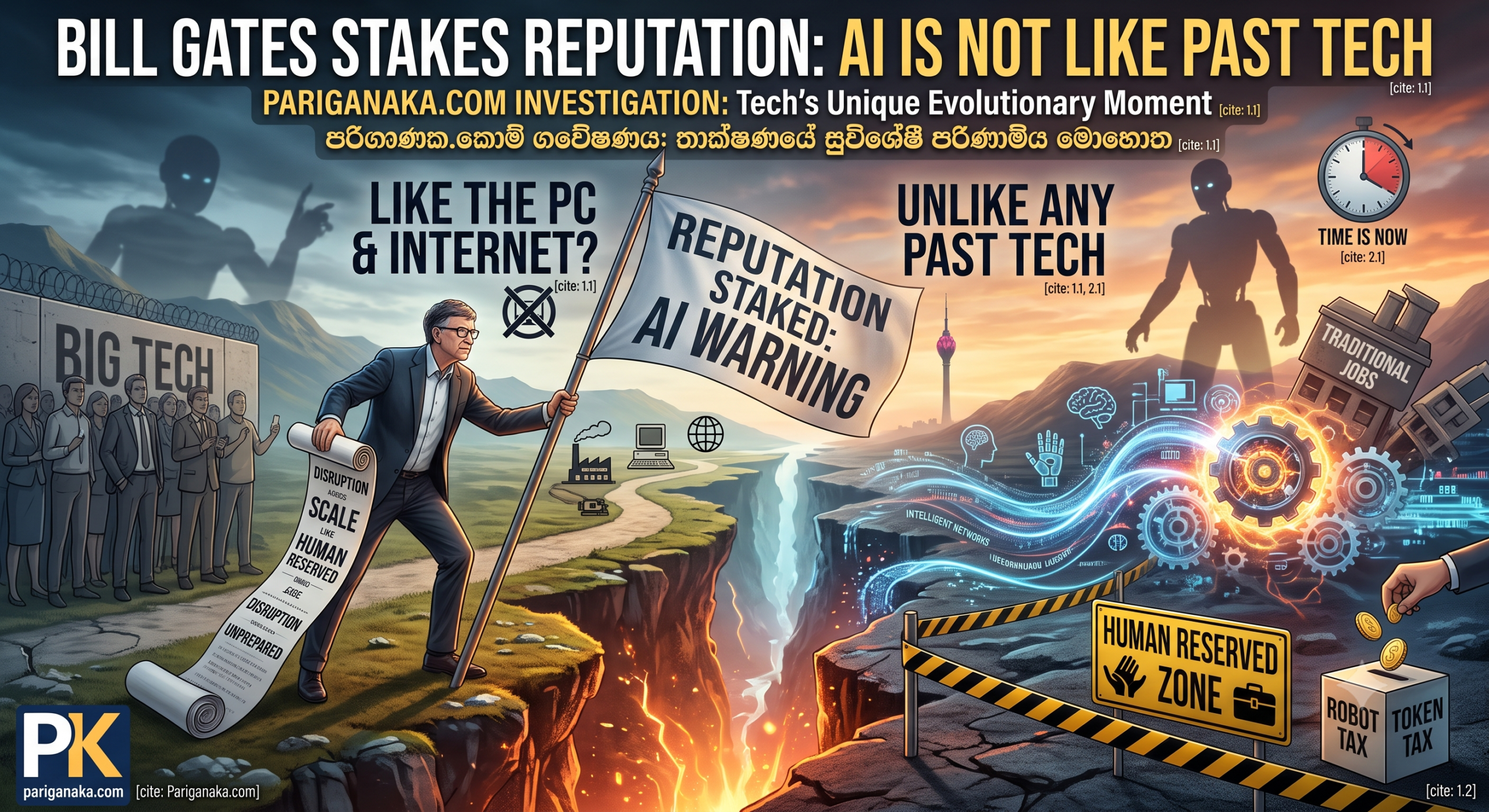
In a staggering departure from the blind optimism he held for years, Microsoft co-founder Bill Gates has recently sounded the alarm, publishing a massive 6,000-word essay that stakes his reputation on a very specific warning: AI is not like the technology of the past.
While tech giants race to deploy AI across every sector, Gates argues that the world is entirely unprepared for the sheer scale of the coming disruption. Here is a breakdown of why Gates believes this is a completely unique moment in human history—and what he proposes we do about it.
The “Breadth” of the Disruption
Historically, technological revolutions—like the Industrial Revolution or the advent of software—ultimately created more jobs than they destroyed. Gates explicitly warns that AI will likely do the opposite.
- Unlike Past Tech: Gates points out that analogies to the effects of past innovations are highly misleading because we have no prior experience with a technology that can adapt so quickly or mimic human cognition and movement.
- A Unique Evolutionary Moment: He emphasizes that AI is different from past tech not merely because of its speed, but because of its vast breadth, as it will impact virtually every field and job.
- The “Turbulent” Era: Due to this unprecedented reach, Gates predicts that the transition into the AI era will rank among the most turbulent periods in all of human history.
The Call for “Human Reserved” Jobs
With AI poised to automate vast swaths of entry-level and mid-level positions—ranging from software engineering to data analysis—Gates warns that millions of workers will be displaced. To combat the social and economic upheaval this will cause, he has proposed a radical concept: designating certain jobs as “human reserved”.
Much like a nature reserve where society deliberately chooses not to build roads or buildings because the loss would be too great, Gates argues we should actively protect certain roles from automation. For example, he notes that while a robot could technically deliver the awful news of an incurable disease to a patient, it absolutely should not.
Taxing the Robots
To address the impending economic imbalance, Gates has joined leading AI companies in calling for radical changes to global taxation.
Currently, the tax system inherently nudges employers toward replacing human workers with machines; if a company hires a human, it pays payroll taxes, but if it buys a robot, that purchase is typically written off as a business expense. To level the playing field, Gates suggests implementing new levies specifically on robots, as well as taxing “tokens”—the units of data processed by AI systems.
Breaking Ranks with Big Tech
Perhaps the most striking element of Gates’ intervention is his candid criticism of his own industry. He claims that behind closed doors, the people who truly understand how advanced AI is getting are extremely worried, but tech elites are knowingly downplaying these immense risks in public due to the staggering amount of money involved.
While Gates admits that he would support a credible, global plan to slow down AI advancements, he acknowledges that the geopolitical and economic incentives pushing the technology forward make such a pause highly unlikely. The industry is going full speed ahead, which amplifies extreme risks, including the threat of bioterrorism—which Gates now estimates is 50 times higher due to the potential of AI-engineered viruses.
The Ultimate Choice
Gates’ message is ultimately a massive reality check for both governments and citizens. He stresses that artificial intelligence will either become the greatest equalizer ever invented or the worst source of injustice. The technology is already here, and as Gates makes perfectly clear: we do not have the luxury of moving slowly to figure out a transition plan.
Leave a Reply