
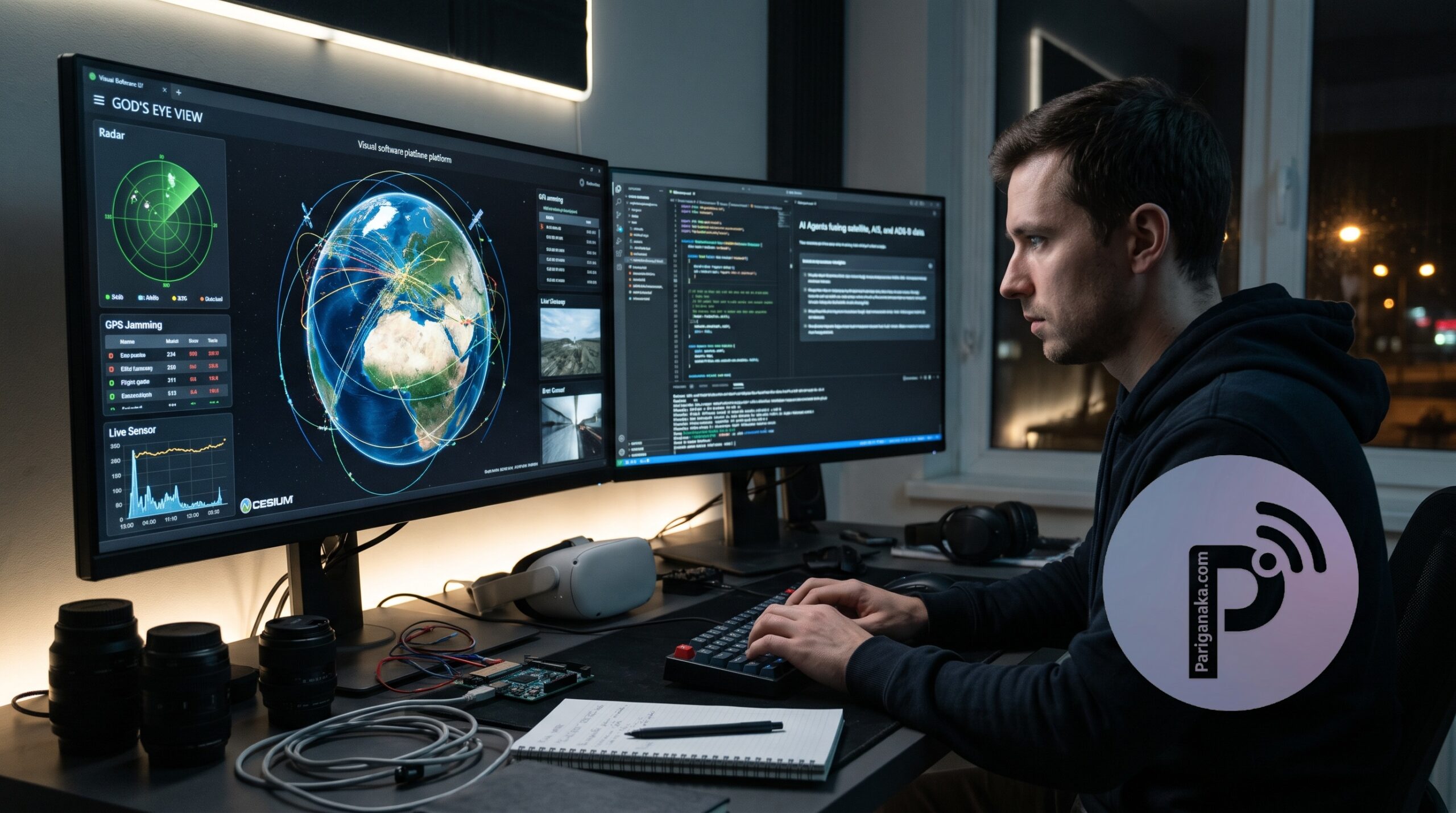
For decades, the ability to monitor the physical world in real-time—fusing satellite imagery, radar, maritime transponders, and commercial flight data—was a capability reserved exclusively for nation-states, intelligence agencies, and elite defense contractors like Palantir. Building a single, comprehensive geospatial dashboard required massive budgets, security clearances, and months of labor by specialized engineering teams.
However, that paradigm has drastically shifted. Driven by the rapid evolution of Agentic AI, the intelligence monopoly has officially been broken.
The Democratization of Surveillance
As detailed by technologist Bilawal Sidhu in his recent breakdown of the “God’s Eye View” project, the transformation is happening at a staggering pace. Using a stack of publicly available APIs and a “swarm of AI agents,” a solo developer can now build a living, breathing 3D model of reality over a single weekend.
The underlying data has always been out there: Open-source commercial satellite imagery, ADS-B signals from planes, AIS tracking from ships, and live CCTV feeds. None of this data is individually novel. The true innovation lies in the fusion of these disparate streams into a single, cohesive picture—a task that AI agents can now execute flawlessly.
This represents a massive shift in digital humanism and the power dynamics of surveillance. Historically, surveillance has been a one-way mirror—a tool used by powerful institutions to look down at the public. Today, those same signals can be harnessed by journalists, open-source intelligence (OSINT) researchers, and independent media platforms to look back up at power.
When AI Agents Become the Execution Layer
By leveraging AI agents to write the complex code required to fuse these platforms, the technical barrier to entry has evaporated. A developer no longer needs to manually code the integration of 3D rendering engines like Cesium with global data feeds. Instead, they provide the blueprint, and the AI handles the execution.
Since the original “God’s Eye View” codebase was open-sourced, an entire ecosystem of community-built dashboards has emerged:
- Shadow Broker: A highly modular globe fusing public feeds, allowing users to plug in their own API keys for synthetic aperture radar imagery.
- Ult and Worldwide View: Custom 4D platforms tracking nuclear sites, seismic activity, live prediction markets, and conflict casualty data.
- Unwitting Sensor Networks: Developers are tracking electronic warfare and GPS jamming simply by monitoring the degradation of commercial airliner GPS signals.
In the OSINT world, intelligence isn’t just about seeing what is there; it’s about noticing what goes missing. When massive oil tankers suddenly go dark mid-voyage to sneak through the Strait of Hormuz, or when flights rapidly reroute before the news reports an airspace closure, that absence of data tells a critical story.
The Future of Global Awareness
While major defense primes still hold an edge with proprietary, highly classified sensors, the gap between state-level intelligence and open-source citizen intelligence is rapidly closing. The execution layer is now right at our fingertips.
We are moving away from static maps and entering an era of 4D reality models. For independent publishers, researchers, and tech enthusiasts, the question is no longer if these tools will be built, but what we will choose to uncover with them.
(Source insights via Bilawal Sidhu / YouTube)
Leave a Reply