
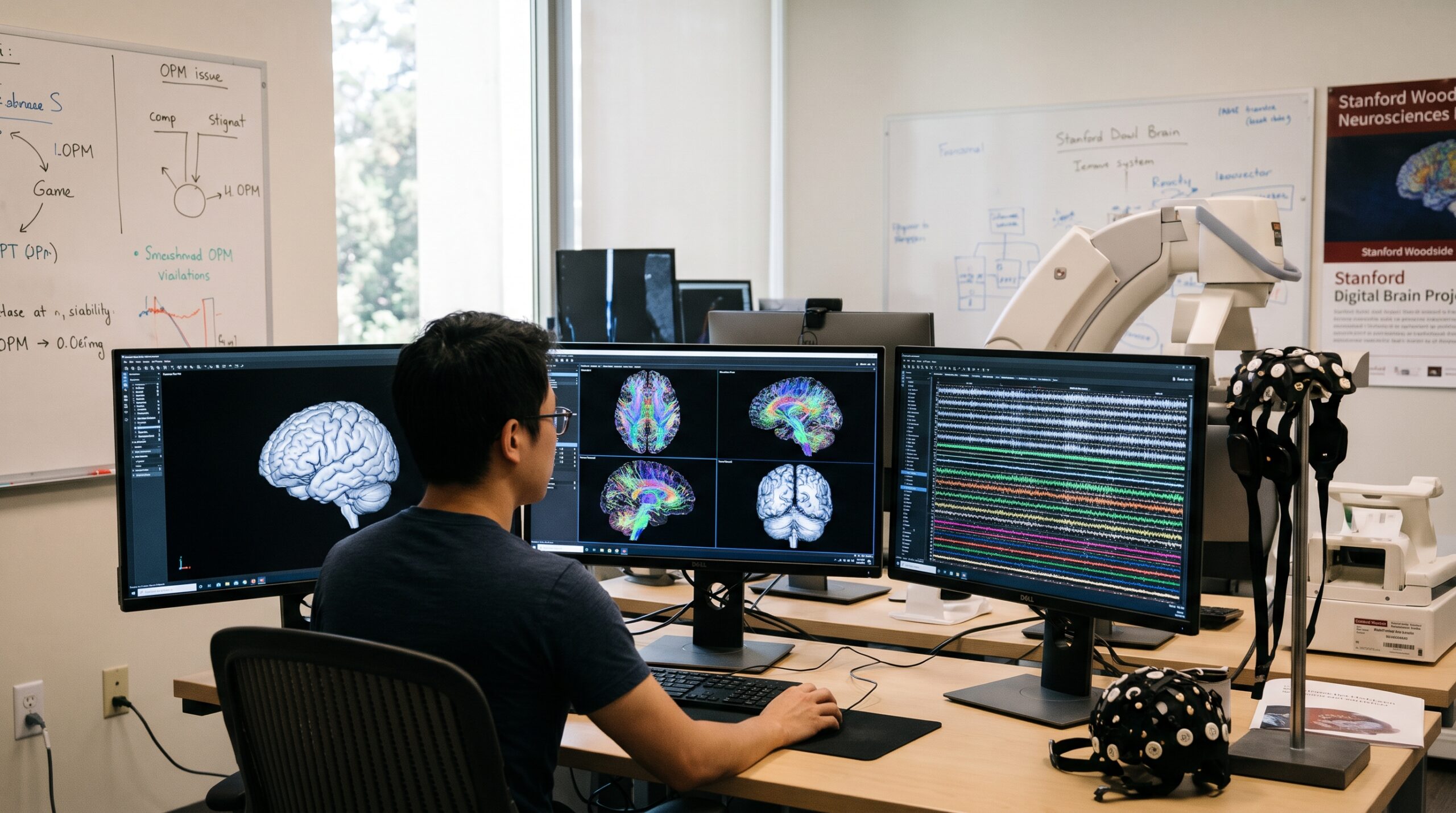
For decades, treating mental health disorders has been hampered by a fundamental problem: the tools available are incredibly crude. Most psychiatric drugs act on the brain in a generalized way, often bringing a cascade of unwanted side effects. To solve this, researchers are turning to a bold new approach—building a digital, predictive model of the human mind.
The “Foundation Model” of the Brain
Led by the Woodside Neurosciences Institute, the Stanford Digital Brain Project aims to create a “foundation model” for brain data.
Much like Large Language Models (LLMs) are exceptionally good at predicting and generating text, this new model is designed to process and predict brain activity. If you input something from the outside world—such as a specific sound or a picture—the digital model will simulate exactly how a real human brain would respond.
By establishing a baseline for how a typical, healthy brain functions, scientists can begin to map out the complex deviations that result in mental health disorders.
A Virtual Testbed for Neuroscience
Perhaps the most revolutionary aspect of this predictive model is its role as a hypothesis generator.
Currently, testing neurological hypotheses requires human trials, which are slow, expensive, and limited in scope. A highly accurate digital model allows researchers to run an infinite number of virtual experiments. Instead of testing a theory on people first, scientists can simulate cognitive processes, test how people perceive the world, and identify potential interventions in a purely digital environment before moving to clinical trials.
The Technology: Unprecedented Data Collection
To build a model this complex, the underlying necessity is data. The Stanford team aims to scale brain data collection by a factor of 20 to 50 times larger than the biggest experiments in existence today.
To gather this massive, dense dataset, the project relies on a combination of two cutting-edge technologies that provide both spatial and temporal insights:
- 7-Tesla MRI: A highly advanced magnetic resonance imaging machine that maps the whole brain with unprecedented spatial resolution.
- OPM (Optically Pumped Magnetometers): A groundbreaking technology that records human brain activity with millisecond resolution, allowing scientists to capture 1,000 distinct measurements every single second.
By merging the where (MRI) with the when (OPM), researchers can observe the brain in action with a level of fidelity previously thought impossible.
From Science to Real-World Impact
While the Stanford Digital Brain Project is a massive leap forward for basic science, its ultimate goal is highly practical.
By modeling the brain digitally, clinicians will eventually be able to predict disease onset, track the progression of pathologies, and map the specific functions of different brain regions. More importantly, it opens the door to truly personalized medicine—allowing doctors to design, optimize, and simulate customized therapeutic treatments for individuals, significantly reducing the guesswork and side effects of mental health care.
Leave a Reply