
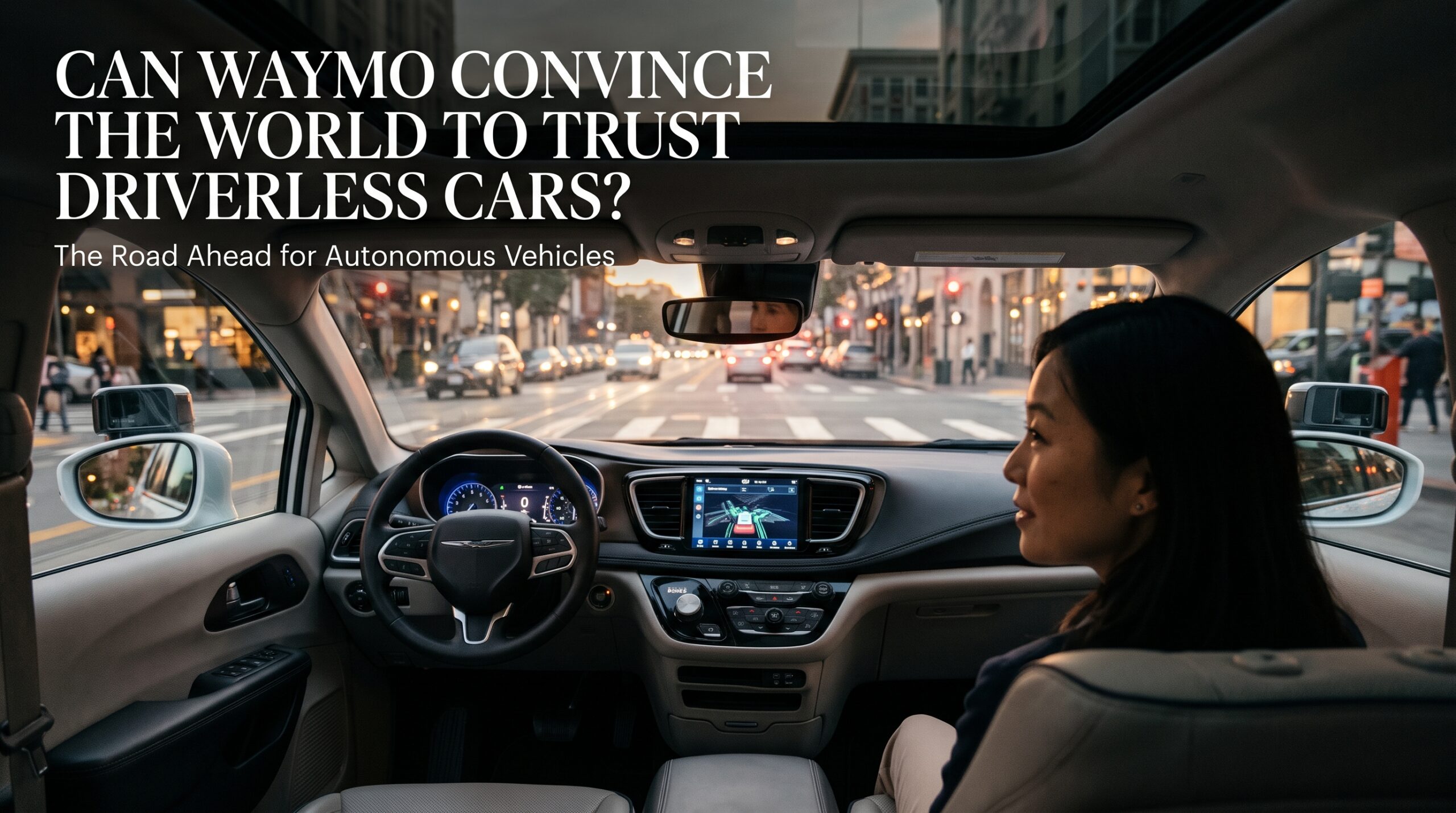
For decades, the reality of self-driving cars seemed perpetually just “around the corner.” However, in cities like San Francisco, driverless vehicles have finally arrived in full force, raising crucial questions about safety, scalability, and societal trust. In a recent interview, Emily Chang rode alongside Waymo co-CEO Tekedra Mawakana to discuss the company’s vision, its approach to safety, and whether humanity is ready to hand the steering wheel over to robots.
The Trust Factor: Balancing Safety and Public Perception Despite the growing visibility of autonomous robo-taxis, a significant portion of the public remains hesitant. According to a 2026 Pew Research poll, 71% of adults stated they would feel uncomfortable riding in a driverless car. This fear persists even as safety data paints a more favorable picture. A study by the independent nonprofit Insurance Institute for Highway Safety found that Waymo vehicles in four cities were involved in 68% fewer crashes than human drivers, and boasted a 91% lower rate of rear-ending other vehicles.
Mawakana acknowledges that Waymo’s system is not completely flawless. Instead of promising perfection, she asks the public to consider the alternative: “I think it’s important for society to grapple with that question of how uncomfortable am I with the status quo. Is it worth it to get an improvement by embracing this new technology that isn’t promising to be perfect, but at the same time it can really improve road safety?”
However, the margin for error in the court of public opinion is razor-thin. Wayward autonomous vehicles blocking emergency personnel, driving through flood zones, or—in the catastrophic 2023 case involving competitor Cruise—dragging a pedestrian, rapidly go viral and damage public trust. Waymo combats this by heavily relying on simulations and ingesting massive amounts of data from real-world edge cases to continuously refine its software.
Inside the Tech: How a Waymo ‘Sees’ Waymo’s strategy differs heavily from competitors like Tesla. While Elon Musk has criticized LiDAR as costly and unnecessary in favor of a primarily camera-and-AI-based approach, Waymo relies on a deeply redundant tech stack.
Waymo outfits its fleet with overlapping sensors designed to build a 360-degree, three-dimensional picture of the environment up to three football fields away:
- 13 Cameras: Capture visual details such as traffic light colors and lane markings.
- 6 Radar Sensors: Measure distance and velocity, serving as a reliable backup when weather obscures cameras.
- 4 LiDAR Sensors: Use light pulses to measure the precise shape and distance of surrounding objects.
- Onboard Compute: Analyzes this data against high-definition maps to predict the movements of surrounding cars and pedestrians.
Currently, Waymo integrates this hardware suite into the Zeekr electric minivan, an undertaking completed entirely at Waymo’s facility in Phoenix, Arizona, to ensure tight control over the intellectual property. By keeping both the hardware and software tech stacks in-house, Waymo aims to steadily drive down costs without compromising safety.
Privacy and the Surveillance Question With fleets of cars continuously recording high-definition video and audio on public streets, privacy has become a rising concern. Critics worry that Waymo is inadvertently building a sprawling surveillance network. Mawakana clarified that while Waymo complies with lawful, properly scoped requests from law enforcement, the company actively attempts to down-scope requests and is not in the business of proactive surveillance or flagging minor civil infractions to police.
The Long-Term Vision Mawakana’s ultimate goal is not necessarily to eliminate human driving entirely, but to provide a superhumanly safe alternative. Waymo hopes to license its technology to automakers for private vehicle ownership, expanding beyond its current ride-hailing model.
For Mawakana, who admittedly still loves blasting music in a fast car on the way to the beach, the future of transportation is about having choices. “I think that Waymo will be available to people who want that option. A lot of people like driving, and I want those people to drive when they can pay attention and when it’s enjoyable,” she explained. Ultimately, Waymo’s success will depend on its ability to prove, mile by mile, that a robot can indeed be a better driver than a human.
Leave a Reply