
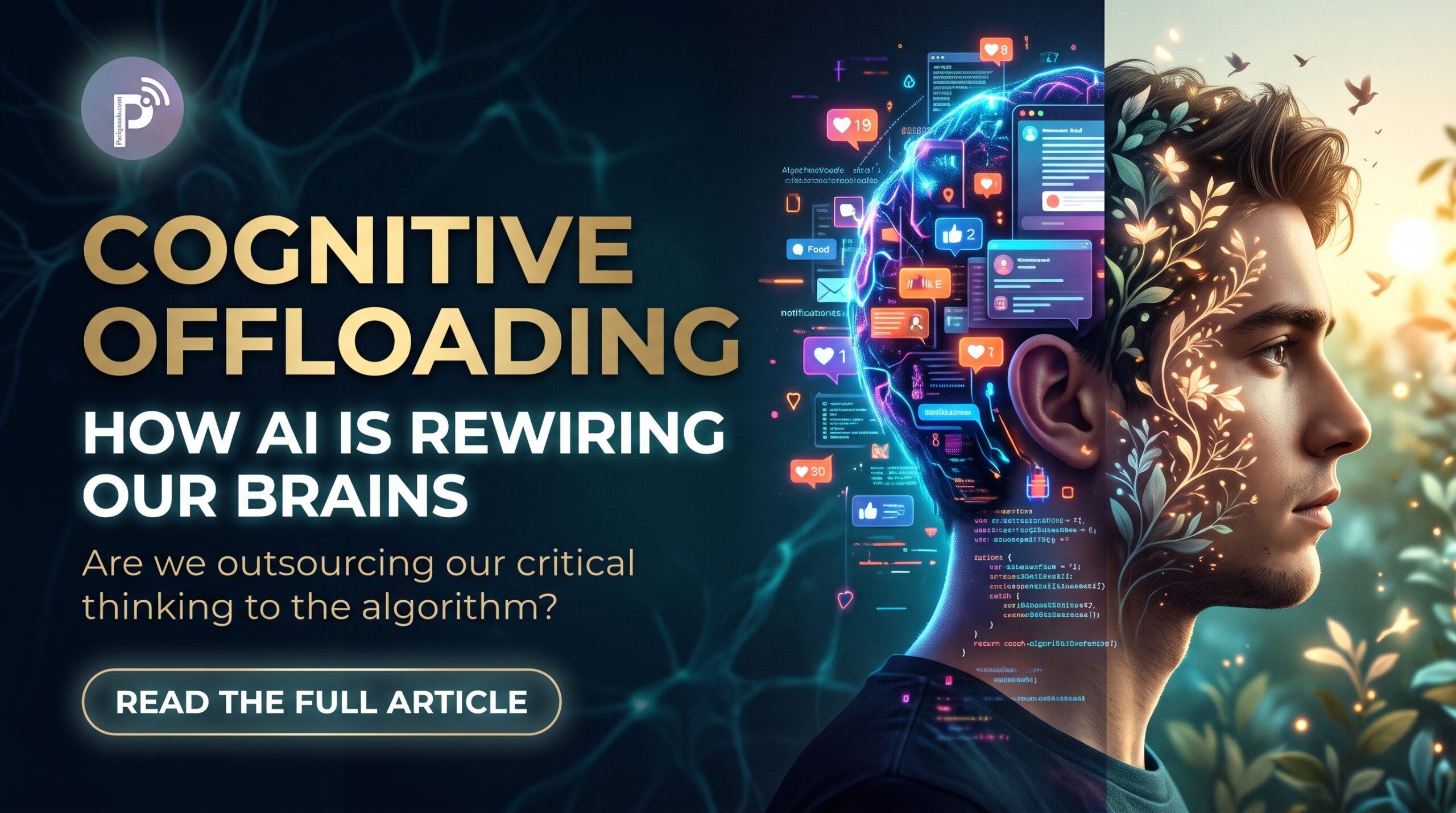
Humans have always relied on tools to make life easier, from books and calculators to GPS navigation. Every invention has helped us outsource mental labor in some way. But now, Artificial Intelligence (AI) is taking this a step further, handling tasks like writing, researching, and reasoning for us in mere seconds. Researchers call this phenomenon “cognitive offloading,” and it is fundamentally changing the way our brains function.
The Decline of Critical Thinking A recent study from MIT revealed that people who relied heavily on AI assistants for tasks like writing essays showed decreased brain activity in areas crucial for critical thinking and problem-solving. The core issue is not that AI is making us less intelligent, but that it discourages us from engaging deeply with problems. When an AI generates a stunningly complex and convincing answer, many users accept it without question. This over-reliance stops us from considering alternatives and evaluating other possible solutions, effectively dulling our human critical thinking skills.
Researchers at TU Berlin further explored this by monitoring brainwave activity during visual tasks with AI assistance. They discovered a direct link between our trust in AI and the mental effort we invest. When the AI performed well, participants used less of their own attention and memory. However, when the AI’s advice became unpredictable, subjects quickly re-engaged their own cognitive resources. This suggests that our growing trust in flawless AI systems might lead us to passively accept machine-generated answers as our only starting point.
The Algorithm’s Grip on Attention Beyond language models like ChatGPT, powerful AI algorithms operate quietly in the background of everyday apps like TikTok, Instagram, and YouTube. These systems track minute details: how long you watch a video, which thumbnail caught your eye, and how quickly you scroll. In a split second, the AI analyzes this data to predict and serve the content you are most likely to engage with, aiming to keep you on the platform as long as possible.
This endless stream of curated content, combined with constant notifications, creates a severe toll on our attention. Every notification forces the brain to make a decision—stay focused or switch tasks. This constant “task-switching” carries high cognitive costs, leading to fatigue, negative emotions, and an increased risk of making mistakes.
More concerning is how these platforms exploit our brain’s dopamine system. Anticipating a notification or the next video in a feed triggers the same reward centers in the brain as addiction. The endless, unpredictable nature of social media creates a compulsive cycle of checking and scrolling, which can make ordinary, slower-paced activities feel unrewarding by comparison.
Reclaiming Control: The 30-Day Digital Reset Attention is not a fixed trait; like a muscle, it can be trained. Addiction experts recommend a “dopamine fast”—abstaining from digital triggers for a sufficient period, often around 30 days, to allow the brain’s chemistry to reset.
Practical steps include:
- Minimizing Interruptions: Turn off non-essential notifications and keep your phone out of the bedroom.
- Reducing Appeal: Switch your phone screen to grayscale to make apps less visually stimulating.
- Embracing Effort: Engage in challenging activities like reading, exercising, or learning a new skill. These activities may not offer instant gratification, but they require sustained effort that helps restore a healthier balance in the brain.
AI is an incredible tool for efficiency, but its unchecked use can silently degrade our cognitive stamina and focus. The challenge is not to ban the technology, but to learn when to use it intentionally, when to trust it, and most importantly, when to think for ourselves.
Leave a Reply