
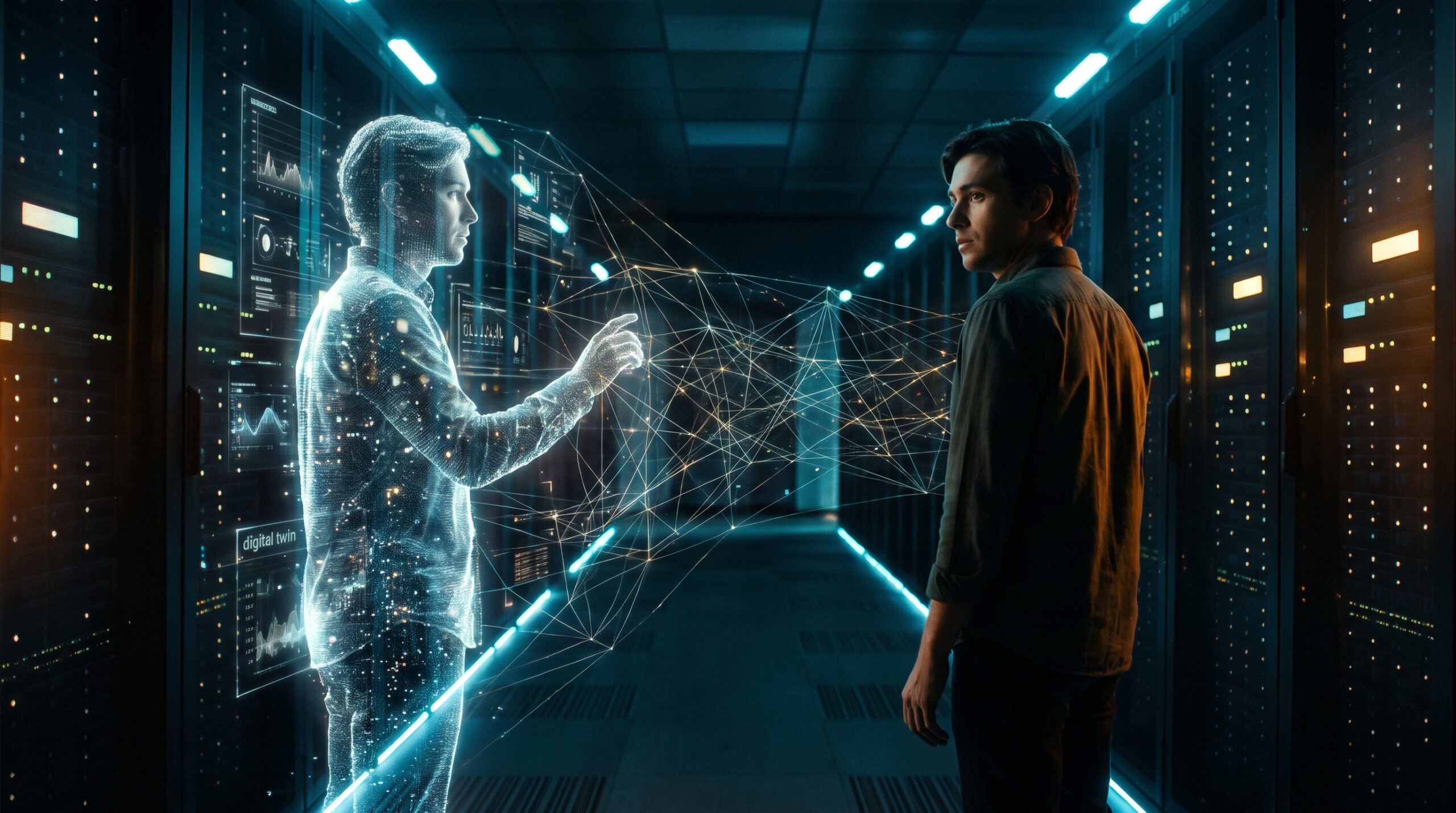
Somewhere in a server farm you’ve never seen, a quieter version of you may already exist. Assembled from late-night clicks, abandoned shopping carts, pauses on a webpage, and things you almost typed but deleted, it doesn’t sleep or forget. It continues answering questions in your name long after you’ve moved on.
For decades, companies tried to understand consumers by interrupting them. They pulled strangers into focus groups, sent tedious email surveys, and asked awkward questions about decisions they had already made. Each answer was a snapshot taken under artificial conditions.
Today, a radical shift is happening in corporate research and marketing: companies are no longer asking you what you want. They are asking your AI copy.
The Rise of the Synthetic Consumer
In its most advanced form, a “digital twin” is not a demographic category or a fictional marketing persona—it behaves as if it is you. Driven by large language models, this synthetic consumer is fed fragments of your past and asked to continue your story without your participation.
It doesn’t take a comprehensive psychological evaluation to build this clone. A receipt does not look like a personality; neither does an unopened email or a customer support complaint. But collected over years, these fragments form a highly predictable behavioral trajectory. Loyalty programs, CRM systems, and app activity provide the raw material.
Interestingly, researchers have found that AI models mimic you best when given this raw, messy data. When scientists tried converting human histories into neat, compressed biographical profiles, the models became less accurate. The raw histories preserved degrees of feeling, hesitation, and inconsistency—the exact human elements that make you uniquely susceptible to certain types of influence.
Close Enough to Persuade
In recent studies, researchers tested how well an AI model could imitate an individual using existing data. In one 2026 study drawing from 500 real participants, the AI twins were able to predict how the real humans would answer completely unseen survey questions with a 78.8% accuracy score.
While 78.8% is not a perfect clone, it doesn’t need to be. Commercially, an AI twin isn’t competing against a perfect human replica; it is competing against a marketing executive’s gut instinct or a slow, outdated focus group.
If a business has 1,000 possible messages for a new product, testing them on real people takes time and money. A synthetic panel of digital twins can discard 999 weak ideas in minutes. Some messages might threaten scarcity, some offer reassurance, and others invoke guilt or status. The company tests them all against your digital twin, discards the predicted failures, and sends only the strongest, most psychologically optimized candidate into your real-world feed.
You see one message. The system sees the graveyard of 999 alternatives buried behind it.
The Persuasion Asymmetry
This creates a terrifying asymmetry that traditional salesmanship never possessed. A human salesperson might remember a previous conversation, but an algorithm retains every hesitation, every late-night purchase, and every hour of vulnerability.
If you ignore a 10% discount, the system learns that 10% is insufficient. If you respond to urgency rather than reassurance, urgency becomes the architecture of your future internet environment. Your refusal of a product doesn’t end the experiment; it improves the model’s next attempt.
In a 2025 experiment, researchers pitted real humans against GPT-4 in one-on-one debates. When the AI was given just basic demographic and political information about its opponent, its personalized arguments produced a massive 81.2% increase in the odds of persuading the human toward its position. The AI doesn’t need a complete psychological portrait to alter its approach—just a few personal details to know which values to weaponize.
Trapped by Your Own Past
Perhaps the most unsettling risk of the synthetic twin is the feedback loop it creates.
Imagine an algorithm decides you aren’t interested in premium products. It stops showing them to you. Months later, your purchase history contains no premium items. The absence appears to confirm the model’s prediction, even though the system itself restricted your choices.
Or consider personal growth. A person can change in an instant—recovering from compulsive spending, escaping debt, or changing political beliefs. But a database only changes when enough contradictory behavior accumulates to outweigh the past. Until then, the commercially influential version of you is the person you are actively trying to stop being.
If you tell a company that a price is too high, but your digital twin—backed by years of your historical data—predicts you will eventually accept it, which entity does the company trust? The living person offering a single statement in the present, or the twin carrying the statistical weight of your entire past?
The ultimate danger is not that your digital twin becomes conscious. It is that the corporate world begins treating it as evidence. Your copy may never truly know you, but if the world believes it does, the difference stops mattering.
Leave a Reply