
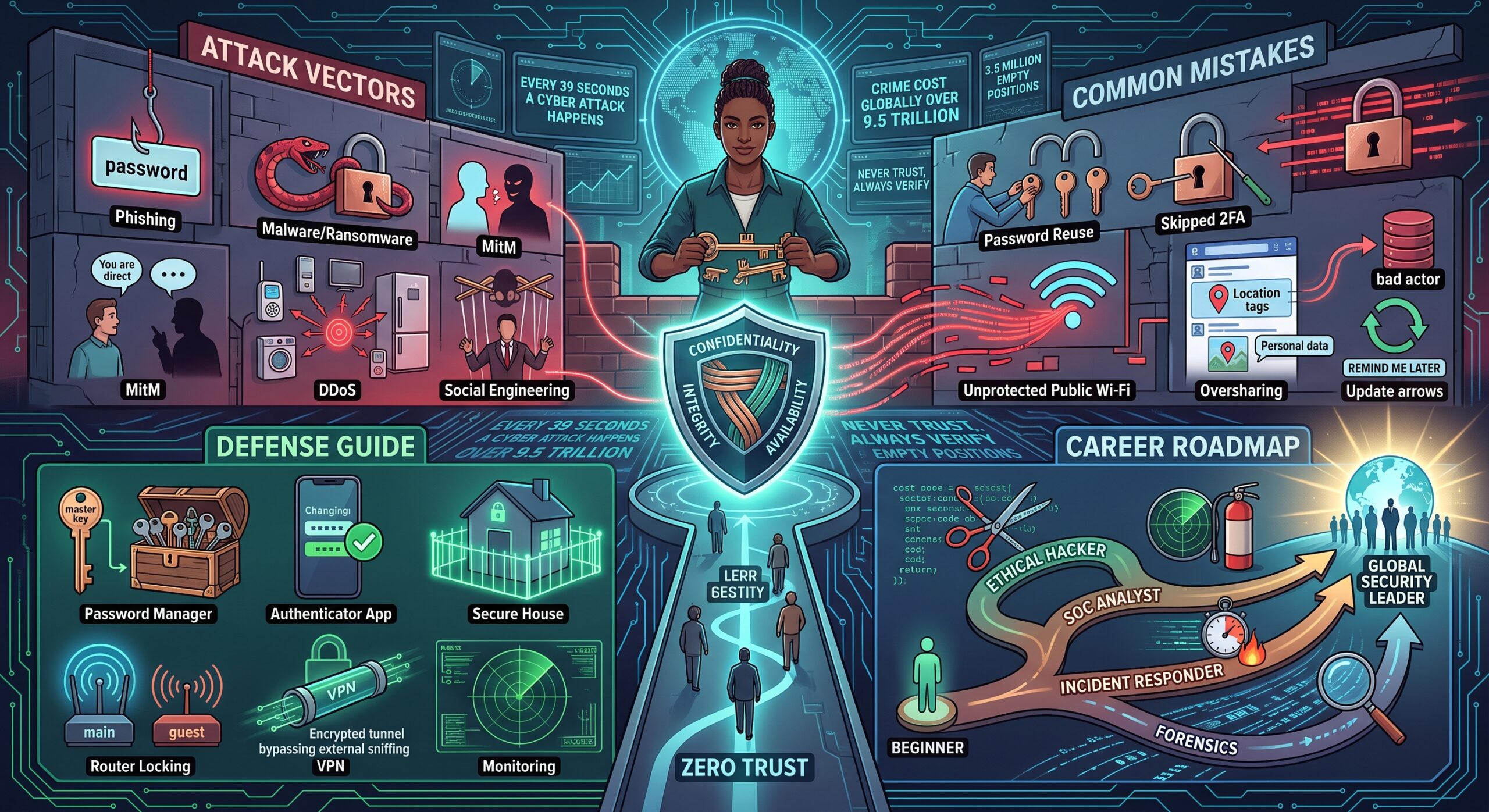
The internet is fundamentally woven into our daily lives, yet the vast majority of users are unaware of the mechanics operating beneath the surface—and the threats lurking within them. In 2024 alone, cybercrime cost the global economy over $9.5 trillion. Hackers aren’t just targeting massive corporations; their primary target is the everyday user, largely because human error is the easiest vulnerability to exploit.
Whether you are looking to secure your personal data or exploring a transition into a high-demand tech career, this comprehensive breakdown explains exactly how hackers operate, the threats you face, and the actionable steps required to secure your digital footprint.
Understanding the Threat Landscape: How Hackers Think
Forget the Hollywood stereotype of a teenager in a dark hoodie typing green code. The reality of the cyber underworld is highly sophisticated and categorized by different “hats”:
- White Hat Hackers: Ethical professionals paid by major companies to find system vulnerabilities before malicious actors do.
- Black Hat Hackers: Cybercriminals who break into systems for personal gain, chaos, or data theft.
- Gray Hat Hackers: Individuals operating in an ethical gray zone, hacking systems without permission but not necessarily for malicious or destructive reasons.
The most dangerous attackers operate with extreme patience and think like detectives. They consistently follow the path of least resistance. Why spend hours trying to crack complex encryption when they can simply send a fake email to 10,000 people and wait for one uninformed user to willingly hand over their password?
The Most Common Digital Weapons
Cyber attacks occur globally every 39 seconds. Here are the primary digital weapons deployed today:
- Phishing and Spear Phishing: The act of using a fake email or message—often cleverly disguised as a trusted entity like a bank or an employer—to trick you into clicking a malicious link.
- Malware & Ransomware: Malicious software designed to damage or gain unauthorized access to your system. Ransomware, in particular, encrypts all your files and demands a cryptocurrency payment to unlock them.
- Man-in-the-Middle (MitM) Attacks: Often occurring on public Wi-Fi networks, an attacker secretly inserts themselves between your device and the server to intercept and read your data.
- Social Engineering: The manipulation of human psychology rather than technical systems, successfully tricking people into giving up confidential information.
- DDoS Attacks (Distributed Denial of Service): Flooding a server with an overwhelming amount of fake traffic, often using hijacked smart devices, so that legitimate users cannot access the service.
The Biggest Mistakes People Make Online
Even with advanced hardware and software, our daily digital habits are often our weakest link. The most critical mistakes include:
- Reusing Passwords: Using the exact same password across multiple sites means a single data breach can lead to a total digital collapse.
- Skipping Two-Factor Authentication (2FA): Disabling 2FA removes a critical layer of defense that stops 99.9% of automated account attacks.
- Using Unprotected Public Wi-Fi: Connecting to airport or cafe networks without protection leaves your traffic totally exposed to anyone on the same network.
- Oversharing on Social Media: Publicly sharing details like pet names, birthdays, and hometowns provides attackers with the exact answers needed to bypass security questions.
- Ignoring Software Updates: Delaying system updates leaves known security vulnerabilities unpatched and wide open to exploitation.
The Ultimate Defense Guide: Protect Yourself Like a Pro
Securing your digital life does not require a computer science background. Implementing these foundational habits will make you drastically safer:
- Adopt a Password Manager: Tools like Bitwarden generate and store unique, highly complex 20-character passwords for every site you use, meaning you only need to remember one master passphrase.
- Enable Authenticator Apps: Rely on time-based codes from apps like Google Authenticator or Authy instead of traditional SMS text codes, which are vulnerable to interception.
- Lock Down Your Home Network: Log into your home router, change the default admin credentials, ensure WPA3 encryption is active, and set up a separate “guest network” specifically for vulnerable smart home devices.
- Utilize Trusted VPNs: Whenever connecting to public Wi-Fi, use a reputable Virtual Private Network (VPN) to instantly encrypt your traffic.
- Monitor Your Exposure: Regularly enter your email on trusted sites like HaveIBeenPwned to see if your data has appeared in any known breaches.
Core Concepts for the Curious
For those looking to understand the broader mechanics of enterprise security, the entire industry is built upon a foundation known as the CIA Triad:
- Confidentiality: Ensuring data is only accessible to authorized individuals.
- Integrity: Ensuring data remains completely accurate and unaltered by unauthorized parties.
- Availability: Ensuring systems and data are reliably accessible when needed.
Furthermore, modern network security has rapidly shifted toward a Zero Trust architecture. Instead of trusting everything already inside a network, the modern standard is “never trust, always verify”—meaning every single access request is rigorously authenticated regardless of where it originates.
Exploring a Career in Cybersecurity
With a global shortage of over 3.5 million professionals, cybersecurity offers incredibly dynamic and rewarding career paths. Roles range from Penetration Testers (ethical hackers who probe systems for weaknesses), to SOC Analysts (the first line of defense monitoring live network traffic), to Digital Forensics Analysts (investigating cybercrimes post-incident).
If you want to transition into this field, a traditional computer science degree is not strictly required. A strategic roadmap involves:
- Learning foundational networking and getting comfortable with the Linux command line.
- Studying for universally recognized certifications like the CompTIA Security+.
- Gaining practical, hands-on experience through interactive, browser-based platforms like TryHackMe.
- Building a personal portfolio via home labs and participating in Capture The Flag (CTF) challenges to prove your skills to employers.
Ultimately, cybersecurity is not just about technology; it is about protecting people and safeguarding the critical digital infrastructure that our modern world relies upon.
Leave a Reply