
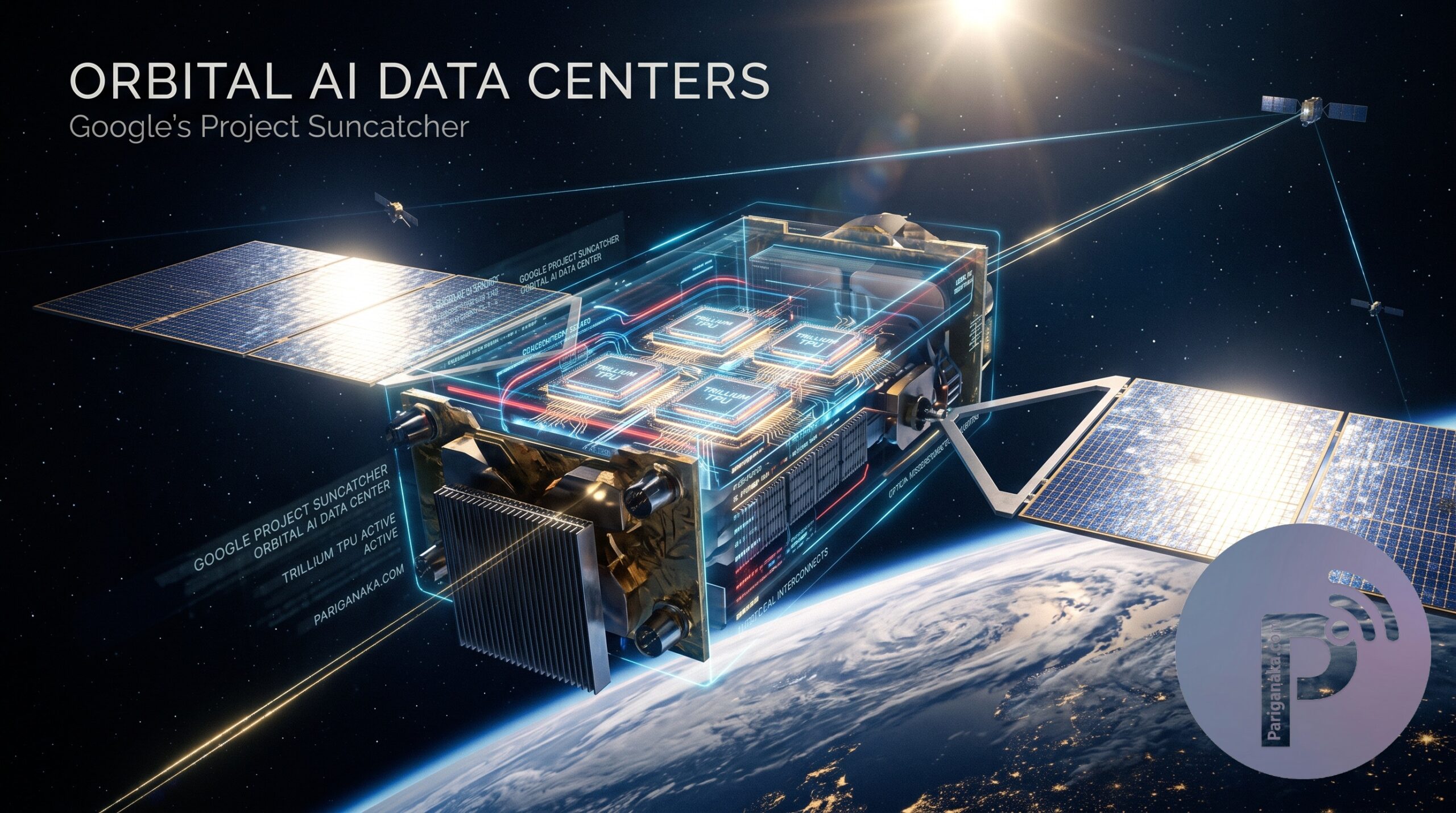
As artificial intelligence scales at breakneck speed in 2026, the biggest bottleneck facing the tech industry is no longer algorithm design—it is electricity and heat. With terrestrial data centers straining national power grids and consuming billions of gallons of cooling water, Google has officially taken its most ambitious infrastructure moonshot off the planet.
Pariganaka.com explores “Project Suncatcher”—Google’s groundbreaking initiative that recently placed four of its flagship AI chips into low-Earth orbit to test whether the future of cloud computing belongs in space.
What is Google’s Project Suncatcher?
First conceptualized in late 2025 and entering orbital testing this month, Project Suncatcher is a long-term research initiative by Google to evaluate whether scalable machine learning infrastructure can operate in space.
Partnering with satellite imaging leader Planet, Google launched a prototype satellite aboard SpaceX’s Falcon 9 Transporter-18 rideshare mission. The payload carries four of Google’s custom Trillium Tensor Processing Units (TPUs), tasked with running live AI workloads in the harsh environment of low-Earth orbit (LEO).
Why Move AI Infrastructure to Space?
At the core of Project Suncatcher is simple physics: solar efficiency.
- 8x More Solar Power: Unlike terrestrial solar farms that lose efficiency to night cycles, weather, and atmospheric filtering, satellites in sun-synchronous low-Earth orbit have access to near-constant sunlight—generating up to eight times more solar energy than panels on Earth.
- Solving the Terrestrial “Inference Reckoning”: Even though AI token costs have plummeted over the past two years, global AI usage has exploded so rapidly that enterprise compute bills and data center power demands are reaching unsustainable levels. Offloading heavy training and batch inference workloads to solar-powered orbital clusters could relieve massive pressure on Earth’s power grids.
The 3 Massive Engineering Hurdles in Orbit
Putting delicate silicon designed for climate-controlled server rooms into the vacuum of space requires overcoming three extreme environmental challenges:
- Surviving 100G Launch Forces: During the 10-minute rocket ascent into orbit, spacecraft experience sustained acceleration of 10G, while individual circuit components like TPU chips can experience localized vibration loads between 50G and 100G. Google subjected the prototype to intense three-axis vibration testing prior to launch to ensure the solder joints and silicon survived intact.
- Cosmic Rays and “Bitflips”: Outside Earth’s protective magnetosphere, high-energy cosmic rays and solar protons bombard electronic circuits, flipping binary
0s to1s (bitflips) and corrupting AI calculations. Before launch, Google blasted its Trillium TPUs with a proton beam at UC Davis’s Crocker Nuclear Laboratory, proving the chips could withstand a radiation dose equivalent to a five-year space mission. - Cooling Chips in a Vacuum: AI accelerators generate immense heat in a tiny footprint. On Earth, data centers use chilled air or liquid cooling loops. In the vacuum of space, there is no air to carry heat away. Google’s orbital prototype tests a specialized closed-loop system of heat pipes and thermal radiators that reject waste heat directly into deep space as infrared radiation.
What’s Next: Laser-Linked Satellite Constellations in 2027
A single satellite with four TPUs is only step one. Google’s roadmap includes a second major orbital test in 2027 involving two satellites flying in formation.
That mission will test ultra-precise laser optical interconnects—allowing multiple satellites moving at 27,000 km/h to link together with high-bandwidth, low-latency laser beams, effectively turning a constellation of satellites into a single, giant orbital supercomputer.
Leave a Reply