
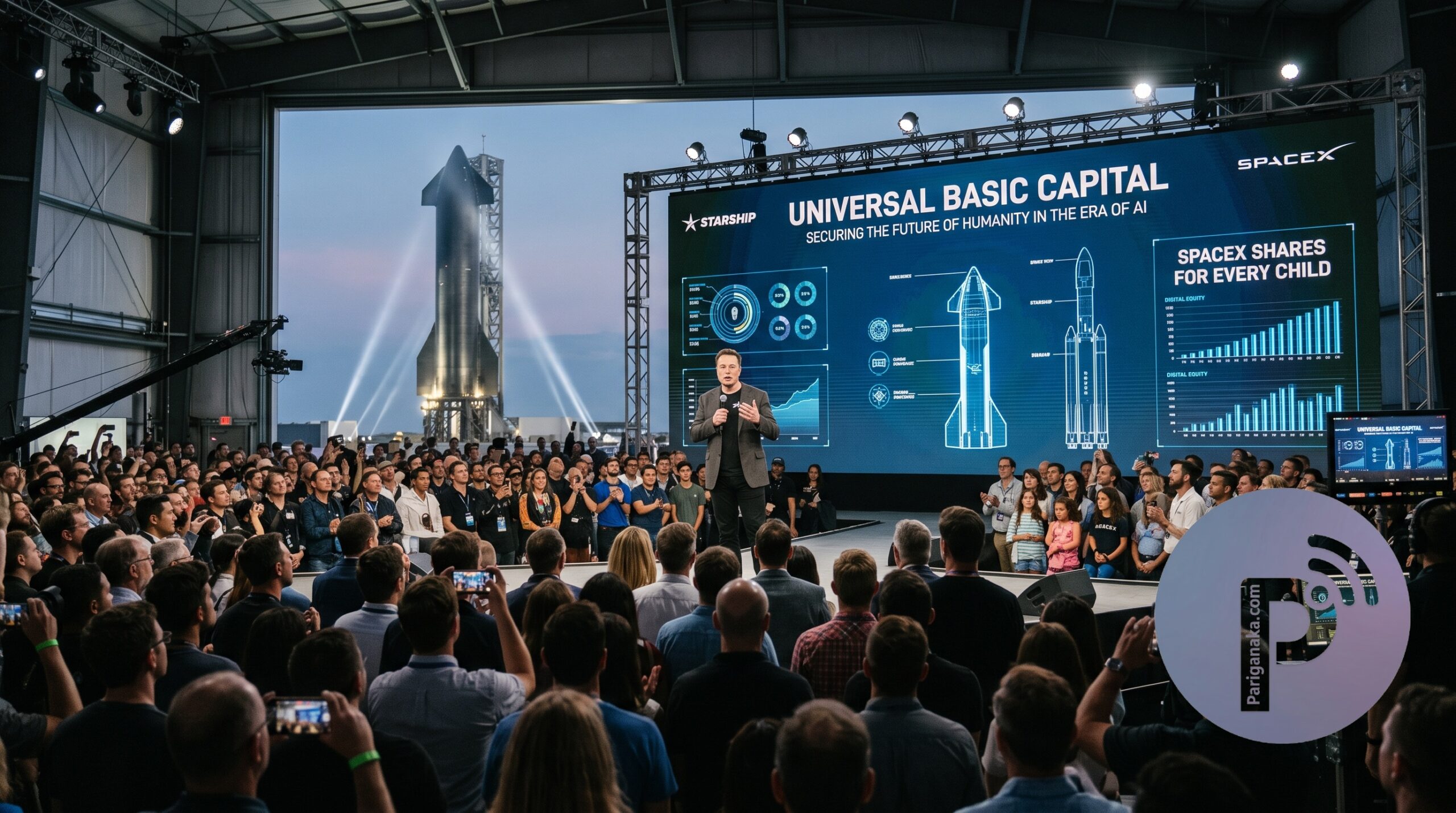
As concerns over artificial intelligence displacing human workers reach unprecedented levels in 2026, Elon Musk and a growing coalition of tech leaders, politicians, and economists are rallying around a new economic model: Universal Basic Capital (UBC).
Rather than traditional cash handouts, UBC aims to give citizens direct equity stakes in high-growth technology and capital markets, allowing everyday Americans to build compounding wealth alongside the expansion of AI.
1. Musk’s SpaceX Share Pledge for American Children
Elon Musk announced a proposal to distribute shares of SpaceX—his aerospace enterprise that also owns the AI chatbot Grok—to every child in America, promising that the initial grant would be “the first of many.”
- Funding Source: Musk indicated the shares could be drawn directly from his personal equity in SpaceX.
- Precedent: SpaceX President Gwynne Shotwell previously gifted personal company shares to children’s investment accounts (“Trump Accounts”).
- Billionaire Philanthropy: Wealthy investors, including John Arnold, noted that gifting equity into child investment accounts provides ultra-wealthy individuals a direct mechanism for large-scale philanthropy without building extensive private foundation overhead.
2. From Universal Basic Income (UBI) to Universal Basic Capital (UBC)
For years, tech executives championed Universal Basic Income (UBI)—regular cash payments from the government—to offset automation. However, sentiment among leading AI figures is shifting toward collective ownership and capital assets:
- Sam Altman (OpenAI): Previously a major UBI proponent who personally funded pilot programs, Altman now advocates for shared equity, a Public Wealth Fund, or “Universal Basic Compute”—where citizens own a fractional share of raw processing power (e.g., ChatGPT compute) that they can use or sell.
- Dario Amodei (Anthropic): Warning that AI could eliminate half of all entry-level white-collar jobs, Anthropic launched a Public Benefit Fund by pledging at least 5% of its shares toward public interest initiatives and direct distributions.
- Economic Distinction: While UBI relies on recurring government cash disbursements, UBC seeds citizens with revenue-generating assets, index funds, or corporate equity that compound over time.
3. Bipartisan Political Proposals and Policy Action
The concept of UBC has gained traction across both sides of the political aisle, albeit with differing implementations:
Progressive Proposals
- Sen. Bernie Sanders (I-VT): Introduced legislation proposing a one-time 50% tax on AI companies, paid in stock, to seed a national sovereign wealth fund. The fund would pay out $1,000 annual dividends to Americans and support public standard-of-living programs.
- Gov. Gavin Newsom (D-CA): Signed an executive order directing California to study UBC implementations, declaring: “We don’t need charity, we need ownership… You cannot save democracy unless you democratize the economy.”
Conservative Proposals
- “Trump Accounts”: A federal program seeding $1,000 index fund investment accounts for American children born between 2025 and 2028.
- Vivek Ramaswamy & Sen. Ted Cruz (R-TX): Framed child investment accounts as a free-market alternative to traditional welfare, arguing that compounding capital allows everyday Americans to participate in capitalist wealth creation rather than relying on state payouts.
- Steve Bannon: Former Trump advisor argued the federal government should mandate that AI giants surrender 50% of their equity directly to American citizens rather than accepting minor tax settlements.
4. Driving Urgency: Accelerated AI Job Losses in 2026
The surge in policy interest comes as AI-driven workforce disruptions accelerate dramatically:
- 120,000+ Job Cuts: According to career analysis firm Challenger, Gray & Christmas, over 120,136 jobs were cut due to AI through September 2026—making AI the leading driver of job losses this year (compared to nearly 55,000 total AI-related cuts in 2025).
- Data Value Argument: A Web3 Foundation study revealed that an individual American’s personal data yields between $393,000 and $830,000 in lifetime value for tech firms, backing the argument that citizens deserve a direct share in the industry’s profits.
5. Key Debates, Criticisms, and Legal Obstacles
Despite growing interest, UBC faces significant economic, legal, and ideological pushback:
- Investor Risk & Financial Literacy: Economists Betsey Stevenson and Ioana Marinescu point out that giving equity rather than cash carries risks. Untrained individuals might be enticed to sell their shares prematurely to wealthy buyers or become locked into non-liquid holdings.
- Free-Market Opponents: Think tanks like the Cato Institute and Heritage Foundation argue that government equity stakes in private tech firms intrude on free-market competition, while venture capitalist Marc Andreessen previously criticized state-managed basic income as turning citizens into “zoo animals.”
- Retraining vs. Redistribution: Federal Reserve Bank of Chicago surveys show that most economists still favor targeted workforce retraining over broad wealth redistribution, though MIT economist David Autor called UBC a “no-regrets policy” that builds a baseline safety net under almost any future scenario.
Conclusion
The debate over Universal Basic Capital marks a pivotal evolution in how society responds to artificial intelligence. As job displacement rises, the conversation is expanding from temporary welfare safety nets to fundamental structural questions about who owns the wealth generated by the AI revolution.
Leave a Reply