
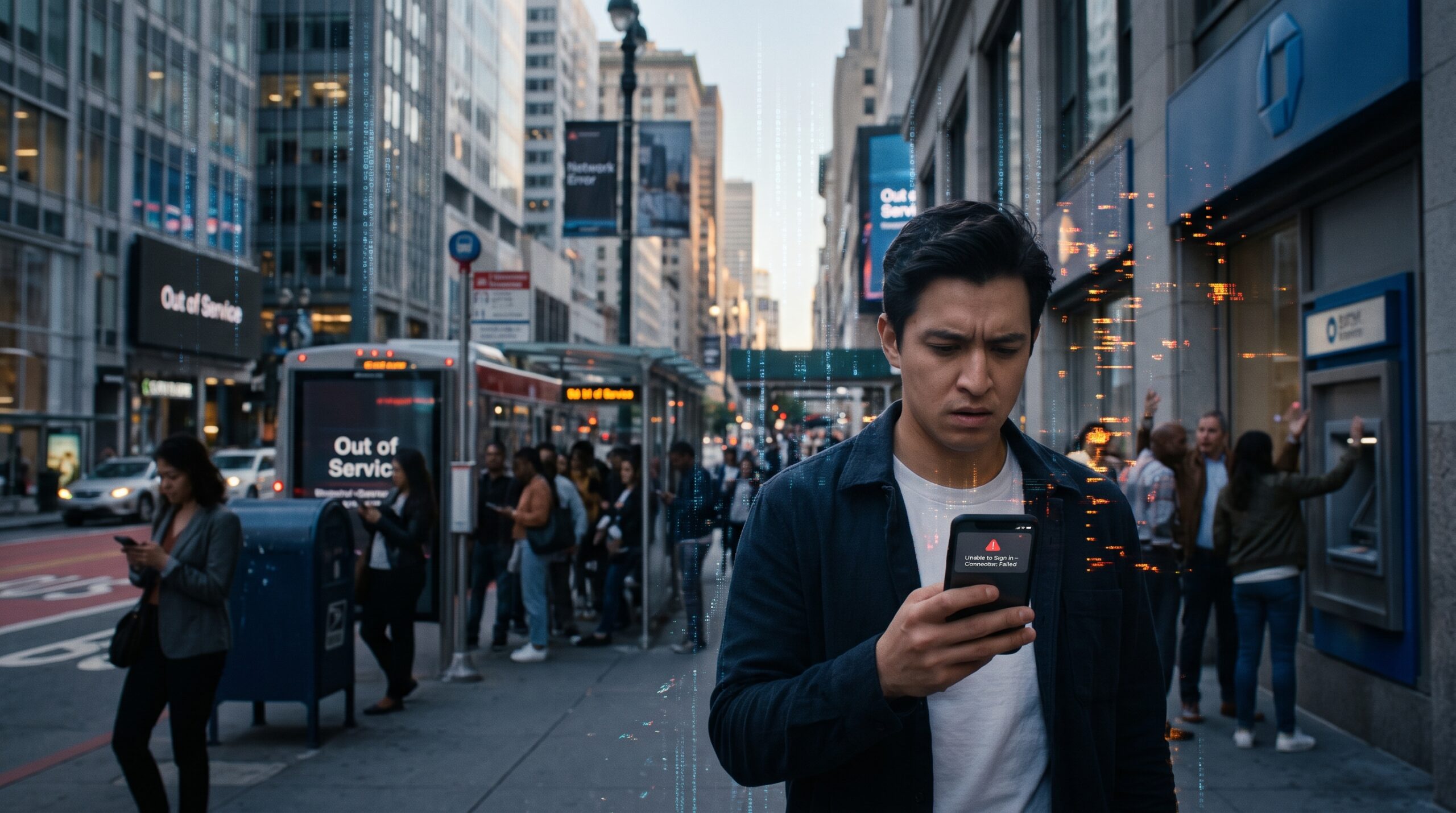
A wave of high-profile digital outages has rattled consumers and major institutions alike—hitting Chase Bank, Microsoft, Uber, and now Apple, where users have reported widespread sign-in and authentication failures across Apple Pay, iCloud, Apple Music, and the App Store.
While the rapid succession of disruptions has sparked fears of coordinated cyberattacks, San Jose State University technology professor Ahmed Banafa suggests in an interview on KTVU FOX 2 San Francisco’s First Chase, then Microsoft, now Apple that the real culprit is far closer to home: aggressive tech layoffs and an overreliance on automation.
The Common Denominator: Layoffs + Automation
According to Banafa, cyberattacks are largely off the table in these recent disruptions—Apple, for instance, attributed its authentication issues to a routine network update. Yet, when similar infrastructure failures hit entirely unrelated sectors—from banking and ride-hailing to Marriott Hotels, the FAA, and even the NSA—a clear pattern emerges.
- Shrinking Engineering Teams: Across industries, organizations have laid off seasoned engineers and veteran IT staff, shrinking teams of 20 down to just a handful of workers.
- The Automation Trap: Companies have attempted to fill the talent gap by pairing less-experienced staff with automated systems. As Banafa warns, an inexperienced operator plus automation does not equal a seasoned engineer.
- Machine-to-Machine Blind Spots: Routine system updates happen daily, but when human oversight is stripped out of critical steps—such as bridging legacy hardware with modern networks—automated processes can trigger cascading failures.
Banafa emphasized that cutting veteran personnel is especially dangerous in high-stakes environments like air traffic control or national security agencies, where institutional memory and human judgment cannot simply be replaced by predictive software.
When Convenience Becomes a Vulnerability
Because digital tools have become an invisible part of daily life—handling everything from morning commutes to instant money transfers—any sudden outage exposes how few offline alternatives consumers actually have.
To navigate an era where major service disruptions are becoming more frequent, Banafa advises consumers to adopt a “trust and verify” mindset:
- Audit Automated Payments: If a bank or payment network goes down, double-check that scheduled auto-payments for mortgages, utilities, or insurance actually cleared rather than assuming the system handled it.
- Beware of Outage Scammers: High-profile outages create prime opportunities for phishing attacks. Never click links in unsolicited messages claiming to “fix” your account or demanding password resets; rely strictly on official company channels for updates.
The Broader AI Shift: Cyber Arms Races & Industry Shakeups
Beyond infrastructure outages, the tech landscape is experiencing rapid turbulence on multiple fronts:
- AI-Powered Cyber Threats: The FBI’s Dallas office recently warned that cybercriminals and state-aligned hackers are using Rex, a superintelligence-powered penetration testing framework, to automate attacks—forcing defenders to deploy defensive AI agents just to keep pace.
- Leadership & Market Shifts: Meanwhile, Silicon Valley is closely watching corporate shakeups, including Nvidia co-founder Jensen Huang stating he would return as CEO if asked following his resignation amid ongoing investigations and board scrutiny, as well as high investor anticipation surrounding Anthropic’s upcoming initial public offering (IPO), which is reportedly oversubscribed by roughly seven times.
As companies race to streamline operations with AI and automation, this string of major outages delivers a sobering reminder: resilient technology still depends on experienced human hands at the wheel.
Leave a Reply