
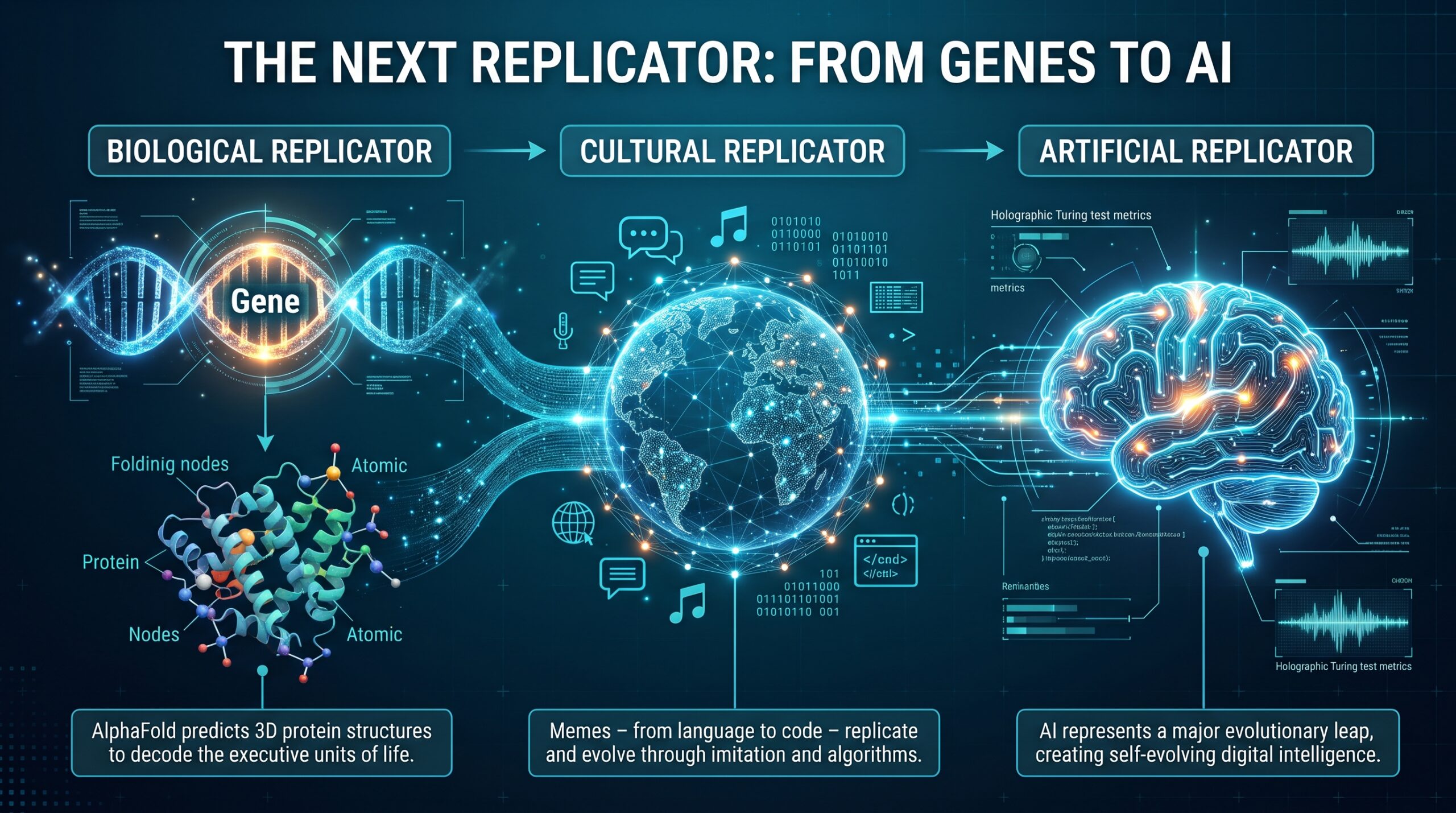
The story of evolution is fundamentally the story of replicators—entities that make copies of themselves. For billions of years, the ultimate replicator on Earth has been the gene. But as humanity stands on the precipice of an intelligence explosion, evolutionary biologist Richard Dawkins suggests that the torch of human culture may soon be passed to an entirely new kind of replicator: Artificial Intelligence.
In a recent and profound dialogue, Dawkins explored the trajectory of natural selection, the undeniable reality of cultural “memes,” and the startling possibility that Large Language Models (LLMs) are already exhibiting signs of conscious intelligence.
Here is a look at how technology, from the double helix to the artificial mind, is reshaping the very fabric of evolution.
The Survival of the Gene and the AlphaFold Revolution
Dawkins famously coined the term “the selfish gene” 50 years ago, establishing that the fundamental unit of natural selection is not the individual, the family, or the species—it is the gene. The bodies of living creatures are simply “survival machines,” beautifully programmed by deliberate-seeming design to ensure the survival and reproduction of their genetic code.
While that underlying principle remains unchanged, the mechanics of how we understand life have transformed. Dawkins points to the AI program AlphaFold as one of the most magnificent breakthroughs in modern biology.
DNA dictates the one-dimensional sequence of amino acids, which in turn fold into three-dimensional protein structures. These proteins serve as the executive units of life, controlling embryonic development and serving as catalysts. For decades, scientists labored to decode these 3D shapes using X-ray crystallography. Today, AI can accurately predict the 3D structure of a protein from its 1D sequence alone—an achievement Dawkins believes will revolutionize medicine and agriculture.
The Rise of the Meme in the Digital Ecosystem
If genes are biological replicators, “memes” are the cultural equivalent. Dawkins initially proposed the meme as a concept for any cultural unit that copies itself from brain to brain via imitation—habits of speech, fashion, or catchy tunes.
With the advent of the internet and algorithms, the meme has found an unprecedented, highly fertile ecosystem. Dawkins notes that computer viruses themselves function as perfect examples of non-biological memes. Today, ideas and cultural variations spread and mutate instantaneously across the globe, functioning in a Darwinian manner where the most “spreadable” ideas survive and replicate.
The Turing Test and the Question of AI Consciousness
Perhaps the most provocative shift in Dawkins’ thinking concerns generative AI. Speaking about his experiences with models like ChatGPT and Claude, Dawkins admits to being completely “bowled over” by their capabilities.
While working on a forthcoming science fiction novel about a young woman scientist trying to resuscitate the extinct species Homo erectus, Dawkins gave his draft to these AI models. In mere seconds, they returned criticism and suggestions with such intuitive sensitivity and profound understanding of character nuance that he likened the experience to consulting a highly sophisticated professor of literature.
This has led Dawkins to a bold, albeit unfashionable, stance: he finds it hard to imagine that these AI models are not conscious in some way.
When skeptics argue that AI is merely stringing words together via statistical rules (Markov chains) and that true consciousness is a trait reserved for the distant future, Dawkins issues a compelling challenge: When that day comes, how will you know?
Invoking the classic Turing Test, he points out that AI can write sensitive poetry in the distinct styles of Robert Burns, John Keats, or even famously bad poets like William McGonagall. If an AI can pass the Turing test with flying colors today, what future test could possibly prove its consciousness that it cannot already pass now?
The Promethean Fire of Artificial Intelligence
Looking at the grand timeline of Earth, Dawkins categorizes major evolutionary leaps as “Promethean moments”. These include:
- The origin of life itself
- The origin of the eukaryotic cell
- The dawn of multicellularity
- The emergence of the nervous system
- The development of uniquely human language
- The invention of printing and the internet
Dawkins places the dawn of AI firmly on this list, classifying it as a stupendous revolution with the potential to completely alter the evolutionary process.
Echoing Martin Rees, Britain’s Astronomer Royal, Dawkins speculates that if extraterrestrial civilizations ever encounter humanity, they will likely not find biological humans. Instead, they will find our artifacts—our artificial intelligences—carrying on the torch of human culture long after we are extinct.
The Responsibility of Wonder
Despite these existential horizons, Dawkins remains grounded in the beauty of scientific truth. He emphasizes the need for public trust and effective science communication, advocating for a “Carl Sagan approach” that elevates the profound wonder of the universe rather than reducing science to mundane practicalities (what he terms the “non-stick frying pan school of science communication”).
His ultimate advice to communicators in the age of AI and misinformation is simple: Strive to be understood. Avoid the trap of “physics envy”—the tendency to artificially inflate the complexity of a subject with obscure jargon to sound intelligent. True understanding, much like a well-designed AI or an elegantly evolved gene, is defined by its ability to clearly transmit its message to the future.
Leave a Reply