
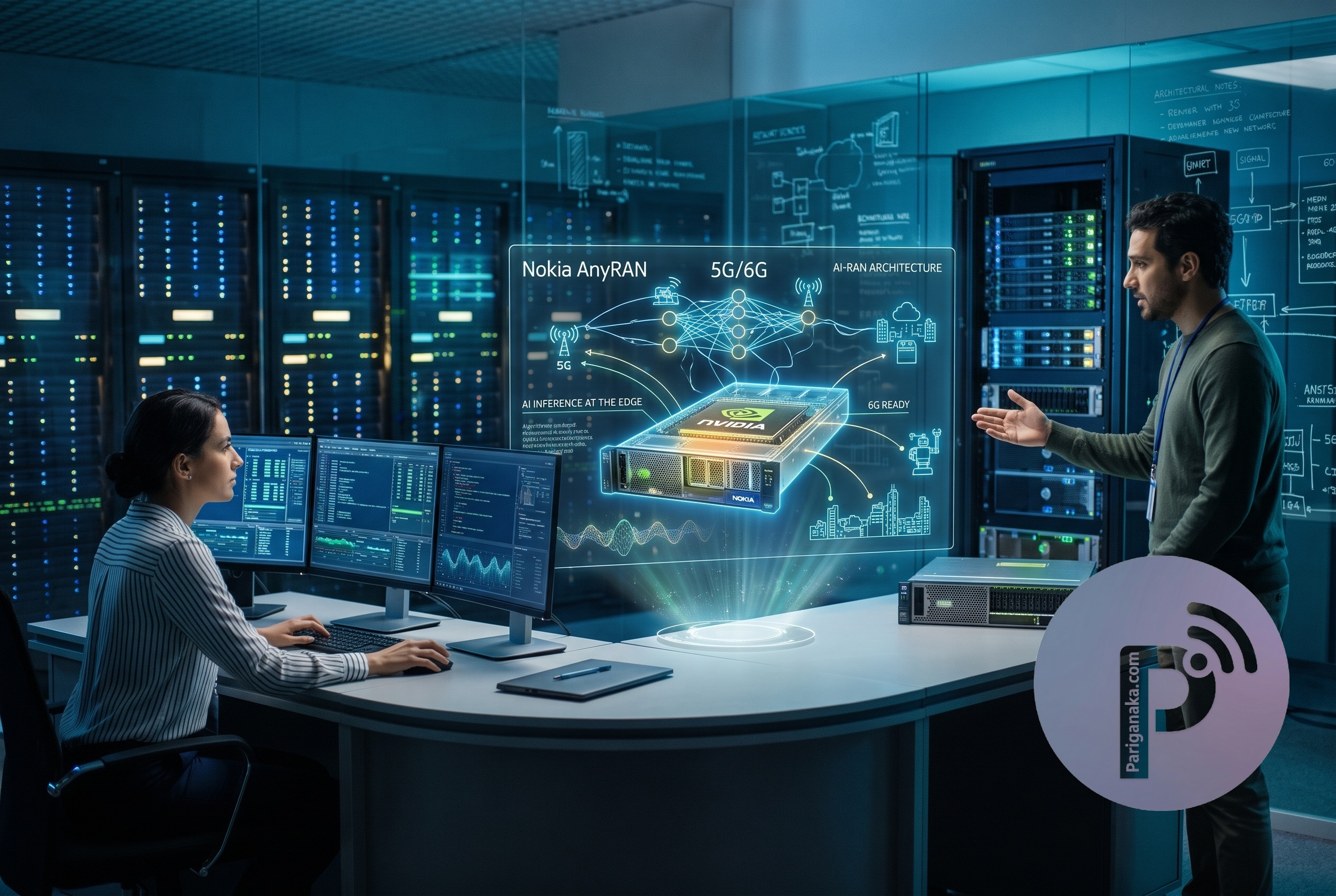
The telecommunications landscape is undergoing a massive paradigm shift. It started decades ago with a simple vision to connect people, but today, Nokia and NVIDIA are taking that vision a step further: connecting intelligence.
Through a powerful new collaboration, the two technology giants are building a unified wireless network built entirely on an AI-RAN (Artificial Intelligence Radio Access Network) architecture.
Here is a look at how this software-defined, programmable infrastructure is poised to transform the tech industry from 5G today to the 6G networks of tomorrow.
The Shift to AI-RAN Architecture
At the core of this advancement is a network optimized heavily for signal processing and AI inference at the edge. Over the past year, this vision has rapidly become a reality.
- Nokia’s AnyRAN software is now running directly on the NVIDIA accelerated computing platform.
- This setup dynamically improves spectral efficiency, maximizing the potential of existing wireless spectrums.
- By running AI inference directly at the edge, this architecture fundamentally shifts the role of traditional telecommunication operators, effectively turning them into AI service providers.
- While the platform is built to power modern 5G networks today, its software-defined framework means it is already prepared for the 6G demands of tomorrow.
Real-World AI Integration and Agentic Operations
Leading global operators are already collaborating with Nokia and NVIDIA to bring AI-RAN into their 5G networks, unlocking highly advanced physical AI and digital humanism capabilities.
The practical applications currently being deployed include:
- Industrial Automation: Powering physical AI at a massive industrial scale.
- Robotics: Coordinating autonomous robots in real-time.
- Smart Cities: Utilizing advanced vision AI to help make cities safer.
- Healthcare Expansion: Bringing critical access to healthcare into remote and underserved areas.
- Emergency Response: Providing real-time voice AI capabilities for emergency services.
- Next-Gen Assistants: Bringing highly natural, seamless conversations to AI assistants.
Beyond consumer and industrial edge applications, operators are fundamentally transforming their own backend operations. Telecoms are increasingly relying on Agentic AI—specifically deploying autonomous AI agents to actively monitor and manage network operations, ensuring that the infrastructure remains highly reliable and secure against threats.
Ultimately, this single, programmable, software-defined platform proves that the foundation for a fully AI-native network is no longer just a concept—it is actively being built.
Sources:[1] NVIDIA, “How Nokia and NVIDIA Are Accelerating the Future of AI-Native Networks” (Oct 23, 2026)
Leave a Reply