
By Pubudu Siriwansa | Founder, Pariganaka.com
If 2024 was the year everyone talked about Artificial Intelligence, and 2025 was the year we tested it, 2026 is the year businesses are finally asking the harder question: Is it actually working?
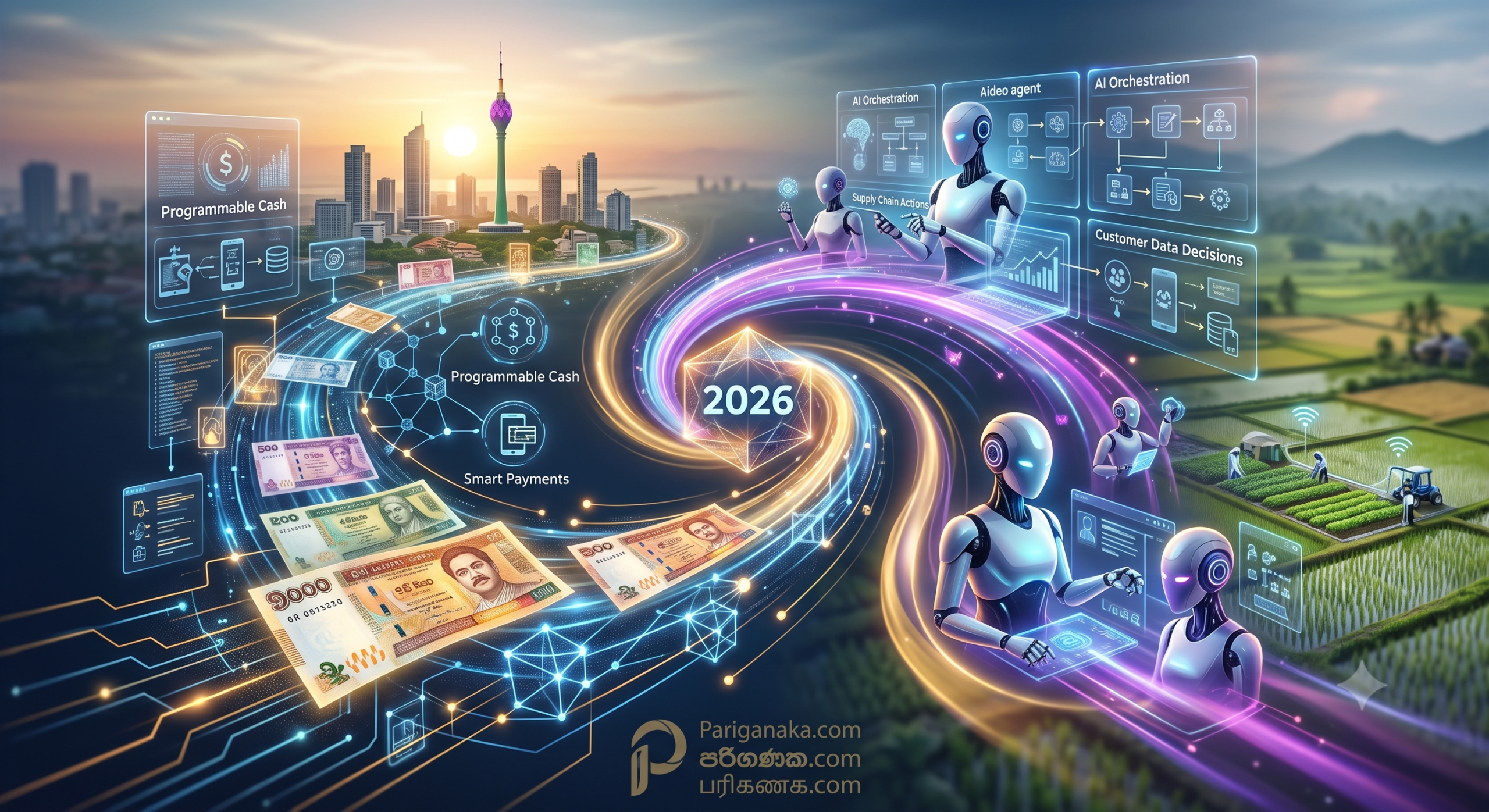
Welcome back to Pariganaka.com. As I track the structural rebuild of our nation’s digital economy, two massive shifts are happening simultaneously. On one front, Sri Lanka’s financial infrastructure is rapidly digitizing. On the other, the global software industry is abandoning traditional apps in favor of autonomous AI.
The gap between early adopters and latecomers is widening. Here is what you need to know to ensure your business—whether an enterprise in Colombo or an MSME in rural Sri Lanka—isn’t left behind.
1. The Programmable Economy: Sri Lanka’s Digital Push
The foundation of any modern tech boom is financial infrastructure. We are moving past standard digital wallets and stepping into the era of the Programmable Economy.
The Central Bank of Sri Lanka (CBSL) has aggressively scaled its Digital Payments Promotion Campaign—under the theme “Shaping the Future through Digital Transactions”. While local adoption of QR payments and digital banking apps is soaring, the ultimate endgame is the Central Bank Digital Currency (CBDC), or the e-Rupee.
Globally, 90% of central banks are now exploring CBDCs, with giants like Visa focusing heavily on developing offline capabilities and advanced cryptography to make these digital currencies scalable.
Why this matters for Sri Lanka:
A fully realized e-Rupee wouldn’t just be “digital cash.” It would be programmable cash. Imagine smart agricultural subsidies that can only be spent on fertilizer, or supply chain payments that execute automatically the second a shipping container clears customs in Hambantota. The underlying technology is laying the tracks for autonomous commerce.
2. The Agentic AI Awakening
While our payment rails upgrade, the software interacting with them is undergoing an evolution. We are officially moving from Generative AI (software that writes and draws) to Agentic AI (software that acts).
Gartner predicts that by the end of 2026, 40% of all enterprise applications will feature task-specific AI agents. These aren’t just chatbots answering customer queries; they are autonomous systems that can execute multi-step workflows across your company’s software stack without human supervision.
Explore the fundamental difference between these two paradigms here:
Key insight: The difference between promise and proof is orchestration. While 79% of global enterprises claim they have adopted AI agents, only about 14% have achieved full, production-level implementation. The winners in 2026 will be those who successfully bridge that gap.
3. What This Means for the Local Workforce
“The Final Human Update යනු තාක්ෂණය මිනිසා අභිබවා යාම නොව, තාක්ෂණය හරහා මිනිසා අලුත් වීමයි.”
(The Final Human Update is not about technology surpassing humanity, but humanity renewing itself through technology.)
As Agentic AI begins handling complex financial transactions over new digital rails, the skillsets required in Sri Lanka will shift. Data entry and basic administrative roles will be heavily automated. However, we will see a massive surge in demand for AI Orchestrators, Cyber Security Analysts, and Digital Compliance Experts who can manage and audit these autonomous agents.
At Pariganaka.com, my mission remains unchanged. I am here to break down these complex, global technologies into simple, actionable insights in English, Sinhala, and Tamil, ensuring that language is never a barrier to your technological empowerment.
The future is programmable, and it is autonomous. Are you ready?
Leave a Reply