
By Pubudu Siriwansa | Founder, Pariganaka.com
When we hear the phrase “digital revolution,” it is easy to picture glass towers in Colombo, server farms, or developers building the next big app. But welcome back to Pariganaka.com, where we look at the whole picture. In 2026, some of the most cutting-edge technology in Sri Lanka isn’t sitting on a desk—it is embedded in the paddy fields of Polonnaruwa and the tea estates of Nuwara Eliya.
We are witnessing the mainstream arrival of Smart Agriculture (AgriTech). For a nation where agriculture is deeply tied to both our culture and our GDP, upgrading from traditional farming to data-driven cultivation is not just an option anymore; it is an economic necessity.
Here is how Artificial Intelligence, IoT (Internet of Things), and the programmable economy are turning our farmers into tech-driven MSME entrepreneurs.
1. The Internet of Tomatoes (IoT in the Field)
Farming has historically relied on generational knowledge and a bit of guesswork. Today, guesswork is being replaced by microprocessors.
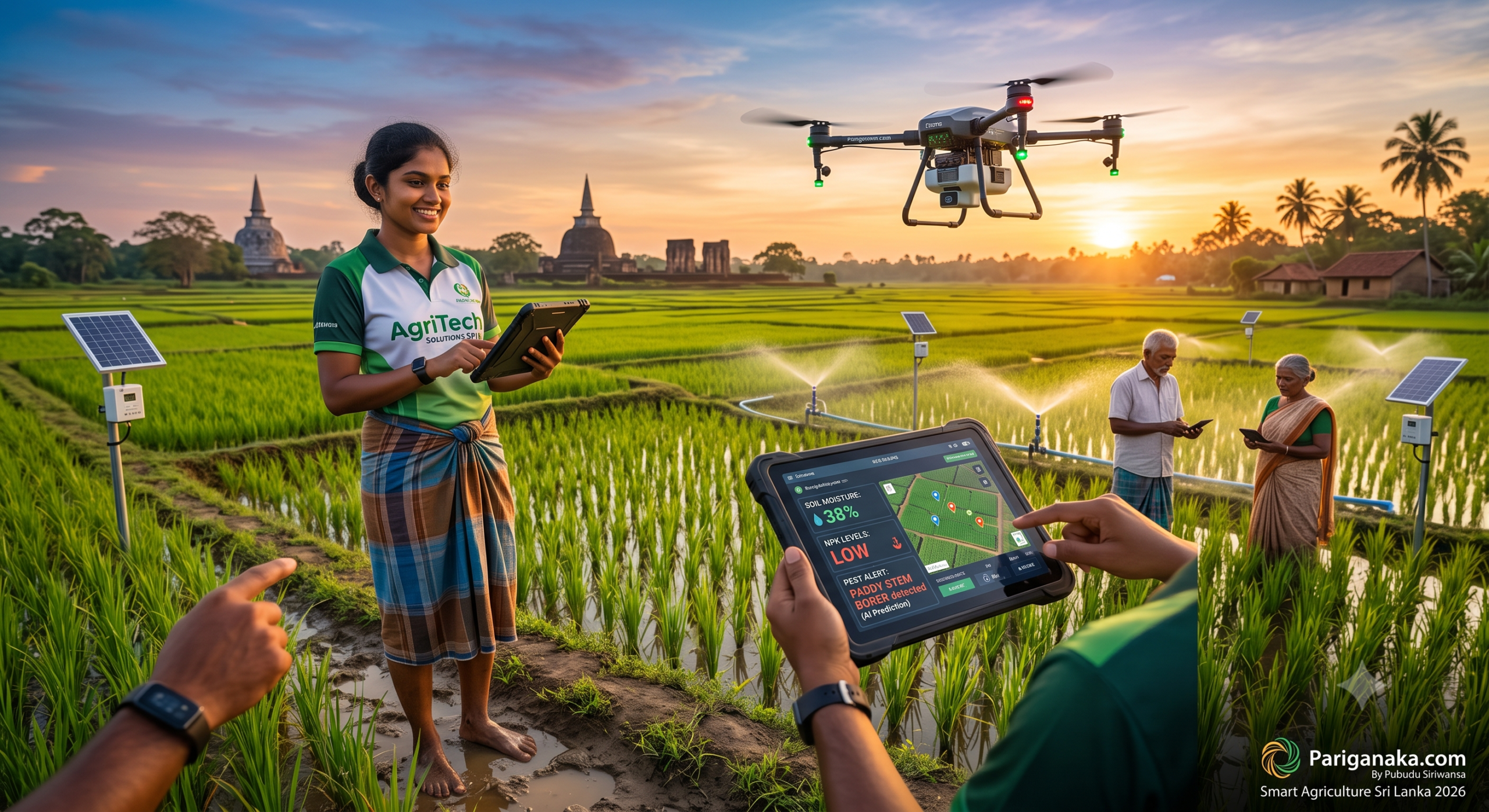
We are seeing a surge in affordable, solar-powered IoT soil sensors being deployed across rural farms. Instead of visually guessing if a crop needs water or fertilizer, farmers now receive real-time alerts directly to their smartphones (or predictive wearables) in Sinhala or Tamil.
- Precision Irrigation: Automated systems release the exact amount of water needed based on real-time soil moisture data, saving millions of liters of water during dry seasons.
- Drone Diagnostics: Drones equipped with multispectral cameras fly over estates, identifying pest infestations or nutrient deficiencies weeks before they are visible to the human eye.
2. Climate-Predictive AI
In an era of unpredictable weather patterns, traditional almanacs no longer cut it. Generative AI was about creating text; Agentic AI in agriculture is about taking action.
Agri-tech startups are now providing local farmers with AI agents that constantly analyze global weather data, local soil conditions, and satellite imagery. If a severe drought is predicted, the AI doesn’t just send a warning—it can autonomously adjust the farm’s automated irrigation schedule and even pre-order drought-resistant fertilizer from local suppliers using connected digital wallets.
3. The e-Rupee and the Farmer’s Wallet
How does a rural farmer afford this? This is where the Central Bank’s push for the e-Rupee (CBDC) and programmable money comes into play.
- Smart Subsidies: The government and NGOs can now issue agricultural subsidies as “programmable digital currency.” These funds are instantly transferred to a farmer’s digital wallet but are coded so they can only be spent on verified agricultural supplies or IoT hardware.
- Hardware-as-a-Service (HaaS): Farmers no longer need to buy a 500,000 Rupee drone. Local co-ops rent out drone time, paid for instantly via micro-transactions on blockchain-backed ledgers. The tech is shared, and the costs are minimized.
Bridging the Knowledge Gap
The hardware is here, but the knowledge gap remains the biggest hurdle. A sensor is useless if the person using it cannot understand the data dashboard.
This is exactly why Pariganaka.com exists. My mission is to ensure that a farmer in Ampara has the exact same access to deep-tech knowledge as a corporate executive. By providing simplified guides and translating complex AgriTech concepts into everyday Sinhala and Tamil, we are making sure no one is left behind in this transition.
“The Final Human Update යනු තාක්ෂණය මිනිසා අභිබවා යාම නොව, තාක්ෂණය හරහා මිනිසා අලුත් වීමයි.” (The Final Human Update is not about technology surpassing humanity, but humanity renewing itself through technology.)
The future of Sri Lankan agriculture isn’t just green; it is digital.
Leave a Reply