
Published: August 8, 2026 | By Pariganaka Editorial Team
Agriculture has always been the heartbeat of Sri Lanka. For generations, the rhythms of the Maha and Yala seasons dictated the flow of life across the island. However, with unpredictable climate shifts and fluctuating global supply chains, traditional farming methods are facing unprecedented challenges.
The solution isn’t to abandon our agricultural roots, but to upgrade them. As we push further into 2026, a new wave of “AgTech” (Agricultural Technology) is quietly taking root across rural Sri Lanka, proving that the most profound technological advancements don’t just happen in Colombo’s corporate towers—they happen in the mud of our paddy fields.
🚜 The Rise of the “Smart Farmer”
The modern Sri Lankan farmer is no longer just relying on the Farmer’s Almanac and intuition. Thanks to the rollout of nationwide rural fiber networks and affordable IoT (Internet of Things) devices, farms are becoming massive data centers.
Here is how AI and IoT are fundamentally changing the agricultural landscape:
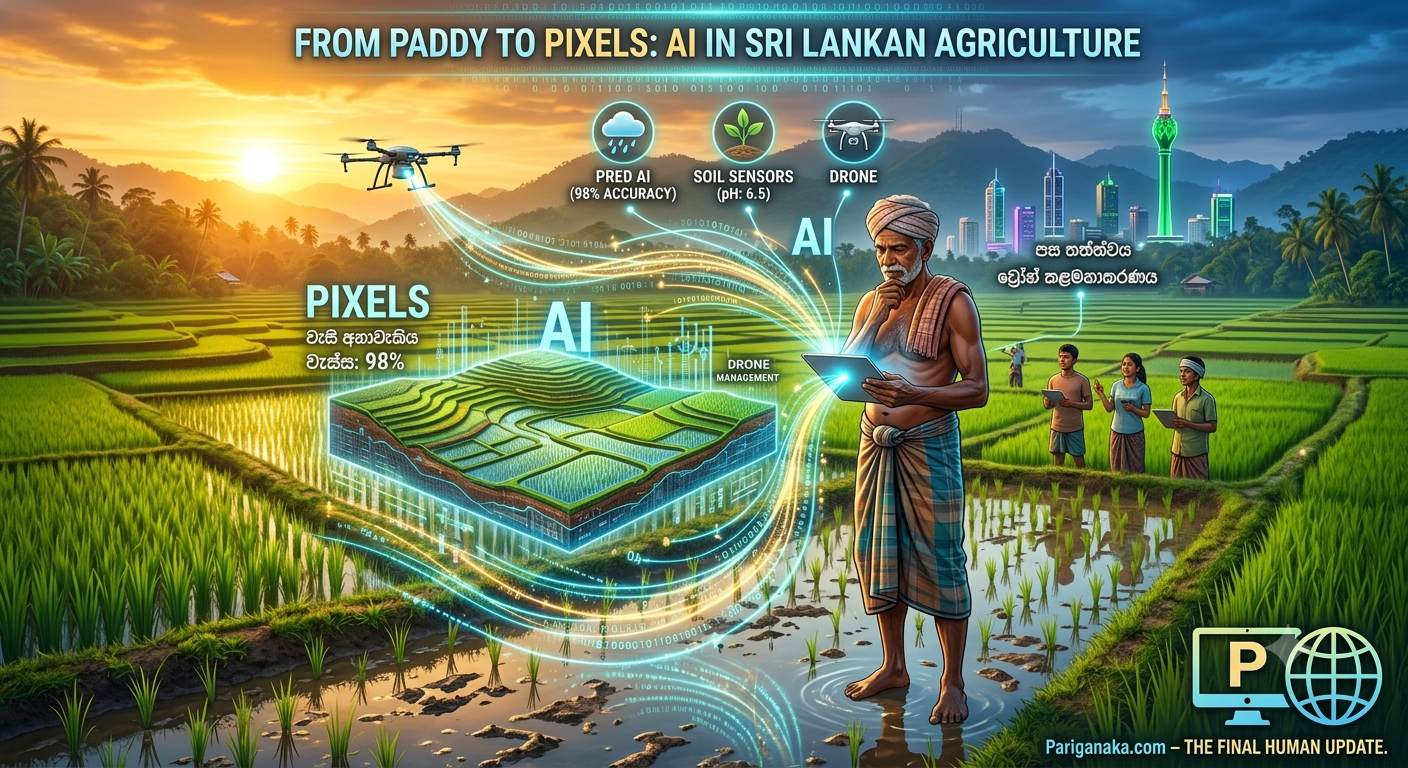
- Hyper-Local Predictive AI: Traditional weather forecasts cover massive regions, but new AI models process data down to the specific square kilometer. Farmers now receive highly accurate, localized alerts regarding rainfall, humidity, and optimal harvesting windows directly to their smartphones.
- Smart Soil Sensors: Low-cost IoT probes planted in the soil continuously monitor moisture and pH levels. Instead of watering an entire field out of habit, farmers use automated irrigation systems that release water only precisely when and where the crops need it, saving millions of liters of water annually.
- Drone-Assisted Crop Management: Autonomous drones equipped with multispectral cameras can scan acres of crops in minutes. They use AI to detect early signs of pest infestations or nutrient deficiencies weeks before they become visible to the human eye, allowing for targeted, minimal pesticide use.
🗣️ Breaking the Language Barrier with AI
The true brilliance of this agricultural revolution isn’t just the hardware; it is the accessibility. For decades, advanced agricultural software was exclusively in English, locking out the very people who needed it most.
Today, utilizing the latest Edge AI and Large Language Models, AgTech applications are fully conversant in natural Sinhala and Tamil. A farmer in Anuradhapura doesn’t need to navigate complex dashboards or understand coding. They can simply use voice commands to ask their phone, “Does the soil in the eastern plot need fertilizer today?” and receive an instant, data-backed answer in their native language.
🇱🇰 Growing a Digital Economy
As Sri Lanka aims for its ambitious digital economy goals by the end of the decade, agriculture must be part of the equation. Integrating AI into our farming practices isn’t just about increasing crop yields; it is about food security, environmental sustainability, and making agriculture an attractive, high-tech career path for the next generation of Sri Lankans.
Technology is at its absolute best when it serves humanity. By merging our rich agricultural heritage with tomorrow’s AI, we aren’t just growing crops—we are cultivating a resilient digital future.
Leave a Reply