
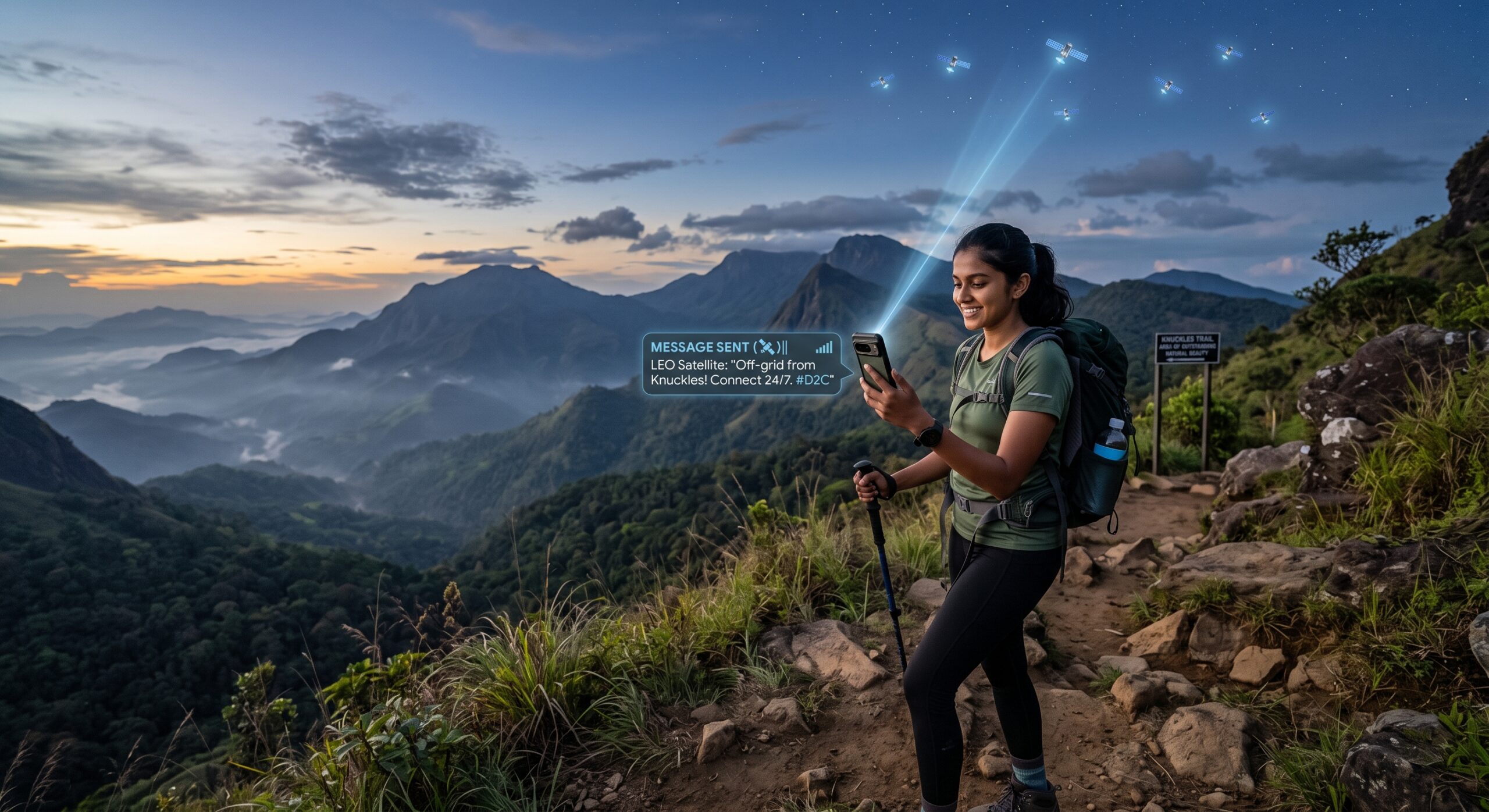
For decades, losing your mobile signal meant you were completely off the grid. Whether you were hiking in remote mountains, sailing offshore, or living in a rural area, “No Service” was a frustrating reality. But in 2026, the mobile landscape has quietly crossed a major threshold.
We have officially entered the era of Direct-to-Cell (D2C) satellite connectivity, a technology that promises to eliminate the mobile dead zone forever. Here is everything you need to know about how your everyday smartphone is now talking directly to space.
What is Direct-to-Cell?
Previously, connecting to a satellite required expensive, bulky equipment with dedicated antennas, such as traditional satellite phones or a Starlink dish. Direct-to-Cell changes the game entirely.
This technology allows standard, unmodified smartphones to connect directly to Low-Earth-Orbit (LEO) satellites just as they would to a regular cell tower. When your phone drifts out of range of a ground network, it automatically switches to a satellite connection. There is no need for a separate dish, a special app, or a bulky handset—just the standard phone already in your pocket.
What Can It Do Right Now?
While companies are aiming for genuine broadband speeds in the future, the technology currently operates under tight power and spectrum limits. Here is what users can actually do in 2026:
- Light Data and Messaging: Current services successfully support SMS, MMS, and light data applications. For instance, messaging platforms like WhatsApp can now transmit over these satellite networks.
- Emergency SOS and Location: Seamless location sharing and text-to-911 emergency services are built-in. This provides critical lifelines in disaster zones where ground-based cell towers might be knocked out.
- Widespread Device Compatibility: Major manufacturers have already built support into their modern hardware. Devices like the Apple iPhone 16 and 17 series, Google Pixel 9 and 10, and Samsung’s Galaxy S24, S25, and S26 series natively support these satellite handovers.
Bridging the Digital Divide
The global rollout is happening rapidly. Just recently, SpaceX’s Starlink and Airtel launched this service in the Democratic Republic of Congo, bringing mobile connectivity to millions who have never had a local cell tower. In the United States, carriers like T-Mobile have launched satellite phone services seamlessly blending terrestrial and space networks.
For a country like Sri Lanka, the implications are massive. Imagine fishermen in deep waters maintaining constant contact with the mainland, or rural farming communities in the central highlands accessing critical weather data without waiting for costly ground-based infrastructure to be built.
Leave a Reply