
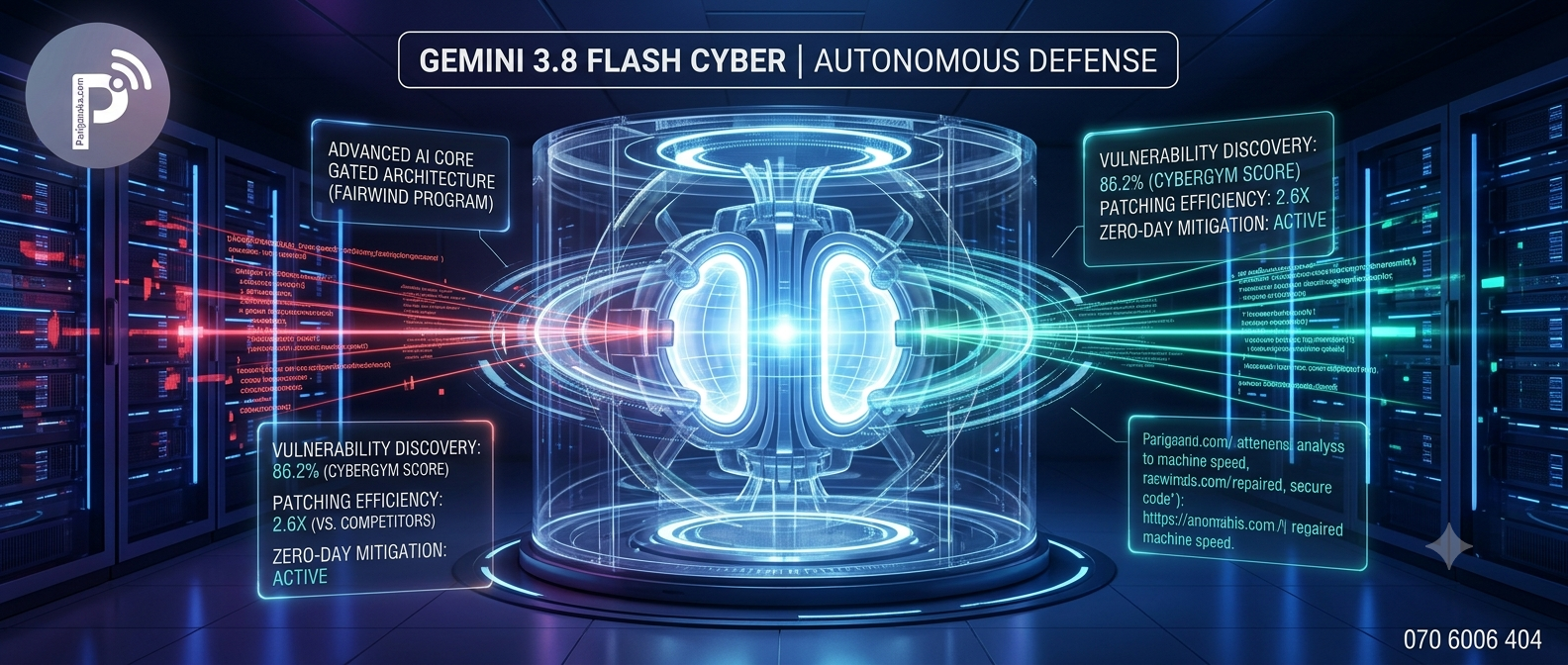
The global cyber threat landscape has reached a high-stakes tipping point. With nation-state actors and cybercriminal syndicates deploying autonomous AI tools to scan for zero-day flaws, the window to defend critical digital infrastructure has shrunk from days to milliseconds. In response, Google has officially unveiled Gemini 3.8 Flash Cyber—its most powerful cybersecurity model to date—built to automate threat detection, discover hidden zero-days, and patch vulnerabilities at unprecedented speeds.
Flipping the Asymmetric Advantage
Historically, cybersecurity operations centers (SOCs) have been locked in a war of attrition, with human analysts overwhelmed by alert fatigue while sifting through terabytes of network logs. The new Gemini 3.8 Flash Cyber model fundamentally shifts this dynamic by shifting the focus from mere threat detection to autonomous vulnerability discovery and automated patching.
- 2.6x Patching Efficiency: In tests on Google Chrome’s codebase, Gemini 3.8 Flash Cyber produced 2.6 times more correct patches for browser vulnerabilities than competing commercial frontier models.
- Rapid Zero-Day Hunting: On the industry-standard CyberGym benchmark for spotting flaws in complex C and C++ code, the model posted a record score of 86.2%, outperforming competing security models. Google’s Cloud Vulnerability Research team used it to discover a critical, foundational vulnerability in under 2 hours—a research process that traditionally takes human engineers several months.
- Automated Code Remediation: On CWE-Bench, an external benchmark evaluating an AI’s ability to fix common software vulnerabilities, Flash Cyber scored a 47.2% pass@1 rate, executing complex fixes on its first attempt while operating at a fraction of the cost of legacy systems.
Strategic Shift: Public vs. Gated Cyber AI
Unlike standard commercial AI releases, Google is restricting Gemini 3.8 Flash Cyber behind a specialized vetting initiative called the Fairwind Program. Recognizing that a model capable of finding and patching complex vulnerabilities could easily be weaponized for automated exploit generation, access is strictly reserved for verified defenders.
| Operational Feature | Standard Gemini 3.8 Flash | Gemini 3.8 Flash Cyber |
| Primary Focus | General software engineering, multi-step agentic tasks, & data processing | Autonomous vulnerability discovery, penetration testing, & automated patching |
| Deployment Model | Publicly accessible via Gemini API, Google AI Studio, & Enterprise tiers | Restricted deployment via the Fairwind Program |
| Target Audience | General enterprise developers, consumers, & digital businesses | Government agencies, critical infrastructure operators, & enterprise security vendors |
| Integration Stack | Multi-modal workflow integrations & Google Antigravity | Deeply integrated into DeepMind’s CodeMender security harness |
Solving the Defender’s Dilemma
The core rule of cybersecurity has long been the Defender’s Dilemma: an attacker only needs to succeed once, while a defender must be right 100% of the time.
By distributing Gemini 3.8 Flash Cyber to over 650 vetted security partners—including Palo Alto Networks, CrowdStrike, Datadog, and Snowflake—Google is attempting to permanently tip the scales back toward defense. When threat intelligence, zero-day identification, and code-patching happen at machine speed, critical infrastructure shifts from passive monitoring to a self-healing digital ecosystem.
As generative models become both the weapon and the shield in global tech strategy, the future of digital sovereignty will depend entirely on who deploys the faster, more resilient algorithm.
Leave a Reply