
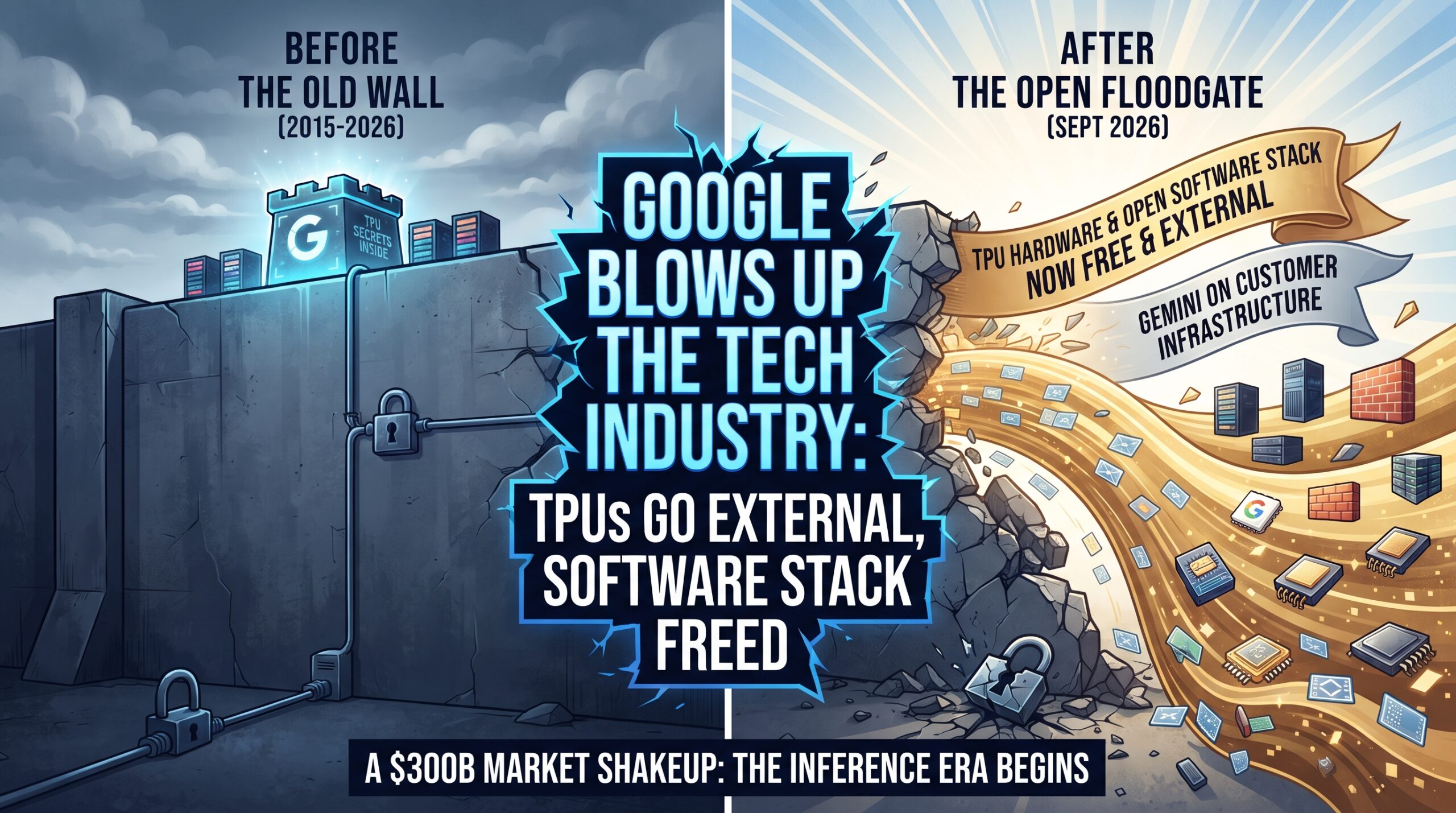
In a move that caught Silicon Valley entirely by surprise, Google has executed a historic reversal of its hardware and software strategy. Abandoning an 11-year policy of keeping its custom artificial intelligence chips strictly within its own walls, the company has announced a sweeping program to ship its Tensor Processing Units (TPUs) into external data centers, open-source its proprietary software stack, and allow its flagship Gemini models to run on customer-owned infrastructure.
1. The Tri-Part Announcement: A Controlled Demolition
The announcement—delivered via a live-streamed presentation and technical white paper—was structured into three distinct parts, each capable of independently shaking the tech sector:
- External TPU Deployment: Google is physically installing its custom AI chips into data centers and racks not owned or operated by Google Cloud. Initial supplier leaks point to approximately 1.4 million chips slated for installation across partner facilities through 2027 and 2028.
- Open Software Stack: The complex software layer—including compilers, libraries, and runtimes that translate code into hardware instructions—is being released under a permanent, open license. Crucially, engineers can use this software stack on hardware that is not manufactured by Google.
- Gemini on Customer Infrastructure: Google’s most valuable intellectual property, the Gemini model lineup, can now be deployed directly behind customer-owned firewalls and external private infrastructure outside Google’s cloud.
2. Market Impact and the Challenge to Nvidia’s Dominance
The market response was immediate. Alphabet shares climbed, Broadcom (Google’s primary partner for physical design and interconnects) saw strong momentum, and Nvidia experienced a notable dip over two trading sessions, wiping over $300 billion in market value off paper.
For years, Nvidia’s primary economic moat wasn’t just its high-performance hardware, but the entrenched software ecosystem that researchers and developers relied on. By releasing its equivalent software layer for free and permitting it to run on rival chips, Google has effectively targeted the core gravity of Nvidia’s dominance.
3. The Origins of the TPU: From Voice Search to Infrastructure Strategy
To understand why Google made this pivot, one must look back to 2013. When voice search workloads began scaling up internally, Google projected that supporting the feature globally would require doubling its entire data center footprint. Facing a scenario where product success would literally bankrupt its infrastructure, Google developed the first Tensor Processing Unit in a record 15 months.
Since 2015, TPUs have powered Google’s internal products—from YouTube recommendations and Google Translate to the training of every Gemini model. However, keeping the chips exclusively internal meant Google continued to pay heavy taxes buying general hardware from competitors to satisfy cloud customers. Furthermore, with competitors like Amazon, Microsoft, and Meta aggressively building their own custom silicon, Google realized that holding onto a shrinking exclusive advantage would eventually reduce it to a commodity.
4. The Inference Era and the Power Bottleneck
The strategic timing of the announcement aligns with a fundamental transition in the AI economy: the shift from training to inference.
- Training is a one-time construction project requiring massive, expensive clusters to build model capabilities.
- Inference is the continuous, daily execution of the model—answering queries, running autonomous agents, and processing background tasks on a massive scale.
As AI agents take over complex multi-step workflows, computation demand resembles a permanent, growing utility bill rather than a temporary construction cost. In an inference-driven economy, the governing metric is performance per watt of electricity, because power grid constraints and recurring electricity costs dictate operational viability. Google’s TPUs, refined over a decade of high-volume consumer serving, are optimized precisely for this metric.
What Lies Ahead
As the first external racks are scheduled to land in partner facilities, the tech industry faces critical questions regarding high-bandwidth memory allocations, regional power grid limits, and how competitors like Amazon and Microsoft will respond to an open, free software alternative. Rather than acting merely as a cloud provider, Google has laid the groundwork to become the foundational infrastructure and standard of the next computing era.
Leave a Reply